

Table of Contents
Quick Answer Box
Brain rot is a slang term—Oxford’s Word of the Year 2024—for the foggy, drained feeling that can follow hours of low-effort content such as memes, reels and endless feeds. It isn’t a medical diagnosis, but heavy, compulsive screen use has been linked with poorer attention, sleep and mood. In the US, about half of teens aged 12–17 spend four or more hours a day on screens (CDC, 2024). Screen limits, a curated feed, breaks from social media and more offline time all help.
Brainrot At a Glance
| Aspect | What it means | What the research says |
|---|---|---|
| Definition | Slang for the foggy, drained feeling after too much low-effort online content. Not a medical diagnosis. | Oxford University Press named “brain rot” its Word of the Year 2024. |
| Common signs | Shorter attention, mental tiredness, forgetfulness, poor sleep, irritability, low mood. | Gloria Mark’s research found people now stay on one screen for about 47 seconds on average before switching (Mark, 2023). |
| Main drivers | Doomscrolling, short-form video and endless personalised feeds. | In a 30-day daily study, more pandemic-related social media use was linked with more depression and PTSD symptoms (Price et al., 2022). |
| Who is most affected | Teens and young adults, whose self-control is still developing. | About half (50.4%) of US teens aged 12–17 spend 4+ hours a day on screens (CDC, 2024). |
| What helps | Screen limits, feed curation, offline time, exercise and breaks from social media. | A one-week break from social media improved well-being, depression and anxiety scores in a randomised trial (Lambert et al., 2022). |
Researchers worry most about young people here: a constant stream of idealised images, online bullying and the quick dopamine rewards of gaming and social feeds land on brains that are still developing self-control (Firth et al., 2019).
Understanding Brain Rot
Have you ever found yourself scrolling through your feed late at night, only to look up and realize hours have slipped away, leaving you feeling mentally drained and foggy? That’s the essence of brain rot—a term that’s buzzing around lately, capturing how our constant digital immersion can dull our minds. As a mental health blogger, I write about it because so many of us are looking for ways to reclaim our focus and clarity. In this post, I’ll dive deep into brainrot, unpacking what it really means and how it sneaks into our daily lives.
Brain rot isn’t just a catchy phrase; it’s a reflection of how overexposure to trivial online content can erode our cognitive sharpness. Oxford University Press even crowned it the Word of the Year in 2024, highlighting its rise in conversations about mental health in the digital age (BBC, 2024). If you’re wondering about brainrot meaning, it’s essentially the perceived decline in mental function from consuming too much low-value, repetitive material online. Think of it as mental junk food—tasty in the moment but leaving you sluggish over time.
Is Brain Rot Real?
Before we go further, let’s address the big question: is brainrot real? It isn’t a formal medical diagnosis, but it points to genuine issues. Brain health experts interviewed by the American Heart Association say there is no evidence that hours of daily screen time change the structure of the brain—but too much low-quality content can still leave you mentally drained and affect your mood (American Heart Association, 2025). Neurologist Dr. Andreana Benitez of the Medical University of South Carolina compares it to junk food: an occasional snack is fine, a steady diet is not. A 2025 rapid review in Brain Sciences links brain rot with mental exhaustion, cognitive overload and emotional numbing, although the authors describe their work as exploratory (Yousef et al., 2025). In short, brainrot is a slang term for very real strain from digital overload.
The Rise of Brain Rot in Today’s Society
Brainrot has roots going back further than you might think. Henry David Thoreau used a similar idea in his 1854 book Walden, critiquing society’s avoidance of deep thinking. Fast-forward to now, and brain rot is slang for that numb feeling after bingeing on memes, reels, or endless news updates. Especially among Gen Z, brain rot slang captures the ironic self-awareness of getting hooked on “skibidi toilet”-style nonsense that floods platforms like TikTok.
Cultural examples abound in modern memes and slang. Terms like “skibidi” (nonsensical or bad/cool), “Ohio” (something weird or low-quality), “rizz” (charisma), and “gyat” (exclamation for a large behind) exemplify the brainrot language—absurd catchphrases from viral trends, usually used with a wink at how much time online they reflect. Other brainrot memes include “sigma male” tropes or “looksmaxxing” (obsessing over appearance improvements), often self-deprecatingly acknowledged as mind-numbing.
What is Gen Z brainrot?
It’s the amplified version for younger folks who’ve grown up with screens as constant companions. With about half of US teens aged 12–17 spending four or more hours a day on screens (CDC, 2024), it’s no wonder this generation coined terms like brainrot to describe the haze. Many people describe starting with a quick check of notifications and ending up lost in a rabbit hole, emerging with scattered thoughts and zero productivity.
Brain Rot Explained: Unpacking the Causes
At its core, brain rot stems from digital overload—our brains weren’t designed for the nonstop barrage of information. One major culprit is doomscrolling and brain rot, where you compulsively swipe through negative news or drama, spiking stress without resolution.
Then there’s digital brain rot, fueled by short-form videos that demand little effort but deliver quick rewards. A 2025 review links heavy use of social media and short-form content with cognitive overload and weaker memory, planning and decision-making, though most of this research is early and exploratory (Yousef et al., 2025). Add in AI social media brainrot, where algorithms serve an endless, personalised stream of “slop”—low-quality, often AI-generated content that asks nothing of your critical thinking.
Different Sources That Can Cause Brain Rot
Brain rot isn’t limited to one platform; various sources contribute to this mental haze. Social media apps like TikTok and Instagram top the list with short-form videos and unpredictable “variable reward” feeds that work a little like a slot machine, as Florida Atlantic University explains. Junk content on YouTube, such as mindless challenges or conspiracy theories, adds to the load (El País, 2024). Even traditional media like sensationalist news or binge-watching low-effort TV can leave you foggy, and a constant stream of email and message alerts keeps breaking up your attention. Gaming can become a problem too when it crowds out sleep, schoolwork or friendships, especially in teens.
Illustrative example (a composite, not a real reader): Sarah, a 25-year-old office worker, starts her day with a quick Instagram scroll, but AI-recommended reels keep her hooked on trivial trends. By midday, she’s struggling to focus on reports, her mind foggy from the constant context-switching. This example shows how brainrot creeps in, turning productive time into a mental blur.
Constant exposure to distressing news can make the world feel more dangerous than it is, and more social media exposure during the COVID-19 pandemic was linked with more depression and post-traumatic stress symptoms (Price et al., 2022).
Recognizing Brain Rot Symptoms
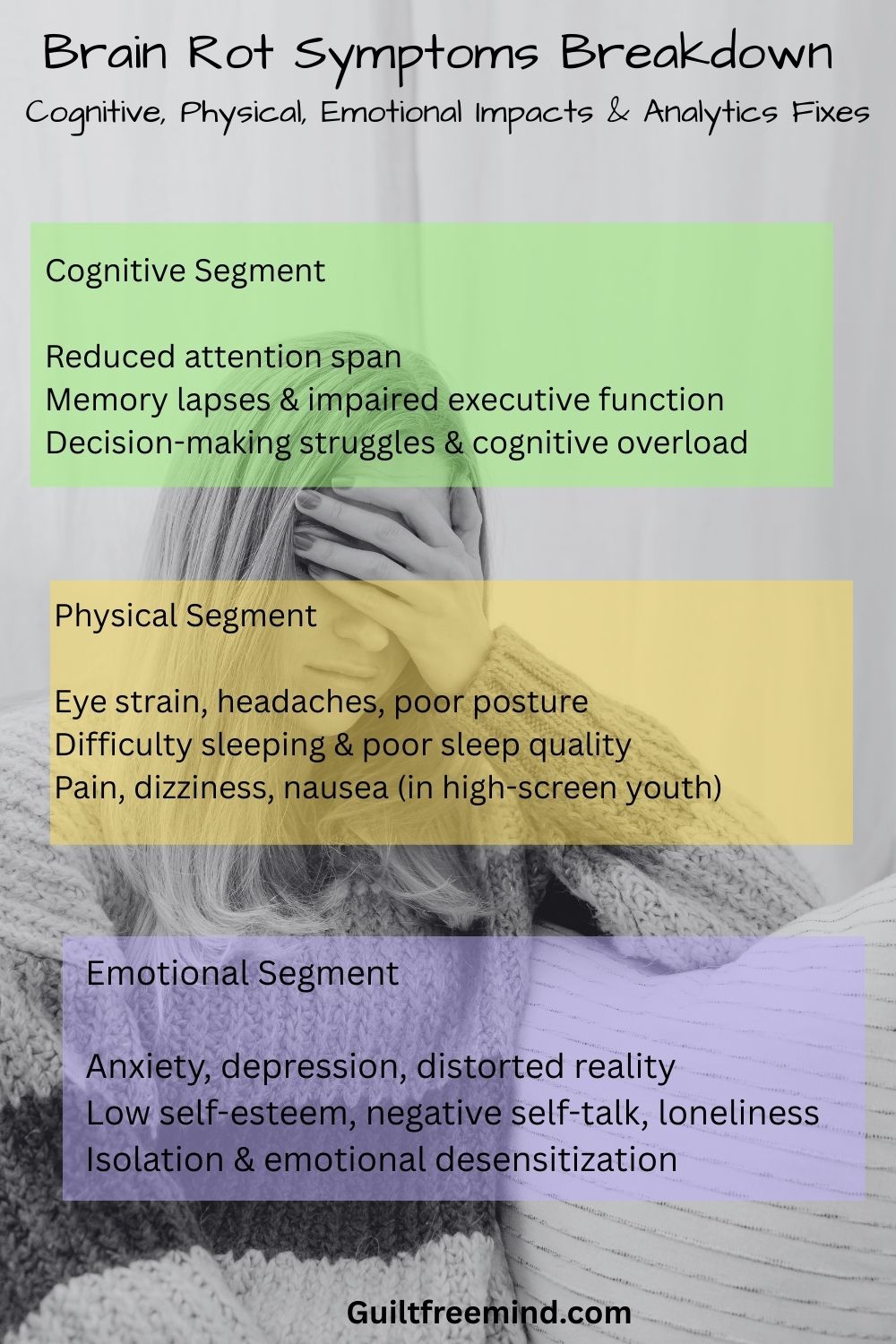
Spotting brain rot symptoms early can make all the difference. Common signs include reduced attention span—jumping from task to task without finishing anything—and mental fatigue that leaves you unmotivated. You might notice memory slips, like forgetting names or details from conversations, or increased anxiety from overload.
Physically, brain rot symptoms can manifest as headaches, poor sleep, or eye strain from long stretches of screen time. Emotionally, it’s that overwhelming feeling of being drained, with lower mood and self-esteem. In young adults, as detailed by Newport Institute, this leads to issues like decision-making struggles and negative self-talk from constant comparisons.
Illustrative example (a composite, not a real reader): Mike, a college student, starts with fun short videos but soon notices brain fog during lectures and irritability with friends. It is a common pattern, and a sign to rethink how and when he scrolls.
Pin this article for later
Brain Rot and Aging
While brainrot is often linked to youth, older adults aren’t immune: hours of passive screen time can crowd out sleep, movement and conversation, which all matter for an ageing brain. The picture isn’t all negative, though. In a US study that followed more than 18,000 adults aged 50 to 65 for up to 17 years, regular internet users had about half the risk of dementia of non-regular users (Cho et al., 2023)—although a study like this can’t fully rule out that healthier people simply go online more. For older readers, the goal is active, purposeful use, balanced with offline activities.
The Impact of Brain Rot on Mental Health and Daily Life
Brain rot doesn’t stop at mild annoyance; it can seep into every corner of life. Heavy media multitasking is linked with poorer attention and memory, and some imaging studies associate problematic internet use with differences in brain regions involved in self-control, although cause and effect are not yet clear (Firth et al., 2019). In everyday terms, that can mean weaker focus, poorer problem-solving and a hit to productivity.
Mentally, heavy use often goes hand in hand with anxiety and depression, though surveys can’t tell which comes first—low mood can drive more scrolling, too. For young adults, it erodes self-concept through the comparison trap—seeing filtered lives online makes your own feel inadequate. Socially, it leads to isolation; despite being “connected,” meaningful interactions suffer.
In the workplace, brain rot means lower focus: every switch to a feed or notification breaks your concentration, and Gloria Mark’s research shows just how often we now switch (Mark, 2023). Heavy social media use can also chip away at mood and self-image, which follows people into work and study.
Expert Insights on Brain Rot
Attention researcher Gloria Mark, a professor at the University of California, Irvine, has tracked how long people stay on one screen before switching. In her studies, that average fell from about two and a half minutes in 2004 to roughly 47 seconds in recent years (Mark, 2023).
Key Statistics on Brain Rot
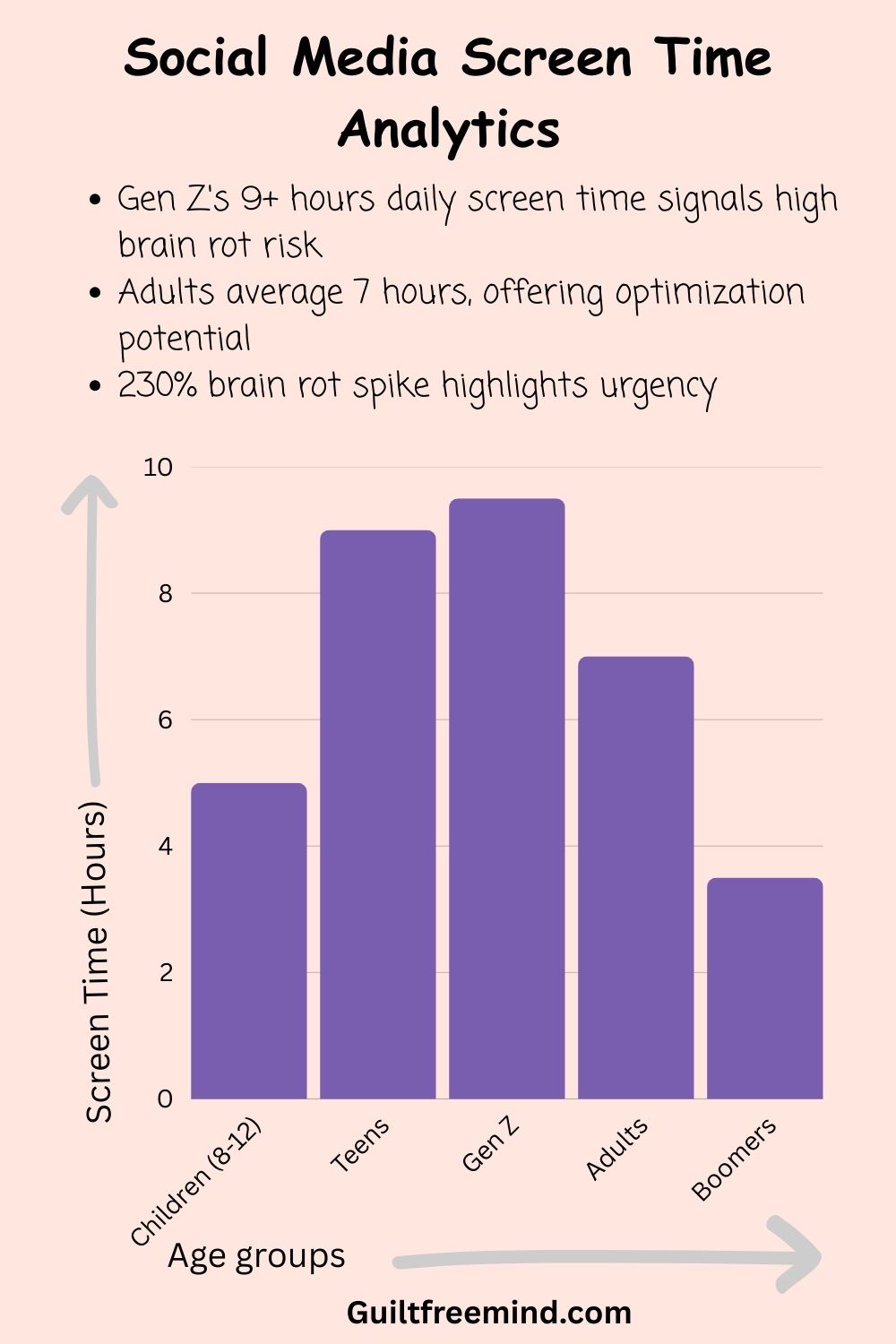
Diving into the numbers: brain rot itself isn’t counted in surveys, because it isn’t a diagnosis. What researchers do measure is screen time and how constantly people are online—and those numbers are high, especially for young people.
Screen time and teens: what US surveys show
- About half (50.4%) of US teens aged 12–17 spend four or more hours a day on screens (CDC, 2024).
- The share rises with age: 45.6% of 12–14-year-olds and 55.0% of 15–17-year-olds.
- Teens with 4+ hours a day were more likely to report anxiety symptoms (27.1% vs 12.3%) and depression symptoms (25.9% vs 9.5%) in the previous two weeks—a link, not proof of cause.
- About 4 in 10 US teens aged 13–17 say they are online “almost constantly”, and 21% say this about TikTok alone (Pew Research Center, 2025).
Pin this article for later
Brain Rot vs. Normal Scrolling: A Comparison
To clarify, here’s a quick comparison table:
| Aspect | Normal Scrolling | Brain Rot |
|---|---|---|
| Duration | Short, purposeful sessions (e.g., 20-30 min) | Prolonged, compulsive hours without breaks |
| Content Quality | Educational or meaningful | Trivial, junk, or negative |
| Effects on Focus | Minimal disruption | Shortened attention span, multitasking overload |
| Mental Impact | Refreshing or informative | Fatigue, anxiety, cognitive fog |
| Recovery | Easy, no lingering haze | Requires detox to regain clarity |
This table highlights how occasional scrolling isn’t harmful, but tipping into excess leads to brain rot.
Is Brain Rot Always Bad? Debunking Common Myths
Is brainrot always a bad thing? Not entirely—some experts argue it’s overstated. As The Guardian’s exploration points out, there’s no good evidence that moderate use causes lasting brain damage, and some screen time—learning a skill, keeping in touch with people you love—can be good for you.
That said, when brain rot tips into excess, the negatives outweigh. It’s about balance—using digital tools mindfully rather than letting them rot our potential. A 2025 survey of 1,091 adolescents found that those who exercised more reported less ego depletion (the mental tiredness that follows a lot of self-control), which was in turn linked to less brain-rot behavior, although a survey like this cannot prove cause and effect (Gan et al., 2025).
Strategies to Combat Brain Rot and Reclaim Your Mind
- Fighting brain rot starts with awareness.
- Set screen limits using your phone’s built-in tools, such as Screen Time on iPhone or Digital Wellbeing on Android.
- Practice the 20-20-20 break for tired eyes—every 20 minutes, look at something 20 feet away for 20 seconds.
- Curate your feeds to avoid negativity
- Unfollow triggers and add inspiring accounts.
- Engage offline: Read books, hike, or learn a skill to stimulate your brain.
- Mindfulness meditation, as Calm suggests, rebuilds focus.
- A digital detox can help: in a randomised trial, adults who took a one-week break from social media reported better well-being and fewer depression and anxiety symptoms than those who kept scrolling as usual (Lambert et al., 2022).
Simple swaps help: for example, replacing a late-night scroll with five minutes of journaling. Exercise helps too: in a survey of 4,058 Chinese teens, more physical activity weakened the link between avoiding uncomfortable feelings and anxiety—and anxiety, in turn, went with more brain-rot behaviour (Peng et al., 2025).
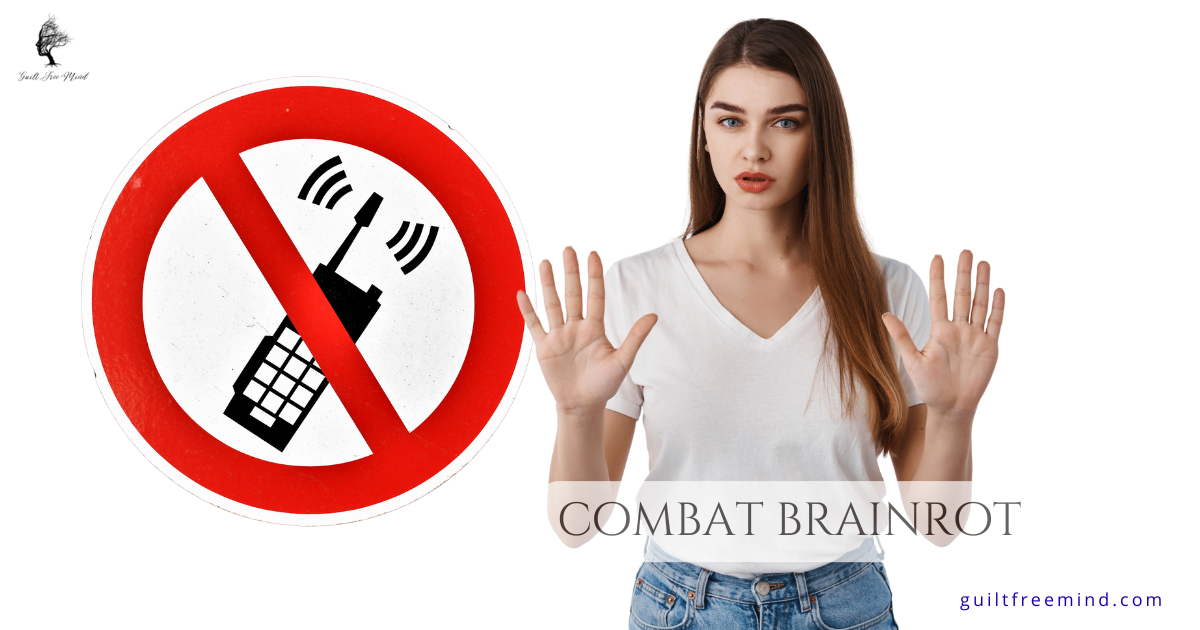
Too much fast, low-effort content can overload your attention and make it harder to focus, plan and switch between tasks.
Test Your Knowledge: Brain Rot Quiz
Think you know brain rot? Take this quick quiz to reflect on your own scrolling habits—it’s for fun and self-reflection, not a diagnosis:

Explore More on Guilt Free Mind: Break Free from Brain Rot
Guilt Free Mind is your trusted companion on the journey toward mindful living, emotional well-being, and digital balance. If you’ve been lost in the mental fog of low-value content overload, it’s time to reclaim your clarity. Through evidence-based guidance and heart-centered insights, Guilt Free Mind helps you combat brain rot, embrace cognitive wellness, and restore your mental sharpness. Explore my six holistic wellness hubs below:
🧘♀️ Self-Care and Wellness: Replace brain-rotting scrolls with nurturing rituals that rejuvenate your mind and body. Discover mindful routines, tech-free self-care practices, and tools to reset your focus—helping you break the cycle of digital fatigue without guilt.
🧠 Understanding Personality and Behavior: Why does brain rot hook us despite the haze? Dive into the psychology of addictive content habits and dopamine traps that dull your cognition. Build self-awareness and strategies to regain control over your thoughts and attention.
🎨 Creative Healing and Therapy: Turn cognitive overload into creative flow. Use art, journaling, or expressive therapies to process mental fog and rebuild sharpness—fostering healing and reconnection with your authentic self, away from mindless media.
💡 Mindful Productivity and Focus: Sharpen your mind in a distracted world. Learn techniques for mindful content consumption, setting digital boundaries, and habits that enhance concentration—reducing brain rot’s grip and boosting your daily efficiency.
💪 Emotional Recovery and Resilience: If brain rot has left you drained or foggy, this hub supports your comeback. Explore ways to heal from digital exhaustion, manage emotional dips, and cultivate strength for a more resilient mindset.
😌 Stress, Anxiety, and Depression Toolkit: Brain rot often amplifies stress and low moods through endless trivial content. Access mindfulness exercises, breathing techniques, and reframing tools to clear the mental clutter and foster peace, optimism, and balance.
Take Action: Break Free from Brain Rot Today!
Feeling the weight of brain rot? Start small this week: open your phone’s screen-time report to see where your hours actually go, pick one app to limit, and swap one scrolling slot—say, the last 30 minutes before bed—for something offline. Unfollow accounts that leave you drained, and notice how you feel after a few days.
For more ideas, subscribe to my newsletter and explore my mindfulness routines to sharpen your focus. You can also find more on my YouTube channel, Guilt Free Mind.
When to Get Help
Cutting back on screens isn’t always easy. If you can’t cut down despite trying, or your sleep, mood, school or work keep slipping, talk to a doctor or a mental health professional—compulsive scrolling sometimes sits alongside anxiety, depression or ADHD, which can all be treated.
If you are struggling or having thoughts of harming yourself, please reach out now: in India, call Tele-MANAS on 14416 (or 112 in an emergency); in the US, call or text 988; in the UK and Ireland, call Samaritans on 116 123.
Frequently Asked Questions About Brain Rot
Brain rot is slang for the foggy, drained feeling that can follow too much low-effort online content. It isn’t a medical diagnosis, but heavy, compulsive screen use has been linked with poorer attention, sleep and mood.
People describe a shorter attention span, mental tiredness, forgetfulness, irritability, poor sleep and low motivation. If these last or affect daily life, talk to a doctor or mental health professional, as they can also be signs of other conditions.
It’s slang for the numb, ironic feeling after bingeing memes or reels, often used by Gen Z to poke fun at their own habits. Oxford University Press named it Word of the Year 2024.
It’s the same idea applied to a generation that grew up online. In the US, about half of teens aged 12–17 spend four or more hours a day on screens (CDC, 2024).
No. Moderate, purposeful screen use can be relaxing, social or educational. It becomes a problem when it crowds out sleep, focus, movement and real-life connection.
About the Author
Dr. Shruti Bhattacharya is the founder and heart of Guilt Free Mind, where she combines a Ph.D. in Immunology with training in psychology to deliver science-backed mental health strategies. Her mission is to empower readers to overcome stress, anxiety, and emotional challenges with practical, evidence-based tools. Dr. Bhattacharya’s unique blend of expertise and empathy shapes her approach to wellness:
- Academic & Scientific Rigor – Holding a Ph.D. in Immunology and a Bachelor’s degree in Microbiology, Dr. Bhattacharya brings a deep understanding of the biological foundations of mental health, including the gut-brain connection. Her completion of psychology courses, such as The Psychology of Emotions: An Introduction to Embodied Cognition, enhances her ability to bridge science and emotional well-being.
- Dedicated Mental Health Advocacy – With over 15 years of experience, Dr. Bhattacharya has supported hundreds of individuals through online platforms and personal guidance, helping them navigate mental health challenges with actionable strategies. Her work has empowered readers to adopt holistic practices, from mindfulness to nutrition, for lasting resilience.
- Empathetic Connection to Readers – Known for her compassionate and relatable voice, Dr. Bhattacharya is a trusted guide in mental health, turning complex research into accessible advice. Her personal journey as a trauma survivor fuels her commitment to helping others find calm and confidence.
- Lifelong Commitment to Wellness – Dr. Bhattacharya lives the principles she shares, integrating science-based habits like balanced nutrition and stress management into her daily life. Her personal exploration of mental health strategies inspires Guilt Free Mind’s practical, reader-focused content.
🏆 Guilt Free Mind was named one of the Top 100 Mental Health Blogs on Feedspot.

Disclaimer: This content is for informational purposes only and is not a substitute for professional medical advice.
References
- Calm Staff. (n.d.). Do you have brain rot? Here’s how to know. Calm.
- El País Staff. (2024, December 26). The effects of ‘brain rot’: How junk content is damaging our minds. El País.
- Gan, Y., He, Z., Liu, M., Ran, J., Liu, P., Liu, Y., & Deng, L. (2025). A chain mediation model of physical exercise and BrainRot behavior among adolescents. Scientific Reports. https://doi.org/10.1038/s41598-025-02132-6
- Nadler, T. (2025, February 20). The psychological conditioning of brainrot. Florida Atlantic University.
- Newport Institute. (2024, January 10). Brain rot: The impact on young adult mental health. Newport Institute.
- Oxford University Press. (2024, December 2). ‘Brain rot’ named Oxford Word of the Year 2024.
- Peng, J., Quan, Z., Yan, C., Dong, J., Chen, Z., & Liu, P. (2025). Physical exercise moderated the mediating role of anxiety between experiential avoidance and the teenagers BrainRot. Scientific Reports, 15, 40737. https://doi.org/10.1038/s41598-025-24472-z
- Rufo, Y. (n.d.). What is brain rot, the Oxford University Press 2024 word of the year? BBC News.
- The Guardian Staff. (2025, January 29). All in the mind? The surprising truth about brain rot. The Guardian.
- Williamson, L. (2025). Is brain rot real? Here’s what brain health experts say. American Heart Association.
- Firth, J., Torous, J., Stubbs, B., et al. (2019). The “online brain”: how the Internet may be changing our cognition. World Psychiatry, 18(2), 119–129. doi:10.1002/wps.20617
- Price, M., Legrand, A. C., Brier, Z. M. F., et al. (2022). Doomscrolling during COVID-19: the negative association between daily social and traditional media consumption and mental health symptoms during the COVID-19 pandemic. Psychological Trauma, 14(8), 1338–1346. doi:10.1037/tra0001202
- Yousef, A. M. F., Alshamy, A., Tlili, A., & Metwally, A. H. S. (2025). Demystifying the new dilemma of brain rot in the digital era: a review. Brain Sciences, 15(3), 283. doi:10.3390/brainsci15030283
- Mark, G. (2023). Attention span: a groundbreaking way to restore balance, happiness and productivity. Hanover Square Press.
- Centers for Disease Control and Prevention, National Center for Health Statistics. (2024). Daily screen time among teenagers: United States, July 2021–December 2023 (NCHS Data Brief No. 513). https://www.cdc.gov/nchs/products/databriefs/db513.htm
- Cho, G., Betensky, R. A., & Chang, V. W. (2023). Internet usage and the prospective risk of dementia: A population-based cohort study. Journal of the American Geriatrics Society, 71(8), 2419–2429. https://doi.org/10.1111/jgs.18394
- Lambert, J., Barnstable, G., Minter, E., Cooper, J., & McEwan, D. (2022). Taking a one-week break from social media improves well-being, depression, and anxiety: A randomized controlled trial. Cyberpsychology, Behavior, and Social Networking, 25(5), 287–293. https://doi.org/10.1089/cyber.2021.0324
- Pew Research Center. (2025, December 9). Teens, social media and AI chatbots 2025. https://www.pewresearch.org/internet/2025/12/09/teens-social-media-and-ai-chatbots-2025/
