

This article is for information only and isn’t a substitute for advice from your doctor or mental health professional.
Table of Contents
Quick Answer
Burnout is what happens when long-term stress, usually at work, wears you down faster than you can recover. The World Health Organization describes three core burnout symptoms: feeling drained or exhausted, growing distant or cynical about your job, and feeling less effective at it. Other common signs of burnout include sleep problems, headaches, stomach upsets, trouble concentrating, irritability and pulling away from people. Burnout isn’t a medical diagnosis, but it is real, it can affect your physical and mental health, and it usually improves when you both rest and change what is causing it.
Maybe you used to like your job and now you dread Sunday evenings. Maybe you sleep for eight hours and still wake up tired, snap at people you care about, or can’t remember the last time work felt meaningful. If that sounds familiar, you may be dealing with burnout.
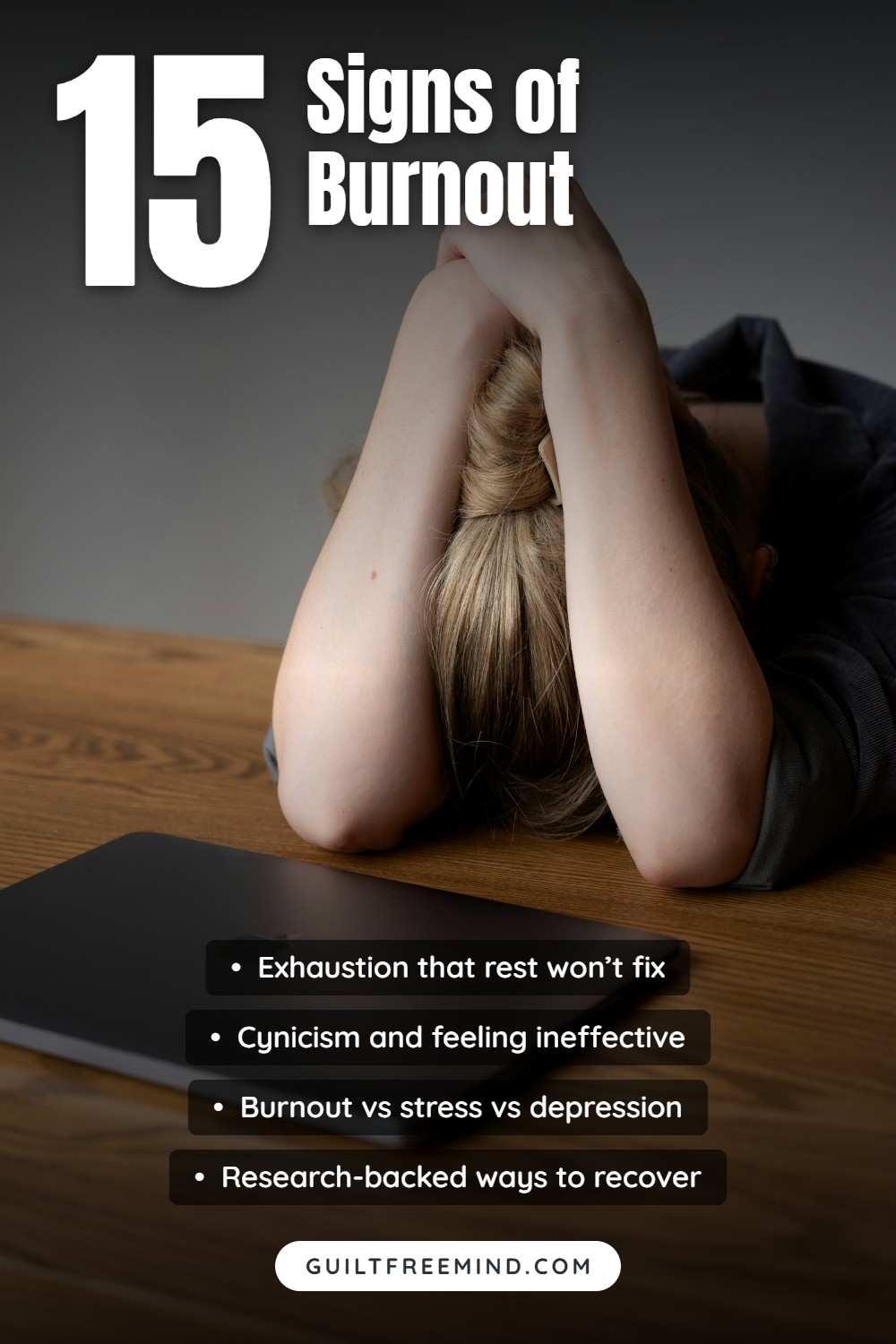
This guide walks through the 15 most common burnout symptoms—emotional, physical, mental and behavioral—how burnout differs from everyday stress and from depression, what causes it, and practical, research-backed ways to recover. If you work from home, our guide on how to avoid work-from-home burnout has tips for that setting, and our guide to work-life balance can help you rebuild the boundaries that burnout tends to wear away.
What Is Burnout?
In its International Classification of Diseases (ICD-11), the World Health Organization describes burnout as a syndrome resulting from chronic workplace stress that has not been successfully managed. WHO lists it as an “occupational phenomenon”—a reason people may seek help—rather than as a medical condition, and it uses the term specifically for work.
Most of what we know about burnout comes from research on people in demanding, people-facing jobs, especially health care. Psychologists Christina Maslach and Michael Leiter, whose work shaped how burnout is measured, note that its links with mental illness are still debated and that far less research has tested ways to treat or prevent it (Maslach & Leiter, 2016).
Burnout isn’t only about paid work, either. Researchers also study parental burnout, which develops when the stress of parenting outweighs a parent’s resources for a long time (Mikolajczak & Roskam, 2018), and many caregivers describe something similar. WHO’s definition is for the workplace, but the warning signs below are worth taking seriously wherever the pressure comes from.
The 3 Core Signs of Burnout
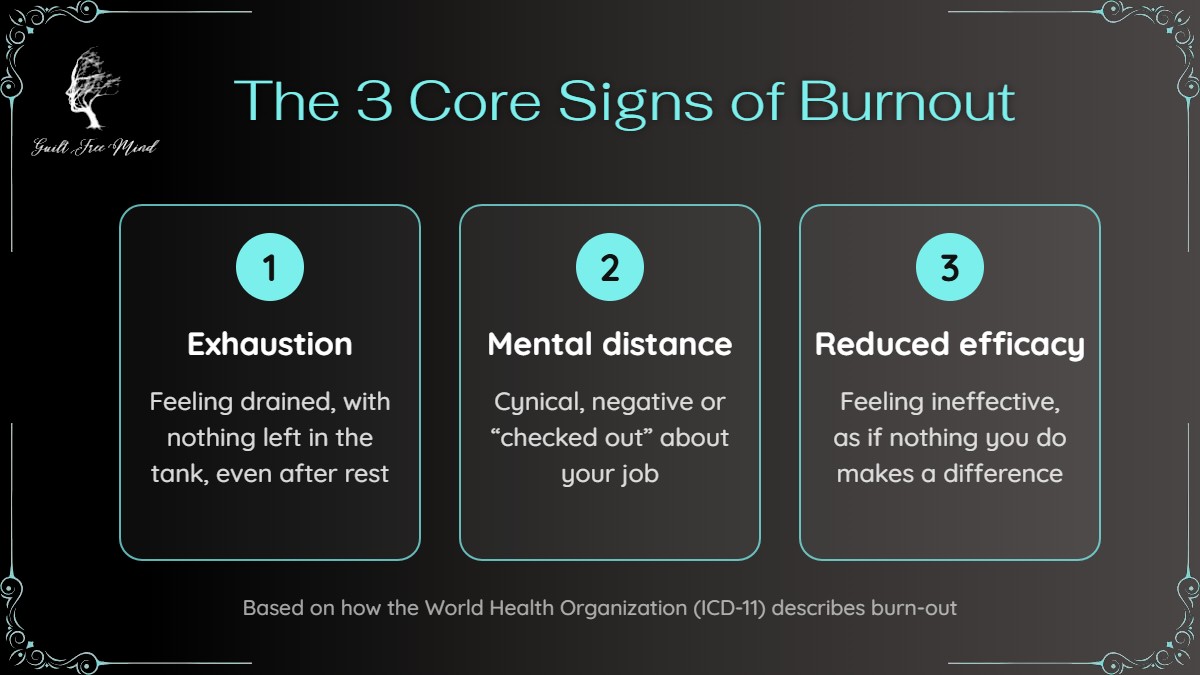
WHO’s definition, and most burnout research, centers on three signs:
1. Exhaustion
This is the heart of burnout: feeling physically and emotionally drained, with nothing left in the tank. Unlike ordinary tiredness, it doesn’t lift much after a good night’s sleep or a weekend off.
2. Mental distance and cynicism
You start pulling back from your work emotionally. Tasks you once cared about feel pointless, you feel numb or negative about colleagues or clients, and you may catch yourself doing the bare minimum just to get through the day.
3. Reduced efficacy
You feel less competent and less productive, as if nothing you do makes a difference. Confidence drops, mistakes creep in, and achievements stop feeling like achievements.
Newer research suggests the picture is a little wider. When researchers in Belgium developed the Burnout Assessment Tool, they found four core features: exhaustion, mental distance, and problems with thinking and with managing emotions, such as poor concentration or unusually strong reactions (Schaufeli et al., 2020).
15 Common Burnout Symptoms
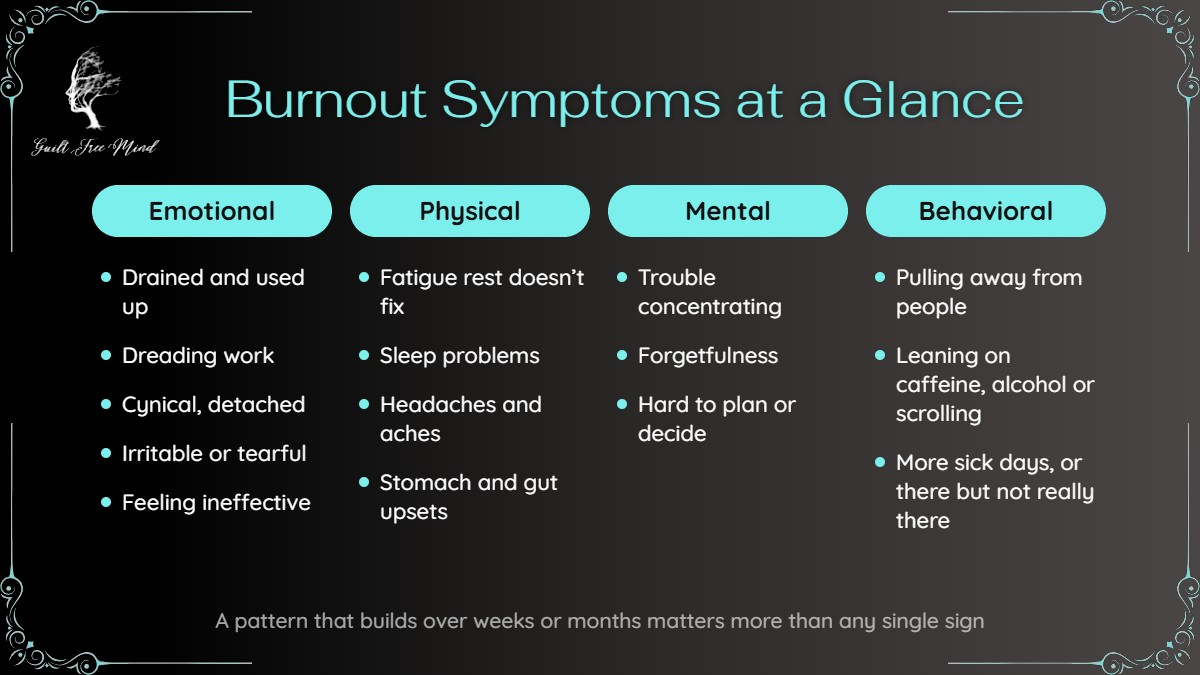
Burnout looks a little different in everyone, but these are the symptoms people notice most often. You don’t need all of them. What matters is a pattern that has built up over weeks or months.
Emotional signs of burnout
- 1. Feeling drained. You feel used up by the end of the day and dread having to do it all again tomorrow.
- 2. Dreading work. Sunday evenings bring a sinking feeling, and you have to drag yourself to get started each day.
- 3. Cynicism and detachment. You feel numb, negative or “checked out” about your work and the people in it.
- 4. Irritability. Small things set you off, you lose patience with colleagues or family, or you feel close to tears more often than usual.
- 5. Feeling ineffective. You doubt your abilities and feel that nothing you do matters or gets noticed.
Physical symptoms of burnout
- 6. Fatigue that rest doesn’t fix. You wake up tired and feel heavy or slowed down for most of the day.
- 7. Sleep problems. You struggle to fall asleep, wake up at night with work on your mind, or wake up unrefreshed.
- 8. Headaches and aches. Tension headaches and neck, shoulder or back pain become more frequent.
- 9. Stomach and gut problems. Nausea, indigestion or changes in your bowel habits show up when work is at its worst.
These symptoms aren’t “all in your head.” A systematic review of 36 prospective studies found that burnout predicted later problems including prolonged fatigue, headaches, gastrointestinal issues, musculoskeletal pain, insomnia and depressive symptoms, and was also linked with higher later risk of type 2 diabetes, high cholesterol and coronary heart disease (Salvagioni et al., 2017). Physical symptoms can have many causes, so see a doctor rather than assuming it’s “just stress.” Our article on when anxiety feels physical explains more about how stress shows up in the body.
Mental (cognitive) symptoms
- 10. Trouble concentrating. You reread the same email three times or keep losing your train of thought.
- 11. Forgetfulness. You miss appointments, forget tasks or lose track of what you were about to do.
- 12. Difficulty planning and deciding. Simple decisions feel huge, and juggling several tasks becomes much harder than it used to be.
A systematic review of studies that used objective tests found burnout linked with poorer executive function, attention and memory (Deligkaris et al., 2014), and people with clinical burnout commonly have problems with memory and planning (Grossi et al., 2015).
Behavioral signs of burnout
- 13. Pulling away from people. You skip lunch with colleagues, cancel plans or have no energy left for friends and family.
- 14. Leaning on quick fixes. More caffeine to get going, or food, alcohol or endless scrolling to switch off. Using food, drugs or alcohol to feel better or to numb how you feel is one of the warning signs Mayo Clinic lists. If your phone has become the main way you unwind, our guide to a dopamine detox may help.
- 15. Calling in sick, or showing up but not really there. Burnout is linked with more sick days and with “presenteeism,” working while too unwell or depleted to function well (Salvagioni et al., 2017).
Early Warning Signs of Burnout
Burnout rarely arrives overnight. It tends to creep up, and the early signs are easy to write off as a busy patch. Watch for these:
- You need longer and longer to recover after a workday or a weekend.
- You are sleeping less, or sleeping badly, because work is on your mind.
- You can’t stop thinking about work in your free time.
- Things that used to feel easy now take real effort.
- You have stopped doing the things that recharge you because you are “too busy.”
In a two-year Swedish study of 388 working adults, too little sleep (under six hours a night) was the main risk factor for developing clinical burnout, along with high work demands and thinking about work during leisure time (Söderström et al., 2012). Only 15 people in the study developed clinical burnout, so it is a small piece of evidence, but it points to something practical: protecting your sleep and your time off is one of the earliest things you can do.
Are there “stages” of burnout?
You may see burnout described in five or twelve stages online. These models are popular, but they haven’t been well tested in research, so treat them as a rough map rather than a checklist. The more useful message is that burnout usually builds gradually, which is why catching it early helps.
Burnout vs Stress: What’s the Difference?
Stress and burnout are related, but they feel different. Stress usually means too much: too many demands and too little time. Burnout is more like not enough: not enough energy, motivation or care left to give.
| Stress | Burnout | |
|---|---|---|
| How it feels | Pressured, rushed, “wired” | Drained, empty, “checked out” |
| Emotions | Urgency, worry, frustration | Numbness, cynicism, feeling defeated about work |
| Energy | You keep pushing, often on adrenaline | Running on empty, even after rest |
| Engagement | Over-involved: you care, maybe too much | Detached: you have stopped caring as much |
| After a break | Usually eases once the deadline passes or you rest | Often returns quickly, because the causes haven’t changed |
Short-term stress is a normal part of life and can even help you rise to a challenge. Burnout develops when stress stays high for a long time without enough chance to recover. For everyday stress, our guide to combat everyday stress is a good place to start.
Burnout vs Depression
Burnout and depression share several symptoms, including exhaustion, poor concentration and loss of interest, so they can be hard to tell apart. A 2019 meta-analysis found that burnout is clearly linked with both depression and anxiety, yet concluded that they are separate conditions rather than the same thing (Koutsimani et al., 2019). Other researchers argue that the line between burnout and depression is much less clear, especially in severe burnout (Bianchi et al., 2015).
A few differences can help you tell which one you may be facing:
- Burnout is mostly tied to one area of life, usually work. Depression tends to color everything, including time off, hobbies and relationships.
- With burnout, you may still enjoy weekends or holidays, at least at first. With depression, low mood and loss of pleasure usually follow you wherever you are.
- Depression often brings feelings of worthlessness or guilt, changes in appetite or weight, and sometimes thoughts of death or suicide.
Burnout can also lead to depression: in long-term studies, people with burnout were more likely to develop depressive symptoms later (Salvagioni et al., 2017). If your low mood has lasted two weeks or more, or it shows up in every part of your life, talk to a doctor. Our guides to the signs of depression and to clinical depression or sadness can help you put words to what you are feeling.
What Causes Burnout?
Burnout isn’t a personal weakness. Research points mainly to the conditions people work in. Leiter and Maslach group the main sources into six areas of work life; the worse the fit between you and your job in these areas, the higher the risk (Leiter & Maslach, 1999):
- Workload: too much to do, for too long, with too little time to recover.
- Control: little say over how, when or what you work on.
- Reward: effort that goes unrecognized, whether in pay, praise or appreciation.
- Community: conflict, isolation or a lack of support from colleagues or managers.
- Fairness: decisions that feel unfair, or favoritism.
- Values: being asked to do work that clashes with what you believe in.
Another widely used model, the job demands–resources model, found that high job demands mainly drive exhaustion, while a lack of resources, such as support, feedback or control, mainly drives disengagement (Demerouti et al., 2001).
Life outside work matters too. Caring for children or relatives, juggling two jobs, money worries and little support at home all add to the load. Some personal patterns can also raise the risk: in research on parents, perfectionism and weaker stress-management skills predicted both parental and job burnout (Mikolajczak & Roskam, 2018). If perfectionism, finding it hard to say no or constant overthinking sound familiar, they are worth working on. If the problem is a hostile workplace, our guide to workplace bullying explains your options.
Who is most at risk?
Anyone can burn out, but people in caring and people-facing work have been studied most, especially in health care. In 2022 the U.S. Surgeon General issued an advisory on health worker burnout, calling it a crisis and stressing that its causes lie mostly in systems and workplaces rather than in individuals (U.S. Surgeon General, 2022).
Burnout Self-Check (Not a Diagnosis)
There is no single agreed test for burnout. A review of 182 studies on physician burnout found at least 142 different definitions, which is why estimates of how common it is ranged from 0% to 80.5% (Rotenstein et al., 2018). Researchers use questionnaires such as the Maslach Burnout Inventory, the Copenhagen Burnout Inventory (Kristensen et al., 2005) and the Burnout Assessment Tool, but an online “burnout test” can’t diagnose you.
Instead, ask yourself these questions about the past few weeks:
- Do I feel exhausted most days, even after rest?
- Do I dread work or feel cynical about it?
- Have I become more irritable or impatient with people?
- Do I feel that what I do doesn’t matter or isn’t good enough?
- Is it harder to concentrate or remember things?
- Has my sleep changed?
- Do I get headaches, stomach problems or aches without a clear cause?
- Am I pulling away from friends, family or colleagues?
- Am I relying more on caffeine, alcohol, food or my phone to cope?
- Have I stopped doing the things that used to recharge me?
If you answered yes to several of these and they have lasted for weeks, take it seriously. Use your answers as a starting point for a conversation with your doctor, a therapist or someone you trust. Writing them down can help; our guide on how to start journaling shows you how.
How to Recover from Burnout
Recovery usually needs two things at once: a real chance for your body and mind to rest, and changes to at least some of what wore you down. Research on burnout programs backs this up. In a review of 25 intervention studies, 80% of programs reduced burnout; those aimed at the individual helped in the short term, while those that combined personal support with changes at work had longer-lasting effects (Awa et al., 2010).
1. Name it and tell someone
Saying “I think I’m burning out” to a partner, friend or colleague is often the first relief. Isolation makes burnout worse; support makes change possible.
2. Get a health check
Exhaustion, poor sleep and low mood can also come from thyroid problems, anemia, sleep apnea, depression and other conditions. A doctor can rule these out and help you plan time off if you need it.
3. Protect your sleep
Keep regular sleep and wake times, and treat sleep as non-negotiable rather than the first thing you cut when work piles up. Our tips to improve sleep quality can help.
4. Switch off from work in your own time
Recovery researchers call this psychological detachment: mentally stepping away from work when you are off. Along with relaxation, learning something new and having control over your free time, it is one of the four recovery experiences researchers measure when they study how people unwind from work (Sonnentag & Fritz, 2007). Try turning off work notifications after hours, keeping a clear end-of-day ritual and taking real breaks.
5. Lighten the load where you can
Talk to your manager about priorities, deadlines and what can wait or be shared, and ask for more say over how you do your work. In a meta-analysis of programs for physicians, changes made by the organization reduced burnout more than programs aimed only at individuals (Panagioti et al., 2017). If your workplace offers an Employee Assistance Program (EAP), it usually includes free, confidential counseling.
6. Set boundaries
Protect your evenings, weekends and breaks, and practise saying no to extra tasks that don’t fit. Our guide on how to learn to say no has 16 ways to do it kindly but firmly.
7. Calm your stress response
Slow breathing, progressive muscle relaxation, gentle movement and time outdoors can help settle a body that has been on high alert for months. Try our step-by-step guide to deep breathing for anxiety or some relaxation music.
8. Reconnect with what matters
Make time for people and activities that refill you, not just the ones that keep you functioning. Reconnecting with your values can also help you decide what needs to change, at work or beyond it.
9. Consider therapy
A therapist can help you untangle what is driving your burnout, set limits and handle the thoughts that keep you overworking. In a meta-analysis of controlled studies, cognitive-behavioral and relaxation-based programs reduced emotional exhaustion, with benefits still present more than six months later (Maricuţoiu et al., 2016). Read more about cognitive behavioral therapy or general counseling.
Both personal strategies and changes to how work is organized can make a real difference. A meta-analysis in The Lancet found that, across studies, programs of both kinds reduced the share of physicians with burnout from 54% to 44% (West et al., 2016).
How Long Does Burnout Last?
There is no fixed timeline. How long recovery takes depends on how severe burnout has become, how long it has been building and whether its causes change.
Severe burnout can take a long time to heal. In a Swedish study that followed 217 people treated for stress-related exhaustion disorder, a clinical form of burnout, almost half still reported fatigue seven years after first seeking care, 73% said their tolerance for stress was lower, and about a third were still clinically judged to have exhaustion (Glise et al., 2020). These were people with severe burnout who needed specialist care, so the findings may not apply to milder burnout. But they are a strong reason to act on the early signs instead of pushing through.
When to Get Help
See a doctor or mental health professional if:
- your symptoms have lasted more than a couple of weeks or keep getting worse;
- you can’t sleep, function at work or look after yourself or your family;
- you feel low, hopeless or numb most of the time, not just at work;
- you are drinking more or using other substances to cope;
- you have physical symptoms such as chest pain, palpitations or ongoing stomach problems, which need checking in their own right.
You don’t have to wait until you reach breaking point. If you are struggling or having thoughts of harming yourself, please reach out now: in the US, call or text 988; in India, call Tele-MANAS on 14416 (or 112 in an emergency); in the UK and Ireland, call Samaritans on 116 123. If alcohol or drug use is part of the picture, the SAMHSA National Helpline (1-800-662-4357) offers free, confidential support in the US.
Keep Reading on Guilt Free Mind
- How to avoid work-from-home burnout?
- Work-life Balance: Amazing Strategies
- Combat everyday stress: 25 brilliant strategies
- Productivity loss: how to get back on track?
- 16 tips to improve sleep quality
- Learn to say NO: 16 ways
- 11 signs of depression
- Deep Breathing for Anxiety
- Cognitive Behavioral Therapy for Anxiety: How It Works and What to Expect
- The Perfectionism Dilemma: Side Effects
Final Thoughts
Burnout is a signal, not a personal failure. Exhaustion, cynicism and feeling ineffective are signs that the demands on you have outweighed your resources for too long. The good news is that burnout can improve, especially when you catch it early, rest properly and change some of what is causing it. Start with one small step this week: protect an evening, have an honest conversation or book a check-up. You deserve to feel like yourself again.
Frequently Asked Questions
Early signs often include needing longer to recover after work, sleeping less or worse, thinking about work in your free time, feeling irritable and dreading the start of the week. Exhaustion that doesn’t lift with rest is the most common core symptom.
Common physical symptoms include ongoing fatigue, sleep problems, headaches, muscle or back pain and stomach or gut problems. Long-term burnout has also been linked with a higher risk of type 2 diabetes, high cholesterol and heart disease, so it is worth seeing a doctor.
No. The World Health Organization lists burnout as an occupational phenomenon caused by chronic workplace stress, not as a medical condition. It can still affect your mental and physical health and raise the risk of problems such as depression and insomnia.
There is no set timeline. It depends on how severe burnout has become and whether its causes change. Severe, clinical burnout can take months or even years to resolve fully, which is why acting on the early signs helps.
Burnout is mainly tied to work and centers on exhaustion, cynicism and feeling ineffective there. Depression usually affects every area of life and brings persistent low mood or loss of pleasure. The two overlap, and burnout can lead to depression, so if low mood lasts two weeks or more, talk to a doctor.
Rest properly, protect your sleep, switch off from work in your free time and set boundaries, while also changing what is causing the burnout, such as workload or lack of control. Support from a doctor or therapist, for example cognitive-behavioral approaches, can help.
About the Author
Dr. Shruti Bhattacharya is the founder and heart of Guilt Free Mind, where she combines a Ph.D. in Immunology with training in psychology to deliver science-backed mental health strategies. Her mission is to empower readers to overcome stress, anxiety, and emotional challenges with practical, evidence-based tools. Dr. Bhattacharya’s unique blend of expertise and empathy shapes her approach to wellness:
- Academic & Scientific Rigor – Holding a Ph.D. in Immunology and a Bachelor’s degree in Microbiology, Dr. Bhattacharya brings a deep understanding of the biological foundations of mental health, including the gut-brain connection. Her completion of psychology courses, such as The Psychology of Emotions: An Introduction to Embodied Cognition, enhances her ability to bridge science and emotional well-being.
- Dedicated Mental Health Advocacy – With over 15 years of experience, Dr. Bhattacharya has supported hundreds of individuals through online platforms and personal guidance, helping them navigate mental health challenges with actionable strategies. Her work has empowered readers to adopt holistic practices, from mindfulness to nutrition, for lasting resilience.
- Empathetic Connection to Readers – Known for her compassionate and relatable voice, Dr. Bhattacharya is a trusted guide in mental health, turning complex research into accessible advice. Her personal journey as a trauma survivor fuels her commitment to helping others find calm and confidence.
- Lifelong Commitment to Wellness – Dr. Bhattacharya lives the principles she shares, integrating science-based habits like balanced nutrition and stress management into her daily life. Her personal exploration of mental health strategies inspires Guilt Free Mind’s practical, reader-focused content.
🏆 Guilt Free Mind was named one of the Top 100 Mental Health Blogs on Feedspot.

Disclaimer: This content is for informational purposes only and is not a substitute for professional medical advice.
References
- Awa, W. L., Plaumann, M., & Walter, U. (2010). Burnout prevention: A review of intervention programs. Patient Education and Counseling, 78(2), 184–190. https://doi.org/10.1016/j.pec.2009.04.008
- Bianchi, R., Schonfeld, I. S., & Laurent, E. (2015). Burnout–depression overlap: A review. Clinical Psychology Review, 36, 28–41. https://doi.org/10.1016/j.cpr.2015.01.004
- Deligkaris, P., Panagopoulou, E., Montgomery, A. J., & Masoura, E. (2014). Job burnout and cognitive functioning: A systematic review. Work & Stress, 28(2), 107–123. https://doi.org/10.1080/02678373.2014.909545
- Demerouti, E., Bakker, A. B., Nachreiner, F., & Schaufeli, W. B. (2001). The job demands-resources model of burnout. Journal of Applied Psychology, 86(3), 499–512. https://doi.org/10.1037/0021-9010.86.3.499
- Glise, K., Wiegner, L., & Jonsdottir, I. H. (2020). Long-term follow-up of residual symptoms in patients treated for stress-related exhaustion. BMC Psychology, 8(1), 26. https://doi.org/10.1186/s40359-020-0395-8
- Grossi, G., Perski, A., Osika, W., & Savic, I. (2015). Stress-related exhaustion disorder – clinical manifestation of burnout? A review of assessment methods, sleep impairments, cognitive disturbances, and neuro-biological and physiological changes in clinical burnout. Scandinavian Journal of Psychology, 56(6), 626–636. https://doi.org/10.1111/sjop.12251
- Koutsimani, P., Montgomery, A., & Georganta, K. (2019). The relationship between burnout, depression, and anxiety: A systematic review and meta-analysis. Frontiers in Psychology, 10, 284. https://doi.org/10.3389/fpsyg.2019.00284
- Kristensen, T. S., Borritz, M., Villadsen, E., & Christensen, K. B. (2005). The Copenhagen Burnout Inventory: A new tool for the assessment of burnout. Work & Stress, 19(3), 192–207. https://doi.org/10.1080/02678370500297720
- Leiter, M. P., & Maslach, C. (1999). Six areas of worklife: A model of the organizational context of burnout. Journal of Health and Human Services Administration, 21(4), 472–489. https://pubmed.ncbi.nlm.nih.gov/10621016/
- Maricuţoiu, L. P., Sava, F. A., & Butta, O. (2016). The effectiveness of controlled interventions on employees’ burnout: A meta-analysis. Journal of Occupational and Organizational Psychology, 89(1), 1–27. https://doi.org/10.1111/joop.12099
- Maslach, C., & Leiter, M. P. (2016). Understanding the burnout experience: Recent research and its implications for psychiatry. World Psychiatry, 15(2), 103–111. https://doi.org/10.1002/wps.20311
- Mayo Clinic Staff. (2023). Job burnout: How to spot it and take action. Mayo Clinic. https://www.mayoclinic.org/healthy-lifestyle/adult-health/in-depth/burnout/art-20046642
- Mikolajczak, M., & Roskam, I. (2018). A theoretical and clinical framework for parental burnout: The balance between risks and resources (BR²). Frontiers in Psychology, 9, 886. https://doi.org/10.3389/fpsyg.2018.00886
- Panagioti, M., Panagopoulou, E., Bower, P., Lewith, G., Kontopantelis, E., Chew-Graham, C., Dawson, S., van Marwijk, H., Geraghty, K., & Esmail, A. (2017). Controlled interventions to reduce burnout in physicians: A systematic review and meta-analysis. JAMA Internal Medicine, 177(2), 195–205. https://doi.org/10.1001/jamainternmed.2016.7674
- Rotenstein, L. S., Torre, M., Ramos, M. A., Rosales, R. C., Guille, C., Sen, S., & Mata, D. A. (2018). Prevalence of burnout among physicians: A systematic review. JAMA, 320(11), 1131–1150. https://doi.org/10.1001/jama.2018.12777
- Salvagioni, D. A. J., Melanda, F. N., Mesas, A. E., González, A. D., Gabani, F. L., & Andrade, S. M. (2017). Physical, psychological and occupational consequences of job burnout: A systematic review of prospective studies. PLOS ONE, 12(10), e0185781. https://doi.org/10.1371/journal.pone.0185781
- Schaufeli, W. B., Desart, S., & De Witte, H. (2020). Burnout Assessment Tool (BAT)—Development, validity, and reliability. International Journal of Environmental Research and Public Health, 17(24), 9495. https://doi.org/10.3390/ijerph17249495
- Söderström, M., Jeding, K., Ekstedt, M., Perski, A., & Åkerstedt, T. (2012). Insufficient sleep predicts clinical burnout. Journal of Occupational Health Psychology, 17(2), 175–183. https://doi.org/10.1037/a0027518
- Sonnentag, S., & Fritz, C. (2007). The Recovery Experience Questionnaire: Development and validation of a measure for assessing recuperation and unwinding from work. Journal of Occupational Health Psychology, 12(3), 204–221. https://doi.org/10.1037/1076-8998.12.3.204
- U.S. Surgeon General. (2022). Addressing health worker burnout: The U.S. Surgeon General’s advisory on building a thriving health workforce. U.S. Department of Health and Human Services. https://www.hhs.gov/sites/default/files/health-worker-wellbeing-advisory.pdf
- West, C. P., Dyrbye, L. N., Erwin, P. J., & Shanafelt, T. D. (2016). Interventions to prevent and reduce physician burnout: A systematic review and meta-analysis. The Lancet, 388(10057), 2272–2281. https://doi.org/10.1016/S0140-6736(16)31279-X
- World Health Organization. (2019, May 28). Burn-out an “occupational phenomenon”: International Classification of Diseases. https://www.who.int/news/item/28-05-2019-burn-out-an-occupational-phenomenon-international-classification-of-diseases
