


Quick answer: Overthinking is getting stuck in loops of repetitive, negative thinking: replaying the past (rumination) or catastrophising about the future (worry). It feels like problem-solving but rarely solves anything, and it is linked to anxiety, low mood and poor sleep. Trying to “just stop thinking” usually backfires. What helps is noticing the loop, switching from “why?” to “what can I do next?”, scheduling a short worry time, writing things down, moving your body and, if it is persistent, therapy that targets repetitive thinking.
It is 1 a.m. and you are still replaying a conversation from this afternoon. What did she mean by that? Should I have said something different? What if I have upset everyone? You know it is not helping, but your mind will not let go.
Overthinking is one of the most common struggles people bring to therapy, and one of the most exhausting. The good news is that psychologists now understand a lot about why minds get stuck like this, and which strategies actually loosen the grip. This guide walks you through both.
Table of Contents
At a Glance: Overthinking
| Question | Short answer |
|---|---|
| What is it? | Repetitive, hard-to-control negative thinking about the past (rumination) or the future (worry). |
| How common is it? | Very. In Susan Nolen-Hoeksema’s research, 73% of 25–35-year-olds described themselves as overthinkers. |
| Why do we do it? | It feels like problem-solving, and it is fuelled by anxiety, uncertainty, perfectionism, stress and tiredness. |
| What does it do? | Keeps low mood and anxiety going, makes problem-solving worse and disturbs sleep. |
| What backfires? | Trying to force thoughts away; seeking endless reassurance. |
| What helps? | Naming it, concrete “how” thinking, worry time, writing, movement, self-distancing and targeted CBT. |
What Is Overthinking?
Overthinking is not a diagnosis. It is an everyday word for what psychologists call repetitive negative thinking: thoughts that go round and round, feel hard to control and focus on problems, mistakes or threats (Ehring & Watkins, 2008). It usually takes one of two forms:
| Rumination | Worry | |
|---|---|---|
| Focus | The past and the present | The future |
| Typical question | “Why did this happen? Why am I like this?” | “What if this goes wrong?” |
| Common feeling | Sadness, guilt, regret | Anxiety, dread |
| Most linked with | Depression | Anxiety disorders |
In real life the two often mix. You might replay an awkward meeting (rumination) and then imagine all the ways it could cost you your job (worry).

Is all thinking about problems bad?
No. Reflecting on a problem can be healthy. Psychologist Edward Watkins (2008) reviewed decades of research and concluded that the difference lies in how we think. Helpful thinking tends to be concrete and practical: “What exactly happened, and what is one thing I can do next?” Unhelpful thinking tends to be abstract and evaluative: “Why does this always happen to me? What is wrong with me?” The first moves you forward. The second keeps you circling.

How Common Is Overthinking?
If you overthink, you are in very large company. In research described by the late psychologist Susan Nolen-Hoeksema, 73% of adults aged 25–35 described themselves as overthinkers, compared with 52% of those aged 45–55 and 20% of those aged 65–75 (University of Michigan, 2003). Her work also found that women tend to ruminate more than men, which may partly explain why women are more likely to experience depression.
The fact that overthinking often eases with age is encouraging. It suggests this is a habit of mind that can change, not a fixed part of who you are.
Signs You Are Overthinking
- You replay conversations, wondering what you should have said.
- You spend a long time on small decisions and still feel unsure.
- You imagine worst-case scenarios in detail.
- You keep asking “why?” about things that have no clear answer.
- You seek reassurance again and again, but it never quite sticks.
- You read meaning into every message, pause or facial expression.
- You struggle to fall asleep because your mind will not switch off.
- You feel mentally exhausted even when you have not done much.
- You procrastinate because you are afraid of choosing wrongly.
- You have trouble enjoying the present because your mind is elsewhere.

Why Do We Overthink?
Overthinking rarely has one cause. These are some of the most common drivers:
- It feels useful. Many overthinkers believe that worrying helps them prepare or that analysing a problem will eventually produce an answer. Metacognitive therapy, developed by Adrian Wells, focuses on exactly these beliefs about thinking (Wells, 2009).
- Difficulty tolerating uncertainty. When not knowing feels unbearable, the mind keeps searching for certainty that is not available.
- Anxiety and low mood. Overthinking both feeds and is fed by anxiety and depression.
- Perfectionism and fear of mistakes. If every decision must be perfect, every decision becomes a long debate.
- Past experiences. Growing up with criticism, unpredictability or trauma can train the mind to scan constantly for danger. Our guide to signs of childhood trauma in adults explores this.
- Relationships that make you doubt yourself. Being repeatedly told you are “wrong” or “too sensitive” can leave you second-guessing everything (see our guide on how to respond to gaslighting).
- Stress, tiredness and an overloaded brain. When you are exhausted, it is harder to step out of a thought loop.
- Endless input. Scrolling, notifications and constant comparison give the mind plenty of new material to chew on.

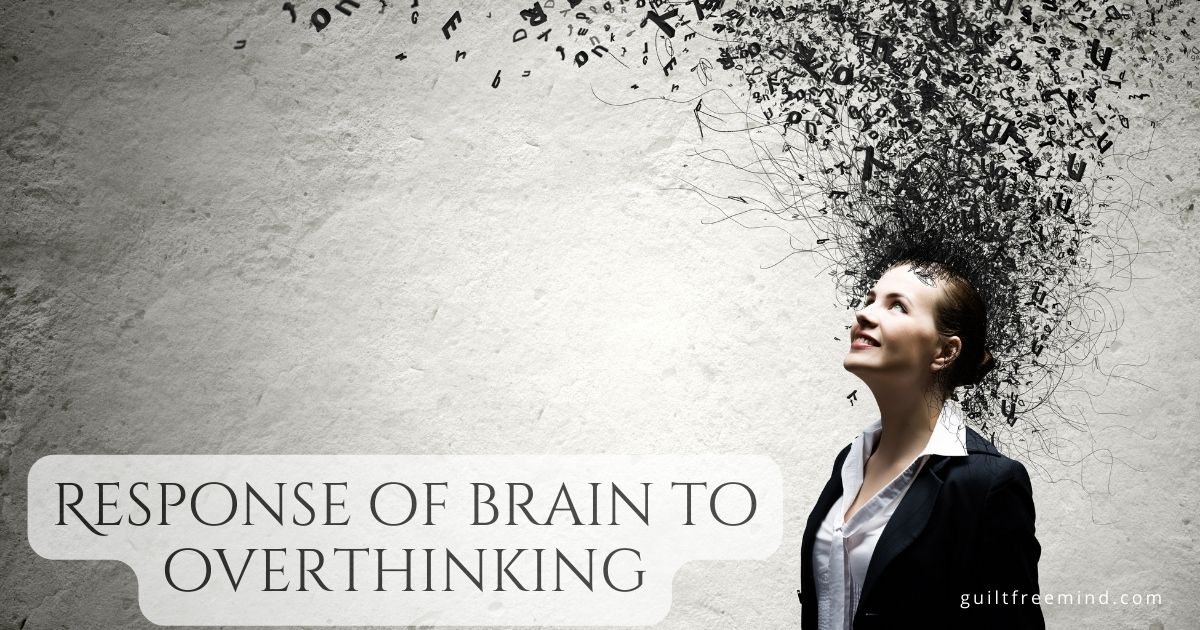
What Overthinking Does to Your Mind and Body
- Low mood and depression. People who ruminate are more likely to develop depression and to stay depressed for longer (Nolen-Hoeksema, 2000).
- Worse problem-solving. Ironically, rumination makes people less effective at solving the very problems they are thinking about (Lyubomirsky & Nolen-Hoeksema, 1995).
- Anxiety across many conditions. Repetitive negative thinking is seen in depression, generalised anxiety, social anxiety, PTSD, OCD, insomnia and more, which is why researchers call it “transdiagnostic” (Ehring & Watkins, 2008).
- Poor sleep. A busy, worried mind at bedtime is one of the main things that keeps insomnia going (Harvey, 2002).
- A stressed body. Rumination can prolong the body’s stress response, keeping you tense long after the stressful event has passed (Watkins & Roberts, 2020).
- Strained relationships. Constant reassurance-seeking and replaying conflicts can wear down both you and the people you love.

Why “Just Stop Thinking About It” Does Not Work
In a famous experiment, people who were told not to think about a white bear later thought about it more than people who were allowed to think about it freely (Wegner et al., 1987). Pushing thoughts away tends to make them bounce back.
So the aim is not to forcibly stop thoughts. It is to change your relationship with them: to notice them, to stop feeding them, and to redirect your attention to something more useful.

How to Stop Overthinking: 12 Science-Backed Ways
You do not need all twelve. Pick two or three that suit you and practise them for a few weeks; habits of mind change with repetition.
1. Notice it and name it
You cannot change a habit you do not notice. When you catch yourself looping, label it gently: “I’m ruminating again” or “This is a worry spiral.” Naming the process creates a little distance from the content.
2. Ask: “Is this a problem I can solve?”
If yes, move to action: what is one small step you can take today? If no, the problem is uncertain or out of your control, so more thinking will not help. That is your cue to use one of the strategies below rather than another round of analysis.
3. Switch from “why?” to “how?”
Abstract “why” questions (“Why am I like this?”) keep you stuck. Concrete “how” questions (“How exactly did this happen, and how could I handle it next time?”) tend to be more helpful and less upsetting. This shift is at the heart of rumination-focused CBT (Watkins, 2008; Watkins et al., 2011).
4. Schedule a daily “worry time”
Set aside 15–20 minutes at the same time and place each day. When a worry pops up at other times, jot it down and postpone it to worry time. In the first studies of this technique, people who practised it for four weeks reported less daily worry than those who did not (Borkovec et al., 1983). Many people find that by worry time, the worry has lost its urgency.
5. Step back with self-distancing
Try thinking about your situation as if you were a kind friend looking in, or talk to yourself in the third person: “Why is Priya so upset about this?” Research by Ethan Kross and Ozlem Ayduk shows that this kind of self-distancing reduces emotional reactivity and helps people reflect on hard experiences without spiralling (Kross & Ayduk, 2017).
6. Write it down
Getting thoughts onto paper helps them stop circling. Try a five-minute “brain dump”, or write about what is bothering you and how you feel about it. Expressive writing has been linked with better mental and physical health in many studies (Pennebaker, 1997). If you like journaling, our self-care journal ideas are a good place to start.
7. Move your body, ideally outdoors
In one study, people who took a 90-minute walk in a natural setting reported less rumination afterwards and showed reduced activity in a brain area linked to rumination. People who walked in a busy urban setting did not (Bratman et al., 2015). Even a short walk in a park can help break a loop.
8. Give your mind something absorbing to do
Brief, healthy distraction, such as a puzzle, cooking, gardening, drawing or a conversation, can interrupt a spiral and lift your mood enough to think more clearly afterwards. In Nolen-Hoeksema’s experiments, people in a low mood who spent a few minutes on a distracting task afterwards thought less negatively and solved problems better than people who spent the same time ruminating (Lyubomirsky & Nolen-Hoeksema, 1995). Creative activities like doodling work well for many people.
9. Practise mindfulness
Mindfulness teaches you to notice thoughts as passing events in the mind rather than facts you must act on. A systematic review of treatments for rumination and worry found that mindfulness-based approaches, along with CBT, helped reduce both (Querstret & Cropley, 2013). Start small: five minutes of noticing your breath, and gently returning each time your mind wanders. Simple deep breathing exercises can also calm the body.
10. Give decisions a time limit
For everyday choices, set a timer (say, ten minutes) and decide when it rings. Remind yourself that most decisions can be adjusted later, and that “good enough” is usually good enough.
11. Protect your sleep
Create a wind-down routine and keep worries out of bed. In one study, people who spent five minutes before bed writing a specific to-do list for the coming days fell asleep faster than people who wrote about tasks they had already completed (Scullin et al., 2018). If you wake at night and start overthinking, get up briefly, write the thought down, and return to bed when you feel sleepy.
12. Get help that targets repetitive thinking
If overthinking is taking over your days, therapy can help a lot. A 2025 analysis of 55 randomised trials found that cognitive behavioural therapy reduced repetitive negative thinking, rumination and worry, and that therapies designed specifically to target these thinking habits worked best (Stenzel et al., 2025). Options include rumination-focused CBT, metacognitive therapy and mindfulness-based cognitive therapy. Our guides to cognitive behavioural therapy and talk therapy for overthinking explain what to expect.
More Ways to Quiet an Overthinking Mind
These extra ideas used to live in a separate article on strategies to overcome overthinking. They work well alongside the twelve above.
Catch your automatic negative thoughts
“Automatic negative thoughts” is a term from cognitive therapy for the quick, unhelpful thoughts that pop up uninvited: “I’ll mess this up”, “They don’t like me”, “This will go wrong”. Write the thought down, then ask: What is the evidence for it, and against it? What would I say to a friend who thought this? This kind of thought-checking is a core part of cognitive behavioural therapy, which has strong research support for anxiety and worry (Hofmann et al., 2012).
Be kind to yourself
Overthinking is often driven by harsh self-criticism: replaying every mistake as proof that you are not good enough. Self-compassion means treating yourself with the warmth you would offer a friend. Across many studies, people with more self-compassion tend to have lower levels of anxiety and depression (MacBeth & Gumley, 2012). Try asking, “What would I say to someone I love in this situation?”
Tell intuition apart from fear
Intuition tends to be calm, quiet and specific. Fear-driven overthinking tends to be loud, urgent and repetitive, and it usually jumps to the worst possible outcome. If a thought keeps shouting the same catastrophe, it is more likely to be anxiety than wisdom.
Ask yourself better questions
Swap “What if everything goes wrong?” for questions that move you forward: “Will this matter in five years?” “What part of this is in my control?” “What is the smallest next step I could take today?”

Notice what went right
Overthinkers tend to replay what went wrong and skip what went well. At the end of each day, write down three things that went well and why. In a well-known online trial, people who did this for one week reported feeling happier and less depressed for up to six months (Seligman et al., 2005).
Face fears in small steps
Avoiding what you are afraid of keeps worry alive, because you never get to learn that you can cope. Gradually facing a feared situation, one small step at a time, is a core technique in CBT for anxiety. If a fear feels too big to face alone, a therapist can help you plan the steps.

Talk it through once, not on repeat
Talking a worry through with someone you trust can bring perspective and relief. But asking for reassurance again and again tends to keep anxiety going and can strain relationships (Starr & Davila, 2008). Share the worry once, listen to their view, and then turn back to your day.
Overthinking at Night
Night-time overthinking is especially common because there are fewer distractions and you are tired. A few things that help:
- Do a short “worry time” in the early evening, not in bed.
- Write tomorrow’s to-do list before you start winding down.
- Keep your phone out of reach so you are not tempted to search for answers at midnight.
- Try a slow breathing exercise or progressive muscle relaxation.
- Remind yourself: “Night-time thoughts are always darker. I will look at this in the morning.”
Overthinking in Relationships
Overthinking can be especially painful in relationships: rereading messages, analysing tone, imagining that a partner is losing interest. If this sounds like you, our dedicated guide to overthinking in a relationship covers attachment, reassurance-seeking and how to talk to your partner about it.

Quick Self-Check
Ask yourself these questions. They are not a diagnosis, but they can help you notice your patterns:
- Do I spend more than an hour a day caught in the same thoughts?
- Do my thoughts focus on “why” and “what if” rather than “what next”?
- Does overthinking regularly keep me awake or make me late, tired or irritable?
- Do I avoid decisions or situations because I cannot stop analysing them?
- Do I feel worse, not better, after a long session of thinking things over?
If you answered “yes” to several of these, the strategies above are worth practising, and it may be worth speaking to a professional.
When Overthinking Is a Sign of Something More
Sometimes overthinking is part of a mental health condition such as generalised anxiety disorder, depression, obsessive-compulsive disorder (OCD) or post-traumatic stress disorder (PTSD). Unwanted, distressing thoughts that feel “stuck” may also be intrusive thoughts, which are treated a little differently. Please speak to a doctor or mental health professional if:
- overthinking is affecting your work, studies, sleep or relationships most days;
- you feel hopeless, or low most of the time;
- you are using alcohol or other substances to switch your mind off;
- you have thoughts of harming yourself.
If you are struggling right now, you can reach out today: India: Tele-MANAS 14416 or 1-800-891-4416 (free, 24/7) · US: call or text 988 · UK: Samaritans 116 123 · In an emergency, call your local emergency number (112 in India).
Conclusion
Overthinking is your mind trying to protect you, using a strategy that no longer works. You do not have to win an argument with your thoughts or force them away. Notice the loop, ask whether there is something practical you can do, and then gently turn your attention towards your life: a walk, a page of writing, a conversation, a good night’s sleep. With practice, the loops get shorter and easier to step out of.
For gentle weekly ideas on calming an anxious mind, join the Guilt Free Mind newsletter.
See you in my next blog post,
Dr. Shruti
Frequently Asked Questions
No. Overthinking is not a diagnosis on its own. It is a very common thinking habit. However, persistent overthinking is linked to anxiety, depression and sleep problems, and it can be part of conditions such as generalised anxiety disorder or OCD. If it is affecting your daily life, it is worth talking to a professional.
Common reasons include believing that worrying helps you prepare, finding uncertainty hard to tolerate, perfectionism, anxiety, low mood, past experiences of criticism or trauma, stress and tiredness. Often it is a habit your mind learned to feel safe, and habits can be changed.
Do your worrying earlier in the evening, write tomorrow’s to-do list before bed, keep your phone away, try slow breathing or muscle relaxation, and if you cannot sleep, get up briefly, jot the thought down and go back to bed when you feel sleepy.
There is no good evidence that overthinkers are more intelligent. Thoughtful, analytical people may be more prone to it, but overthinking actually tends to make problem-solving worse, not better.
Yes. Overthinking keeps the body’s stress response switched on, which can contribute to tension, headaches, stomach upset, fatigue and poor sleep. If you have physical symptoms, it is still important to check them with a doctor.
Overthinking is a thinking pattern; anxiety is an emotional and physical state of fear or unease. They often feed each other: worry is a common feature of anxiety, and anxiety makes overthinking more likely.
No. Overthinking is a thinking habit, not an emotion. But it is closely tied to emotions such as anxiety, fear, guilt and sadness, which can set it off and are often made stronger by it.
About the Author
Dr. Shruti Bhattacharya is the founder and heart of Guilt Free Mind, where she combines a Ph.D. in Immunology with advanced psychology training to deliver science-backed mental health strategies. Her mission is to empower readers to overcome stress, anxiety, and emotional challenges with practical, evidence-based tools. Dr. Bhattacharya’s unique blend of expertise and empathy shapes her approach to wellness:
- Academic & Scientific Rigor – Holding a Ph.D. in Immunology and a Bachelor’s degree in Microbiology, Dr. Bhattacharya brings a deep understanding of the biological foundations of mental health, including the gut-brain connection. Her completion of psychology courses, such as The Psychology of Emotions: An Introduction to Embodied Cognition, from University of Cambridge enhances her ability to bridge science and emotional well-being.
- Dedicated Mental Health Advocacy – With over 15 years of experience, Dr. Bhattacharya has supported hundreds of individuals through online platforms and personal guidance, helping them navigate mental health challenges with actionable strategies. Her work has empowered readers to adopt holistic practices, from mindfulness to nutrition, for lasting resilience.
- Empathetic Connection to Readers – Known for her compassionate and relatable voice, Dr. Bhattacharya is a trusted guide in mental health, turning complex research into accessible advice. Her personal journey as a trauma survivor fuels her commitment to helping others find calm and confidence.
- Lifelong Commitment to Wellness – Dr. Bhattacharya lives the principles she shares, integrating science-based habits like balanced nutrition and stress management into her daily life. Her personal exploration of mental health strategies inspires Guilt Free Mind’s practical, reader-focused content.
🏆 Guilt Free Mind was named one of the Top 100 Mental Health Blogs on Feedspot in 2025.

Follow me on:
Disclaimer: This content is for informational purposes only and is not a substitute for professional medical advice.
References
- Borkovec, T. D., Wilkinson, L., Folensbee, R., & Lerman, C. (1983). Stimulus control applications to the treatment of worry. Behaviour Research and Therapy, 21(3), 247–251. https://doi.org/10.1016/0005-7967(83)90206-1
- Bratman, G. N., Hamilton, J. P., Hahn, K. S., Daily, G. C., & Gross, J. J. (2015). Nature experience reduces rumination and subgenual prefrontal cortex activation. Proceedings of the National Academy of Sciences, 112(28), 8567–8572. https://doi.org/10.1073/pnas.1510459112
- Ehring, T., & Watkins, E. R. (2008). Repetitive negative thinking as a transdiagnostic process. International Journal of Cognitive Therapy, 1(3), 192–205.
- Harvey, A. G. (2002). A cognitive model of insomnia. Behaviour Research and Therapy, 40(8), 869–893.
- Hofmann, S. G., Asnaani, A., Vonk, I. J. J., Sawyer, A. T., & Fang, A. (2012). The efficacy of cognitive behavioral therapy: A review of meta-analyses. Cognitive Therapy and Research, 36(5), 427–440. https://doi.org/10.1007/s10608-012-9476-1
- Kross, E., & Ayduk, O. (2017). Self-distancing: Theory, research, and current directions. Advances in Experimental Social Psychology, 55, 81–136.
- Lyubomirsky, S., & Nolen-Hoeksema, S. (1995). Effects of self-focused rumination on negative thinking and interpersonal problem solving. Journal of Personality and Social Psychology, 69(1), 176–190.
- MacBeth, A., & Gumley, A. (2012). Exploring compassion: A meta-analysis of the association between self-compassion and psychopathology. Clinical Psychology Review, 32(6), 545–552. https://doi.org/10.1016/j.cpr.2012.06.003
- Nolen-Hoeksema, S. (2000). The role of rumination in depressive disorders and mixed anxiety/depressive symptoms. Journal of Abnormal Psychology, 109(3), 504–511.
- Nolen-Hoeksema, S., Wisco, B. E., & Lyubomirsky, S. (2008). Rethinking rumination. Perspectives on Psychological Science, 3(5), 400–424.
- Pennebaker, J. W. (1997). Writing about emotional experiences as a therapeutic process. Psychological Science, 8(3), 162–166.
- Querstret, D., & Cropley, M. (2013). Assessing treatments used to reduce rumination and/or worry: A systematic review. Clinical Psychology Review, 33(8), 996–1009. https://doi.org/10.1016/j.cpr.2013.08.004
- Scullin, M. K., Krueger, M. L., Ballard, H. K., Pruett, N., & Bliwise, D. L. (2018). The effects of bedtime writing on difficulty falling asleep: A polysomnographic study comparing to-do lists and completed activity lists. Journal of Experimental Psychology: General, 147(1), 139–146.
- Seligman, M. E. P., Steen, T. A., Park, N., & Peterson, C. (2005). Positive psychology progress: Empirical validation of interventions. American Psychologist, 60(5), 410–421. https://doi.org/10.1037/0003-066X.60.5.410
- Starr, L. R., & Davila, J. (2008). Excessive reassurance seeking, depression, and interpersonal rejection: A meta-analytic review. Journal of Abnormal Psychology, 117(4), 762–775. https://doi.org/10.1037/a0013866
- Stenzel, K. L., Keller, J., Kirchner, L., Rief, W., & Berg, M. (2025). Efficacy of cognitive behavioral therapy in treating repetitive negative thinking, rumination, and worry: A transdiagnostic meta-analysis. Psychological Medicine. https://doi.org/10.1017/S0033291725000017
- University of Michigan News. (2003, February 4). Most women think too much, overthinkers often drink too much [on Nolen-Hoeksema, Women Who Think Too Much, Henry Holt]. news.umich.edu
- Watkins, E. R. (2008). Constructive and unconstructive repetitive thought. Psychological Bulletin, 134(2), 163–206.
- Watkins, E. R., & Roberts, H. (2020). Reflecting on rumination: Consequences, causes, mechanisms and treatment of rumination. Behaviour Research and Therapy, 127, 103573. https://doi.org/10.1016/j.brat.2020.103573
- Watkins, E. R., Mullan, E., Wingrove, J., Rimes, K., Steiner, H., Bathurst, N., Eastman, R., & Scott, J. (2011). Rumination-focused cognitive-behavioural therapy for residual depression: Phase II randomised controlled trial. British Journal of Psychiatry, 199(4), 317–322. https://doi.org/10.1192/bjp.bp.110.090282
- Wegner, D. M., Schneider, D. J., Carter, S. R., & White, T. L. (1987). Paradoxical effects of thought suppression. Journal of Personality and Social Psychology, 53(1), 5–13.
- Wells, A. (2009). Metacognitive Therapy for Anxiety and Depression. Guilford Press.
