


This article is for information only and isn’t a substitute for advice from your doctor or mental health professional.
Table of Contents
Quick Answer
Common signs of depression include a low or empty mood that lasts most of the day, losing interest in things you used to enjoy, changes in sleep and appetite, tiredness, trouble concentrating, feeling worthless or guilty, and thoughts of death. Doctors look for several of these signs lasting at least two weeks and getting in the way of daily life. Feeling sad after a hard day or week is not the same as depression. If several of the signs below sound familiar, talk to a doctor or mental health professional: depression is common and treatable. If you are thinking about suicide, call or text 988 in the US, or call Tele-MANAS on 14416 in India.
If you are unhappy, it doesn’t necessarily mean you are depressed. The word “depression” is used very loosely nowadays. When people have a bad day or a bad week, they often say they feel depressed, and some even say they are suffering from depression. But depressive disorder is very different from just feeling sad, as I explain in clinical depression or sadness?
In this post, I explain what depression is, how it differs from ordinary sadness, 11 common signs of depression, how the signs can look different in men, how depression is diagnosed and treated, how to help someone you love, and when to get help right away.
What Is Depression?
There are times in our lives when we feel stuck in a deep, dark hole with no way out. In most cases, we feel better by the next day or in a couple of days. If the feelings of hopelessness, despair and numbness don’t go away, it may be depression. Depression is much more than sadness or a response to difficult situations. It can change how a person sees the world and how they get through their daily life.
Doctors call it major depressive disorder, or clinical depression. It is marked by a low mood, a loss of interest, changes in thinking, and physical symptoms such as disturbed sleep or appetite (Otte et al., 2016). It is a common illness that can seriously limit everyday functioning and quality of life (Malhi & Mann, 2018), getting in the way of eating, sleeping, studying, working, enjoying life and spending time with friends. For some people, getting through a single day can feel overwhelming.
Depression is also common. In a large US survey, about 1 in 10 adults (10.4%) had major depression in the past year, and about 1 in 5 (20.6%) had experienced it at some point in their life (Hasin et al., 2018). It occurs about twice as often in women as in men (Otte et al., 2016). It has many possible causes, from genes and stress to difficult life events, which I cover in the causes of depression.
Sadness vs Depression: What’s the Difference?
| Ordinary sadness | Depression | |
|---|---|---|
| How long it lasts | Hours or days, and it eases | Most of the day, nearly every day, for two weeks or more |
| Cause | Usually linked to a clear event | May follow an event, or appear without an obvious reason |
| Enjoyment | You can still enjoy some things | Loss of interest or pleasure in most things |
| Self-image | Your sense of worth stays mostly intact | Feelings of worthlessness or guilt are common |
| Daily life | You can keep going | Work, study, relationships or self-care become hard |
After a loss, grief can look a lot like depression. Grief often comes in waves, while depression tends to feel more constant. My post on the stages of grief explains more. Grief and depression can also happen together, so if your grief feels stuck or overwhelming, it’s worth talking to a professional.
11 Signs of Depression
All of us are different. What one person feels may not be the same as what someone else feels, and we all handle situations in our own way. So the signs of depression vary from person to person, although some signs are common to most people.
Doctors diagnose depression when someone has at least five of the core symptoms for two weeks or more, and at least one of them is a low mood or a loss of interest or pleasure. You don’t need to have every sign below, and having one or two during a bad week doesn’t mean you have depression. What matters is how many signs you notice, how long they last and how much they affect your life.
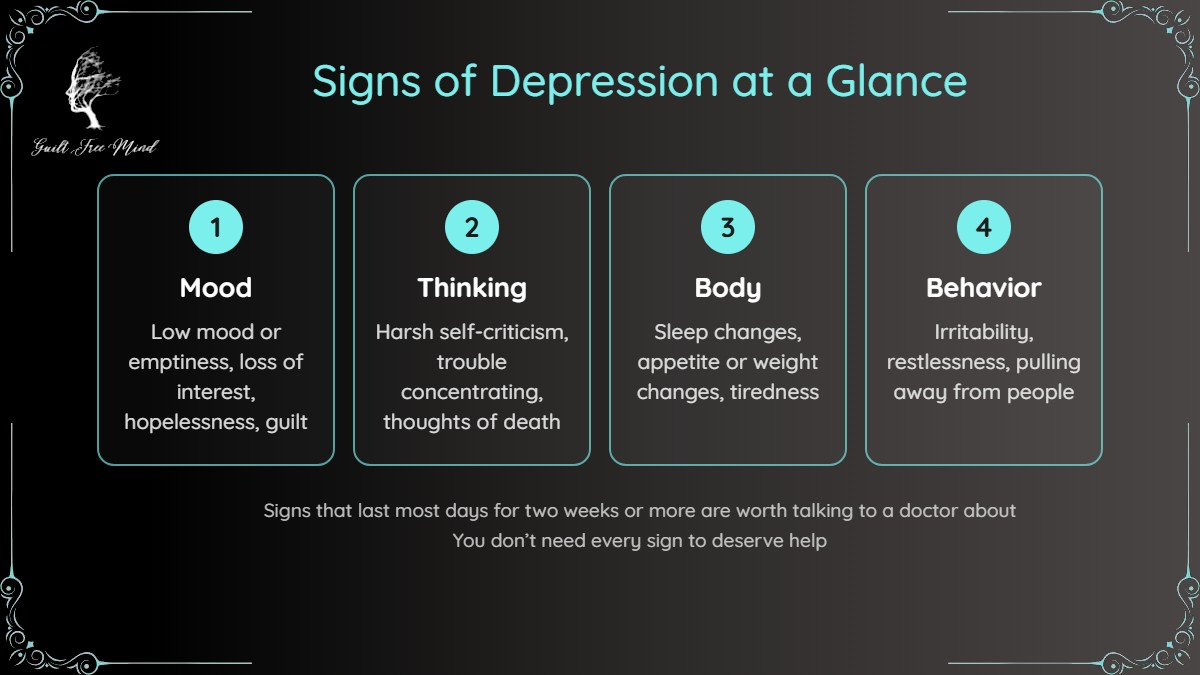
1. A Low or Empty Mood That Doesn’t Lift
The most familiar sign of depression is a low, sad or empty mood that lasts most of the day, nearly every day. Some people describe feeling numb rather than sad, or feeling completely helpless, as if they are stuck in a hole.
Emotions can also feel hard to control. People with depression may feel sad or angry without knowing why, or start crying and not be able to say what set it off. If periods of low mood alternate with periods of unusually high energy, little need for sleep or racing thoughts, tell your doctor, because that pattern can point to bipolar disorder, which is treated differently.
2. Loss of Interest or Pleasure
Another very common sign of depression is a loss of interest in regular activities. Things that once made the person happy, such as playing chess or video games, sports, walking outdoors, cycling or hiking, no longer spark any excitement. If you notice that a loved one is withdrawing from their favorite activities, it can be an important red flag.
Interest in sex often drops too, and many people pull away from friends and family. This loss of pleasure is one of the two core signs doctors look for.
3. A Hopeless Outlook and a Sense of Doom
People with depression often find themselves asking:
- What am I living for?
- Why am I working so hard? What’s the point?
- What is the meaning of life itself?
They tend to come up with negative answers and develop a hopeless outlook. Some feel a constant sense of doom: even when life is going well, their mind tells them that something bad is about to happen and that they won’t recover from it. Living with that feeling takes a heavy toll. These feelings are symptoms of depression. They don’t reflect your life or the reality of your situation.
4. Self-Loathing, Worthlessness and Guilt
Many people with depression stop feeling good about themselves and enter a spiral of self-criticism. Some find it hard to look at themselves in the mirror, or feel they are the root cause of every problem in their life. This can get worse in an unsupportive environment: if parents or loved ones tell them they are responsible for their own problems, the self-blame grows. Strong feelings of worthlessness or guilt that don’t match the situation are a recognized symptom of depression.
5. Sleep Problems
When something stressful is on our minds, it’s hard to sleep, and people with depression are often caught up in worry about the future and second-guessing their decisions. Many find it hard to fall asleep, or wake very early and can’t get back to sleep. Others sleep much more than usual and still wake up tired.
Sleep and depression affect each other. A review of 21 long-term studies found that people with insomnia had about twice the risk of later developing depression compared with people without sleep problems (Baglioni et al., 2011). If sleep is a struggle, my tips to improve sleep quality may help, alongside a chat with your doctor.
6. Changes in Appetite and Weight
When something is constantly weighing on your mind, everyday routines like meals can slip. Some people start eating much more, while others lose their appetite. Those who eat more may gain weight, and those who eat less may lose it without trying.
If someone is deliberately restricting food, or you’re worried about their eating, read my guide to the signs of eating disorders. In the US, the National Alliance for Eating Disorders helpline is 1-866-662-1235.
7. Tiredness and Low Energy
Depression often drains energy. Small tasks such as showering, cooking or replying to a message can feel exhausting, and rest doesn’t seem to help. Some people also notice aches, headaches or stomach problems without a clear physical cause, a reminder that the mind and body are closely linked, as I explain in when anxiety feels physical. Because tiredness has many possible causes, including thyroid problems and anemia, it’s worth getting checked by a doctor.
8. Trouble Concentrating and Making Decisions
Depression affects thinking as well as mood. You might read the same page several times, forget things or find small decisions overwhelming. A review of studies using the same set of thinking tests found moderate problems with attention, memory and executive function (skills such as planning and switching between tasks) in people with depression, and some of these problems continued after their mood had improved (Rock et al., 2014). Repetitive negative thinking is common too, and my guide to overthinking has practical ways to step out of it.
9. Irritability and Anger
Depression doesn’t always look like sadness. Some people become irritable, short-tempered and quick to anger over small things.
In a long-term US study of 536 people with major depression, more than half (54.5%) showed openly irritable or angry behavior, and this was linked with more severe and longer-lasting depression (Judd et al., 2013). So irritability is worth taking seriously rather than dismissing as a “bad temper.”
10. Anxiety and Restlessness
Many people who have depression also have symptoms of anxiety. Common signs include:
- Feelings of panic, dread or danger
- A fast heartbeat and quick breathing
- Sweating or trembling
- Restlessness and feeling tense or on edge
- Trouble focusing on anything other than the worry
The two often go together: in the large US survey, people with major depression were several times more likely than others to also have generalized anxiety disorder (Hasin et al., 2018). Depression can also change how you move. Some people feel restless and fidgety, while others notice their speech and movements slowing down. You can read more in my guide to anxiety disorders.
11. Thoughts of Death or Suicide
Depression can bring thoughts of death or suicide. When someone can’t see a way forward from where they are, ending things can start to seem like an option. It isn’t the answer. Depression is not a permanent state, it is treatable, and these thoughts are a symptom of the illness, not the truth about your life.
If you are having thoughts of suicide, please reach out today: in the US, call or text 988 (the 988 Suicide & Crisis Lifeline); in India, call Tele-MANAS on 14416, or 112 in an emergency; in the UK and Ireland, call Samaritans on 116 123. If you are in immediate danger, call your local emergency number.
If someone you love talks about death or suicide, take it seriously. I explain how to help further down this page.
Signs of Depression in Men
Men and women can experience depression differently. Many women describe feeling hopeless, helpless and stuck in despair, while men are more likely to show it as restlessness, irritability or anger, which friends and family may not recognize as depression.
Research supports this. In a nationally representative US survey, men reported more anger attacks or aggression, substance use and risk taking than women (Martin et al., 2013). In everyday life, this can look like:
- Getting angry quickly over small things
- Drinking more or using drugs to cope
- Reckless driving, gambling or other risky behavior, chasing a moment’s relief
If drinking or drug use is part of the picture, the SAMHSA National Helpline (1-800-662-4357) offers free, confidential support in the US.
How Depression Is Diagnosed
There’s no single test for depression, and no checklist score that proves you have it. A doctor, psychologist or psychiatrist will usually:
- Ask about your symptoms, how long they have lasted and how they affect your life
- Ask about your mood history, including any periods of unusually high mood or energy
- Check for physical causes, such as thyroid problems, anemia or side effects of medicines, often with blood tests
- Ask about alcohol and drug use, and about any thoughts of harming yourself
Many clinics use short questionnaires such as the PHQ-9, which asks nine questions about the past two weeks. In its original study, a score of 10 or more picked up 88% of people who had major depression (Kroenke et al., 2001). It’s a useful screen, but a diagnosis still comes from a conversation with a professional. If you’re not sure who to see, my guide to psychologists vs psychiatrists explains the difference.
Depression Is Treatable
Getting out of depression is possible. You may need guidance and help from a mental health professional, but the first step is recognizing that you might be depressed. Treatment takes time and patience, so please don’t wait: reach out to a doctor or psychologist as soon as you can so that it can begin.
The main treatments are talking therapies, medication, or both (Otte et al., 2016). In a review of 228 trials, about 41% of people improved by at least half within roughly two months of psychotherapy, compared with 17% with usual care, and the main types of therapy worked about equally well (Cuijpers et al., 2021). Cognitive behavioral therapy is one of the best studied, and you can read how it works in cognitive behavioral therapy for depression.
A large review of 522 trials found that all 21 antidepressants studied worked better than placebo for adults with major depression (Cipriani et al., 2018). Decisions about medication should always be made with a doctor, and you should never stop an antidepressant suddenly without medical advice. Creative approaches such as art therapy can support recovery alongside professional treatment, and it helps to know the common myths about clinical depression.
How to Help Someone Who Shows Signs of Depression
If someone you love is struggling with depression, please be their support system. Guide them, help them and tell them that help is available. Please don’t tell them it’s just a phase that will pass with time.
- Stay with them when they are feeling low.
- Ask them to talk about what is bothering them. If they aren’t ready, let them know you’re there whenever they are.
- Offer to help them find a doctor or therapist, and to go with them to the first appointment.
- If they talk about suicide, ask them calmly and directly whether they are thinking of ending their life, and listen without judging.
- Remove or lock away medicines and anything else they could use to harm themselves, and call 988 (US) or your local emergency number if they are in danger. Limiting access to the means of suicide is one of the best-supported ways to prevent it (Mann et al., 2021).
For more ideas, read my guide on how to help someone with depression and my post on emotional support. Supporting someone can be draining, so please look after yourself too.
When to Get Help
See a doctor or mental health professional if signs of depression have lasted two weeks or more, if they are affecting your work, studies, relationships or self-care, or if you’re relying on alcohol or drugs to cope. You don’t need to be sure it’s depression before asking for help.
If you are struggling or having thoughts of harming yourself, please reach out now: in the US, call or text 988; in India, call Tele-MANAS on 14416 (or 112 in an emergency); in the UK and Ireland, call Samaritans on 116 123.
Keep Reading on Guilt Free Mind
- Clinical depression or sadness? The differences
- Causes of depression: a complete guide
- How to help someone with depression?
- Clinical Depression Myths Debunked
- Cognitive Behavioral Therapy for Depression
- Art Therapy for Depression: Does It Work? What the Research Says
- Psychologist vs psychiatrist: whom to approach?
- 16 tips to improve sleep quality
- Overthinking: Why It Happens and 12 Science-Backed Ways to Stop
- Stages of Grief: The 5 Stages, the 7-Stage Model and Where Guilt Fits In
Final Thoughts
The one thing to remember is that depression is not permanent, and it is not a phase. It needs proper support: counseling or therapy, sometimes medication, and self-help techniques. Depression is treatable, so please don’t let what society thinks get in the way of getting help for yourself or someone you love.
Have you ever had counseling for depression? If you don’t mind sharing, tell me in the comments what helped you. Your story of courage could help someone else ask for the help they need.
If you’d like gentle, science-backed mental health tips in your inbox, join my newsletter. If you like watching videos, subscribe to the Guilt Free Mind YouTube channel, and you can also find me on Twitch.
See you in my next blog post,
Dr. Shruti
Frequently Asked Questions
Early signs often include a low mood that lasts most of the day, losing interest in things you used to enjoy, sleep changes and tiredness. They can be subtle at first, such as pulling away from friends or finding everyday tasks harder than usual.
Doctors usually look for symptoms that are present most of the day, nearly every day, for at least two weeks, and that affect daily life. You don’t have to wait two weeks to ask for help if you are struggling.
Yes. Some people feel numb or empty rather than sad, and some mainly notice a loss of interest, irritability, tiredness, trouble concentrating or physical symptoms.
Men with depression may be more likely to show anger or irritability, drink more or use drugs, or take risks, rather than talking about sadness. These signs are easy to miss, so it helps to know them.
Yes. Talking therapies such as cognitive behavioral therapy, antidepressant medication, or a combination help many people. A doctor or mental health professional can help you find the right option for you.
About the Author
Dr. Shruti Bhattacharya is the founder and heart of Guilt Free Mind, where she combines a Ph.D. in Immunology with training in psychology to deliver science-backed mental health strategies. Her mission is to empower readers to overcome stress, anxiety, and emotional challenges with practical, evidence-based tools. Dr. Bhattacharya’s unique blend of expertise and empathy shapes her approach to wellness:
- Academic & Scientific Rigor – Holding a Ph.D. in Immunology and a Bachelor’s degree in Microbiology, Dr. Bhattacharya brings a deep understanding of the biological foundations of mental health, including the gut-brain connection. Her completion of psychology courses, such as The Psychology of Emotions: An Introduction to Embodied Cognition, enhances her ability to bridge science and emotional well-being.
- Dedicated Mental Health Advocacy – With over 15 years of experience, Dr. Bhattacharya has supported hundreds of individuals through online platforms and personal guidance, helping them navigate mental health challenges with actionable strategies. Her work has empowered readers to adopt holistic practices, from mindfulness to nutrition, for lasting resilience.
- Empathetic Connection to Readers – Known for her compassionate and relatable voice, Dr. Bhattacharya is a trusted guide in mental health, turning complex research into accessible advice. Her personal journey as a trauma survivor fuels her commitment to helping others find calm and confidence.
- Lifelong Commitment to Wellness – Dr. Bhattacharya lives the principles she shares, integrating science-based habits like balanced nutrition and stress management into her daily life. Her personal exploration of mental health strategies inspires Guilt Free Mind’s practical, reader-focused content.
🏆 Guilt Free Mind was named one of the Top 100 Mental Health Blogs on Feedspot.

Disclaimer: This content is for informational purposes only and is not a substitute for professional medical advice.
References
- Baglioni, C., Battagliese, G., Feige, B., Spiegelhalder, K., Nissen, C., Voderholzer, U., et al. (2011). Insomnia as a predictor of depression: A meta-analytic evaluation of longitudinal epidemiological studies. Journal of Affective Disorders, 135(1–3), 10–19. https://doi.org/10.1016/j.jad.2011.01.011
- Cipriani, A., Furukawa, T. A., Salanti, G., Chaimani, A., Atkinson, L. Z., Ogawa, Y., et al. (2018). Comparative efficacy and acceptability of 21 antidepressant drugs for the acute treatment of adults with major depressive disorder: A systematic review and network meta-analysis. The Lancet, 391(10128), 1357–1366. https://doi.org/10.1016/S0140-6736(17)32802-7
- Cuijpers, P., Karyotaki, E., Ciharova, M., Miguel, C., Noma, H., & Furukawa, T. A. (2021). The effects of psychotherapies for depression on response, remission, reliable change, and deterioration: A meta-analysis. Acta Psychiatrica Scandinavica, 144(3), 288–299. https://doi.org/10.1111/acps.13335
- Hasin, D. S., Sarvet, A. L., Meyers, J. L., Saha, T. D., Ruan, W. J., Stohl, M., & Grant, B. F. (2018). Epidemiology of adult DSM-5 major depressive disorder and its specifiers in the United States. JAMA Psychiatry, 75(4), 336–346. https://doi.org/10.1001/jamapsychiatry.2017.4602
- Judd, L. L., Schettler, P. J., Coryell, W., Akiskal, H. S., & Fiedorowicz, J. G. (2013). Overt irritability/anger in unipolar major depressive episodes: Past and current characteristics and implications for long-term course. JAMA Psychiatry, 70(11), 1171–1180. https://doi.org/10.1001/jamapsychiatry.2013.1957
- Kroenke, K., Spitzer, R. L., & Williams, J. B. W. (2001). The PHQ-9: Validity of a brief depression severity measure. Journal of General Internal Medicine, 16(9), 606–613. https://doi.org/10.1046/j.1525-1497.2001.016009606.x
- Malhi, G. S., & Mann, J. J. (2018). Depression. The Lancet, 392(10161), 2299–2312. https://doi.org/10.1016/S0140-6736(18)31948-2
- Mann, J. J., Michel, C. A., & Auerbach, R. P. (2021). Improving suicide prevention through evidence-based strategies: A systematic review. American Journal of Psychiatry, 178(7), 611–624. https://doi.org/10.1176/appi.ajp.2020.20060864
- Martin, L. A., Neighbors, H. W., & Griffith, D. M. (2013). The experience of symptoms of depression in men vs women: Analysis of the National Comorbidity Survey Replication. JAMA Psychiatry, 70(10), 1100–1106. https://doi.org/10.1001/jamapsychiatry.2013.1985
- Otte, C., Gold, S. M., Penninx, B. W., Pariante, C. M., Etkin, A., Fava, M., Mohr, D. C., & Schatzberg, A. F. (2016). Major depressive disorder. Nature Reviews Disease Primers, 2, 16065. https://doi.org/10.1038/nrdp.2016.65
- Rock, P. L., Roiser, J. P., Riedel, W. J., & Blackwell, A. D. (2014). Cognitive impairment in depression: A systematic review and meta-analysis. Psychological Medicine, 44(10), 2029–2040. https://doi.org/10.1017/S0033291713002535

3 Comments
Thanks for this beautiful article on one of the most ignored mental health disorders in our society.
Thank you
I am sorting out relevant information about gate io recently, and I saw your article, and your creative ideas are of great help to me. However, I have doubts about some creative issues, can you answer them for me? I will continue to pay attention to your reply. Thanks.