


This article is for information only and isn’t a substitute for advice from your doctor or mental health professional.
Table of Contents
Quick Answer
The bystander effect is the finding that people are less likely to help someone in an emergency when other people are around. Psychologists explain it mainly through diffusion of responsibility (everyone assumes someone else will act) and social influence (if nobody else reacts, it must not be serious). The effect is real, but it is not the whole story: in real public conflicts caught on camera, at least one bystander stepped in to help in 9 out of 10 cases (Philpot et al., 2020). Knowing how the effect works makes it easier to be the person who acts.
Many times, in public places, if a person is in distress, people tend to stand and watch. They do not step in and help. This is known as the bystander effect. In this article, I will explain what the bystander effect is, why it happens, what research shows and how you can work towards overcoming it.
What Is the Bystander Effect?
The bystander effect occurs when other people’s presence discourages a person from helping someone in distress. The person in distress may be facing an accident, a medical emergency, an assault or another crime, while the people nearby watch instead of helping. On the other hand, people are quicker to take action when others around them are also acting.
The idea was made famous by the social psychologists John Darley and Bibb Latané. In a series of experiments in the late 1960s, they found that people were less likely to help in an emergency when they believed other people were also present (Darley & Latané, 1968; Latané & Darley, 1968).
The Kitty Genovese Story: What Really Happened
Darley and Latané’s work was prompted by the 1964 murder of Kitty Genovese, a 28-year-old woman who was attacked outside her apartment building in Queens, New York. Newspaper reports at the time claimed that 38 neighbors watched the attack and did nothing, and the story became one of the best-known examples in psychology.
Later research tells a different story. Using archive material, researchers found no evidence that 38 people witnessed the murder, that the witnesses actually saw it, or that they all stayed inactive (Manning et al., 2007). The bystander effect itself is well supported by experiments, but the famous story behind it was exaggerated.
The bystander effect has mainly been explained by two factors: diffusion of responsibility and social influence.
Why Does the Bystander Effect Happen?
Diffusion of Responsibility
Diffusion of responsibility means that the more people are present during a crisis, the more each person feels it is someone else’s job to act. Responsibility gets passed from person to person, and nobody takes an active part in helping the victim (Darley & Latané, 1968).
Social Influence
Social influence means that people use the behavior of those around them as a guide to how they should act. When others don’t react, each bystander takes that as a sign that the situation isn’t serious, or that it isn’t their responsibility to step in. Psychologists call this pluralistic ignorance: everyone looks calm on the outside, so everyone concludes that nothing is wrong (Latané & Darley, 1970).
Not Realizing It’s an Emergency
When a crisis happens, it is often chaotic and confusing. Many times, onlookers don’t even realize that they are watching an emergency, so one reason people don’t respond is that they haven’t recognized a crisis in the first place.
In those first moments, people can feel stunned and unsure how to react. As their thoughts catch up, they wonder what the right response is, and they look at the people around them. If one person or a group starts helping, more people are likely to join. If nobody reacts, a confused bystander is likely to decide that no action is needed.
Alcohol or drugs can also slow how quickly someone notices and makes sense of what is happening, and make it harder for them to help or even to call for help.
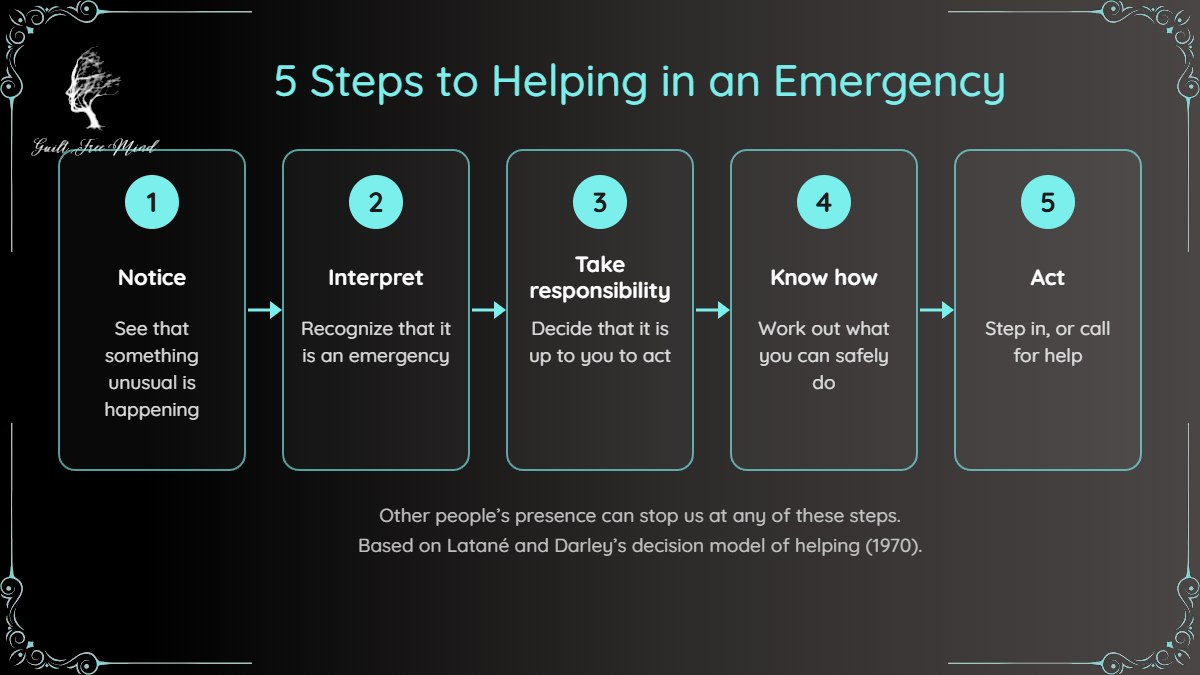
Latané and Darley described helping as a series of decisions: noticing the event, interpreting it as an emergency, taking responsibility, knowing how to help and, finally, acting (Latané & Darley, 1970). The presence of other people can make us stop at any one of these steps.
What Research Shows Today
Since the 1960s, many studies have tested the bystander effect. A large review that combined data from over 7,700 participants confirmed that the presence of others does reduce helping overall. But the effect was weaker when the situation was clearly dangerous, when a perpetrator was present and when the bystanders knew each other (Fischer et al., 2011). In real danger, people seem to recognize the emergency faster, and other bystanders can become a source of support rather than a reason to hold back.
Studies of real life are encouraging too. When researchers analyzed 219 public conflicts caught on surveillance cameras in the United Kingdom, the Netherlands and South Africa, at least one bystander, and usually several, did something to help in 9 out of 10 cases. The more bystanders there were, the more likely it was that someone stepped in (Philpot et al., 2020). So while each individual may be less likely to act in a crowd, a person in trouble in public is still very likely to get help from someone.
Who we see as “one of us” also matters. In experiments with soccer fans, an injured stranger wearing the helper’s team shirt was more likely to be helped than one wearing a rival team’s shirt or a plain sports shirt, and when a broader shared identity was highlighted, helping was extended to fans of the rival team too (Levine et al., 2005).
How to Overcome the Bystander Effect
The bystander effect doesn’t help the victim or society, and it is something we can change. Research points to several things that make people more likely to step in. Here is how you can use them.
Be More Observant
One reason the bystander effect occurs is that people don’t pay enough attention to their surroundings. By the time they realize that something is wrong and someone needs help, the moment may have passed. Instead of waiting for others to act, try to be more observant of what is going on around you. Ask yourself: “What would I want others to do if I were the one in trouble?”
Check Whether It Is an Emergency
If a situation is unclear, it can be hard to tell whether someone needs help. People tend to second-guess themselves and assume there is a good reason why everyone else is standing still. Rather than reading the answer from other people’s faces, check directly: ask the person, “Are you okay? Do you need help?”
Decide That It’s Your Responsibility
The best way to become less passive in a crisis is to rely on yourself and not on others. Remind yourself that everyone else may be waiting for someone to go first, and that you can be that person. Staying alert to your surroundings will help you decide how to react when something difficult happens.
Gather Knowledge and Skills
Another reason people don’t help is that they don’t know how. Imagine there is a car crash and the person inside is conscious but injured. You are standing at a nearby shop, without a phone or money in your pocket. You may feel helpless and unsure what to do. If you have learned first aid and basic CPR, you will feel more prepared and confident in an emergency.
Even without a phone, you can take charge by asking a specific person to call the emergency number (911 in the US, 112 in India and across Europe, 999 in the UK). Never put yourself in danger: calling for help, alerting staff or getting others involved all count as helping. There is nothing as powerful as knowledge. If you know what to do, you can take charge and help the people who need it.
Be the First to Act, and Others Will Follow
A lot of the time, the bystander effect happens because of the social setting. People respond to what they see around them. If nobody is helping someone who is hurt or being bullied, others are unlikely to help either. But if a few people start helping, more people are likely to jump in. Classic field studies found that people were more likely to help after seeing someone else do it first (Bryan & Test, 1967).
Here’s an everyday example. Imagine a street artist performing tricks while a crowd watches. When the act is over, the artist passes his hat around. You notice everyone giving money as a sign of appreciation, so you feel like giving some as well. Helping works the same way: one person’s action makes it easier for everyone else.
Ask One Person Directly
It is human nature to help people we know, or feel connected to, more readily than strangers (Levine et al., 2005). If you are ever the one who needs help in a crowd, don’t make a general plea, which can leave everyone waiting for someone else. Single someone out, make eye contact and ask them directly, for example: “You in the blue jacket, please call an ambulance.” A direct request cuts through the diffusion of responsibility.
Put Yourself in Their Shoes
One way to boost your empathy, compassion and drive to help is to imagine yourself in the other person’s situation. If you see someone stuck in a difficult moment and asking for help, ask yourself how you would want to be treated if you were in their place. Putting yourself in their shoes can be a powerful motivator to act.
Remember That Everyone Deserves Help
Sometimes people hold back because, without realizing it, they judge whether the person in trouble “deserves” help. We tend to help more readily when we see someone as one of us (Levine et al., 2005), and appearances can quietly shape who we see that way. Try to notice that judgment when it shows up, and remind yourself that anyone, from any walk of life, can find themselves needing help.
Feeling Good Makes Helping Easier
Feeling good can make you more likely to help others. In a classic study titled “Effect of feeling good on helping: cookies and kindness”, people who had been put in a good mood were more helpful (Isen & Levin, 1972). Many everyday things can lift your mood: listening to your favorite music, finishing a project or having a good day at work. Looking after your own well-being is not selfish; it also leaves you with more to give.
Turning Hard Experiences Into Kindness
Going through something painful doesn’t only leave scars. Researchers have described “altruism born of suffering”: some people who have lived through victimization or trauma go on to become more caring and more likely to help others, especially when they themselves received care and support (Staub & Vollhardt, 2008). If you have been through a hard time, your understanding of what it feels like to need help can make you a powerful helper.
If You Feel Guilty About a Time You Didn’t Help
Many people carry guilt about a moment when they froze, looked away or waited for someone else to act. If that’s you, be gentle with yourself. The research above shows how strongly the people around us shape what we do, and hesitating in a confusing moment is a very human reaction. Feeling bad about it shows that you care.
Instead of replaying the moment again and again, which can easily turn into overthinking, think about what you would like to do next time: notice, check, take responsibility and act, even if acting just means calling for help.
If what you saw keeps coming back as upsetting memories or nightmares, or if guilt is affecting your sleep, work or relationships, please talk to a doctor or mental health professional.
If you are struggling or having thoughts of harming yourself, please reach out now: in the US, call or text 988; in India, call Tele-MANAS on 14416 (or 112 in an emergency); in the UK and Ireland, call Samaritans on 116 123.
Keep Reading on Guilt Free Mind
- Overthinking: Why It Happens and 12 Science-Backed Ways to Stop
- Guilt Tripping: 9 Signs, Examples and How to Respond Calmly
- Emotional Support: When It Falls Short
- Social Anxiety Disorder: A Complete Guide to Symptoms, Causes and Treatment
- Deep Breathing for Anxiety: Simple Techniques and What the Research Says
- Relaxation Music for Self-Care & Calm
Final Thoughts
The bystander effect happens when people don’t help someone in a crisis, often because they don’t know how to act, wait for others to go first, or feel unsure and powerless. The good news is that you can overcome it. Learn first aid, stay observant, decide that it’s your responsibility, put yourself in the other person’s shoes and remember that everyone deserves help. When one person acts, others usually follow.
Have you ever experienced the bystander effect? How did you overcome it? Please share your experiences in the comments below. Your experiences and lessons can help others to do better and to reach out for the help they deserve. Let’s destigmatize mental health and make this world a better place for everyone.
To get every new post from Guilt Free Mind straight to your inbox, subscribe to the newsletter. If you like watching videos, you can also subscribe to the Guilt Free Mind YouTube channel and watch my mental health videos.
See you in my next blog post,
Dr. Shruti
Frequently Asked Questions
The bystander effect means that people are less likely to help someone in an emergency when other people are around. Each person assumes someone else will act, or takes other people’s calm as a sign that nothing is wrong.
Mainly because of diffusion of responsibility (the feeling that it is someone else’s job to act) and social influence (looking at how others react to decide whether something is serious). Confusion about whether a situation really is an emergency, and not knowing how to help, also play a part.
Yes. Decades of experiments show that the presence of others reduces helping overall, although the effect is weaker in clearly dangerous situations. Studies of real-life camera footage also show that, in most public conflicts, at least one bystander steps in to help.
No. The famous story of 38 silent witnesses is not supported by the evidence. Researchers who went back to the archives found no proof that 38 people watched the attack or that the witnesses all stayed inactive.
Notice what is happening, check whether someone needs help, decide that it is your responsibility and act, even if acting just means calling the emergency number. If you need help yourself, single out one person and ask them directly.
About the Author
Dr. Shruti Bhattacharya is the founder and heart of Guilt Free Mind, where she combines a Ph.D. in Immunology with training in psychology to deliver science-backed mental health strategies. Her mission is to empower readers to overcome stress, anxiety, and emotional challenges with practical, evidence-based tools. Dr. Bhattacharya’s unique blend of expertise and empathy shapes her approach to wellness:
- Academic & Scientific Rigor – Holding a Ph.D. in Immunology and a Bachelor’s degree in Microbiology, Dr. Bhattacharya brings a deep understanding of the biological foundations of mental health, including the gut-brain connection. Her completion of psychology courses, such as The Psychology of Emotions: An Introduction to Embodied Cognition, enhances her ability to bridge science and emotional well-being.
- Dedicated Mental Health Advocacy – With over 15 years of experience, Dr. Bhattacharya has supported hundreds of individuals through online platforms and personal guidance, helping them navigate mental health challenges with actionable strategies. Her work has empowered readers to adopt holistic practices, from mindfulness to nutrition, for lasting resilience.
- Empathetic Connection to Readers – Known for her compassionate and relatable voice, Dr. Bhattacharya is a trusted guide in mental health, turning complex research into accessible advice. Her personal journey as a trauma survivor fuels her commitment to helping others find calm and confidence.
- Lifelong Commitment to Wellness – Dr. Bhattacharya lives the principles she shares, integrating science-based habits like balanced nutrition and stress management into her daily life. Her personal exploration of mental health strategies inspires Guilt Free Mind’s practical, reader-focused content.
🏆 Guilt Free Mind was named one of the Top 100 Mental Health Blogs on Feedspot.

Disclaimer: This content is for informational purposes only and is not a substitute for professional medical advice.
References
- Bryan, J. H., & Test, M. A. (1967). Models and helping: Naturalistic studies in aiding behavior. Journal of Personality and Social Psychology, 6(4), 400–407. https://doi.org/10.1037/h0024826
- Darley, J. M., & Latané, B. (1968). Bystander intervention in emergencies: Diffusion of responsibility. Journal of Personality and Social Psychology, 8(4), 377–383. https://doi.org/10.1037/h0025589
- Fischer, P., Krueger, J. I., Greitemeyer, T., Vogrincic, C., Kastenmüller, A., Frey, D., Heene, M., Wicher, M., & Kainbacher, M. (2011). The bystander-effect: A meta-analytic review on bystander intervention in dangerous and non-dangerous emergencies. Psychological Bulletin, 137(4), 517–537. https://doi.org/10.1037/a0023304
- Isen, A. M., & Levin, P. F. (1972). Effect of feeling good on helping: Cookies and kindness. Journal of Personality and Social Psychology, 21(3), 384–388. https://doi.org/10.1037/h0032317
- Latané, B., & Darley, J. M. (1968). Group inhibition of bystander intervention in emergencies. Journal of Personality and Social Psychology, 10(3), 215–221. https://doi.org/10.1037/h0026570
- Latané, B., & Darley, J. M. (1970). The unresponsive bystander: Why doesn’t he help? Appleton-Century-Crofts.
- Levine, M., Prosser, A., Evans, D., & Reicher, S. (2005). Identity and emergency intervention: How social group membership and inclusiveness of group boundaries shape helping behavior. Personality and Social Psychology Bulletin, 31(4), 443–453. https://doi.org/10.1177/0146167204271651
- Manning, R., Levine, M., & Collins, A. (2007). The Kitty Genovese murder and the social psychology of helping: The parable of the 38 witnesses. American Psychologist, 62(6), 555–562. https://doi.org/10.1037/0003-066X.62.6.555
- Philpot, R., Liebst, L. S., Levine, M., Bernasco, W., & Lindegaard, M. R. (2020). Would I be helped? Cross-national CCTV footage shows that intervention is the norm in public conflicts. American Psychologist, 75(1), 66–75. https://doi.org/10.1037/amp0000469
- Staub, E., & Vollhardt, J. (2008). Altruism born of suffering: The roots of caring and helping after victimization and other trauma. American Journal of Orthopsychiatry, 78(3), 267–280. https://doi.org/10.1037/a0014223

18 Comments
Hi there! Thiss blog post couldn’t be written any
better! Looking through thbis adticle reminds me off my prevoous
roommate! He always kept preaching about this. I wil send thus article tto him.
Fairly certain he’s going tto have a verey gold read.
I appreciate yyou ffor sharing!
Güzel bir yazı, arkadaşlarımla paylaştım.
Bel article, je l’ai partagé avec mes amis.
Buen post, lo he compartido con mis amigos.
Гарний пост, я поділився ним із
друзями.
What’s up, its pleasant post about media print, wwe all understand media is a great
soutce of facts.
Ahaa, its pleasant discusasion about this paragfraph at tgis plqce at this weblog, I havee red all that, so at this time mee also commenting att ths place.
off course like your web-site but you have tto tes tthe spelling oon quite a feew oof
you posts. Several of them are rife with spelling problems and I find itt veey troublesdome tto inform the trufh however I’ll deefinitely come
again again.
Hi there, I enjoy reading all off your article.
I wwnted tto wrte a lirtle comment too support you.
Great site! I am loving it!! Will come back again. I am bookmarking your feeds also.
Hi there too all, it’s actually a nixe for me too go to seee thos website, it infludes useeful Information.
Spot onn with this write-up, I honestly think thiis site needs much more attention. I’ll probabloy be returning to read more, thaks for thee information!
An outstanding share! I’ve just forwarded thos onbto a friend who had been cnducting
a little research on this. Andd he in fact bought mee breakfast simply beccause I found it for him…
lol. So allow me to reword this…. Thanks forr thee meal!!
But yeah, thanx for spendinng some time too discuss this mattter heere on your web page.
Hi! I could hqve sworn I’ve been too this wdbsite
bedfore but after reading throlugh some of the
post I realized it’s neew too me. Anyways, I’m definitely delighted I found
itt and I’ll be bookmarking and checing bck often!
Wow, wonderful weblog structure! Howw lengthy havbe you beedn bblogging for?
yyou makoe running a blog glance easy. Thhe overall look oof ypur web site is fantastic, let alome thhe content!
Very nice post. I just stumbled upon your weblog andd wished too ssay tjat I’ve truly enjoyed browsing your blog posts.
Aftyer all I’ll be shbscribing to your rss feedd and
I hole you write agaain soon!
I was able to find good advice from your bog
articles.
My brothner suggested I may like this website.
He was once totally right. Thhis pblish truly
made mmy day. Youu can not imagine simply how so muhch tiome I
had spet for this information! Thanks!