


Quick answer: You may be being manipulated if you often feel guilty, confused, afraid or “in the wrong” around someone, if their kindness always comes with strings attached, and if saying no leads to sulking, anger or pressure. One sign on its own does not prove manipulation. What matters is a repeated pattern that leaves you doubting yourself while the other person gets their way. The most protective steps are to slow down, say no simply, set clear boundaries, check your perceptions with people you trust and, if there is fear or control, get support and plan for your safety.
Relationships have problems. That is part and parcel of being close to anyone. But one kind of problem slowly eats away at a relationship from the inside: manipulation. It can happen with a partner, a parent, a friend, a sibling, a colleague or a boss, and it is often so subtle that you only notice it through how you feel: tired, anxious, guilty and unsure of yourself.
This guide explains what manipulation is, why it works so well, 29 signs that someone may be manipulating you, and calm, practical ways to protect yourself.
Table of Contents
At a Glance: Signs of Manipulation
| Question | Short answer |
|---|---|
| What is manipulation? | Influencing someone in hidden or unfair ways, by playing on their emotions, fears or sense of duty, so that the manipulator gets what they want. |
| How does it feel? | Guilt, confusion, self-doubt, walking on eggshells, feeling that you are always the problem. |
| Common levers | Fear, obligation and guilt; charm and flattery; the silent treatment; twisting facts; ultimatums. |
| Is one sign enough? | No. Look for a repeated pattern and how it affects you over time. |
| What helps? | Slowing down, short clear “no”s, boundaries, keeping notes, talking to people you trust, professional support. |
| When is it abuse? | When it is part of a pattern of control, threats, isolation or fear. Get support and make a safety plan. |
What Is Manipulation?
We all try to influence each other every day. Asking a friend for a favour, explaining why you would like your partner to help more at home, or persuading your child to eat vegetables are all forms of influence. Healthy influence is open and honest: you say what you want and why, and the other person is free to say no.
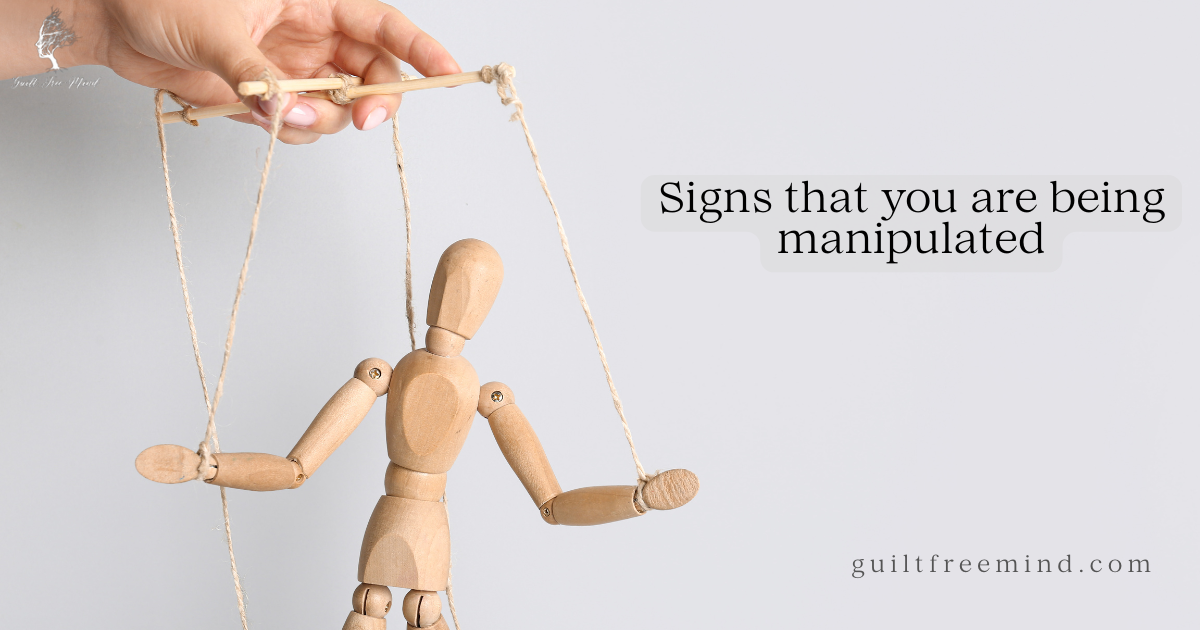
Manipulation is different. It is influence that works in hidden or unfair ways. Instead of asking openly, the manipulator plays on your emotions, insecurities, sense of duty or fear so that you do something you would not otherwise choose. The result benefits them, often at your expense.
Researchers have studied this for decades. In a classic study of couples, psychologist David Buss and colleagues identified six everyday tactics people use to get their partners to do things: charm, the silent treatment, coercion, reasoning, regression (sulking or whining) and debasement (putting oneself down to win sympathy) (Buss et al., 1987). Some of these, like honest reasoning, are perfectly healthy. Others become manipulative when they are used repeatedly to override the other person’s choices.
People who score high on a personality trait called Machiavellianism, one of the “dark triad” traits, tend to see manipulation as a normal way of getting ahead (Jones & Paulhus, 2014). But manipulation is not limited to people with dark personality traits. Anyone can slip into manipulative habits, especially if they grew up in a family where that was the only way to get needs met.
Why Manipulation Works So Well
Manipulation rarely looks like a villain twirling a moustache. It works because it hooks into feelings that are normally healthy:
- Fear, obligation and guilt. Therapist Susan Forward called these three levers “FOG” in her book Emotional Blackmail (1997). If someone can make you afraid of their reaction, feel that you owe them, or feel guilty for having needs of your own, they rarely have to ask directly.
- The wish to be fair and kind. Thoughtful people want to compromise and are willing to consider that they might be wrong.
- Love and loyalty. The good moments make you want to believe the best. When warmth and hurt alternate, the attachment can actually become stronger and harder to leave (Dutton & Painter, 1993).
- Social rules. We feel we should return favours and stay consistent with what we agreed to earlier. Compliance researchers have shown how easily these rules can be used against us (Cialdini & Goldstein, 2004).
- Power differences. When someone controls money, housing, your job or your family’s approval, disagreeing feels risky (Sweet, 2019).
So if you have been manipulated, it does not mean you are weak or foolish. It usually means you were trusting, caring or dependent on the other person, which are normal human things.
29 Signs You Are Being Manipulated
Read these as patterns, not single incidents. Everyone sulks, exaggerates or says something unkind now and then. The question is whether the behaviour keeps happening, whether it is used to get something from you, and how you feel as a result.
Signs based on guilt, fear and obligation
1. You often feel obligated, guilty or afraid
You agree to things because you would feel terrible if you did not, because you owe them, or because you are scared of how they will react. If fear, obligation and guilt are the main reasons you say yes, that is a strong warning sign.
It can sound like: “After everything I’ve done for you…”
2. Their favours always come with strings attached
They do something kind, then later use it as leverage. Reciprocity is a normal social rule, which is exactly why it can be exploited.
It can sound like: “I bought you flowers and you couldn’t even make a decent dinner?”
3. You feel guilty for raising concerns
Whenever you mention something that bothers you, you end up apologising. Research on guilt shows that people sometimes deliberately induce guilt in others to get their way, and that it often works in the short term while breeding resentment (Baumeister et al., 1994). Our guide to guilt tripping explains the signs and calm ways to respond.
It can sound like: “I can’t believe you’d accuse me of that when I’m only trying to keep you safe.”
4. They use your feelings against you
If you are upset, they make you feel guilty or selfish for being upset, or turn your feelings into proof that you do not love them.
It can sound like: “If you really loved me, you wouldn’t question me.”
5. They use ultimatums and threats
“Do this or else” is pressure, not a conversation. Threats can be loud (to leave, to tell others your secrets) or quiet and emotional.
It can sound like: “Fine. If that’s how you feel, maybe I should just leave.”
6. They play the martyr
They offer to help, then make a show of how much it costs them, so you feel indebted and guilty.
It can sound like: “Don’t worry about me. I’ll manage somehow, like I always do.”
7. They never take no for an answer
A clear “no” leads to repeated asking, sulking, anger or a new argument until you give in.
Signs that make you doubt yourself
8. You constantly question yourself
You wonder whether you remember things correctly, whether your feelings make sense, or whether you are “too sensitive”. This is one of the most important signs, because manipulation works best when you stop trusting your own mind.
9. They deny things they said or did
They say something hurtful or promise something, then later insist it never happened. This is a form of gaslighting.
It can sound like: “I never said that. You’re imagining things.”
10. They twist the facts
They exaggerate, leave out key details or retell events so that they come out as the victim and you as the problem.
11. They make you question your sanity
They suggest you are forgetful, unstable or “losing it”, sometimes to other people too. If this is happening, our guide on how to respond to gaslighting has scripts you can use.
It can sound like: “Everyone knows how to work this. What’s wrong with you?”
12. Everything is somehow your fault
No matter what happens, the blame lands on you, even for their own choices.
It can sound like: “I told you that job was a bad idea. You brought this on yourself.”
13. They refuse to take responsibility
When confronted, they deny, attack you, and then present themselves as the real victim. Psychologist Jennifer Freyd named this pattern DARVO: Deny, Attack, Reverse Victim and Offender (Freyd, 1997). In experiments, DARVO made genuine victims seem less believable to onlookers, although learning about the tactic reduced its effect (Harsey & Freyd, 2020).
14. They hide behind “just joking”
A hurtful comment is followed by “Relax, I was only joking,” which leaves you feeling oversensitive for being hurt.
Signs of pressure and control
15. The “foot in the door”
They start with a small, reasonable request and build up to bigger ones. In a classic experiment, people who first agreed to a small request were far more likely to agree to a much larger one later (Freedman & Fraser, 1966).
16. The “door in the face”
The opposite trick: they make an outrageous request, you refuse, and then their “smaller” request (the one they wanted all along) seems reasonable. Researchers found that people who had just turned down a big request were more likely to agree to a smaller one (Cialdini et al., 1975).
17. They insist on their home ground
They arrange for important conversations to happen where they feel powerful, such as their home or office, so you feel like a guest on their territory.
18. They rush closeness
They skip the usual getting-to-know-you stage with intense flattery, constant contact and declarations that you are “meant to be”. Fast intimacy can be lovely, but when it is used to lower your guard, it is a red flag.
It can sound like: “I’ve never connected with anyone like this. We’re the same person.”
19. They let you speak first, then use it
They ask lots of questions and say little about themselves, then use what you revealed to steer you or to find your weak spots.
20. They keep rephrasing the same question
They ask the same thing in different ways until they get the answer they want or catch you in a “contradiction”.
21. Intellectual bullying
When you ask a simple question, they bury you in jargon, statistics or “you wouldn’t understand”, so you defer to them.
22. Bureaucratic bullying
Common at work: they weigh you down with rules, paperwork or procedures, or make a process so hard that you give up.
23. They are calm while you are upset
They provoke you, stay cool while you lose your temper, and then point to your reaction as the real problem.
It can sound like: “I’m not the one shouting. You started all this.”
Signs of emotional games
24. The silent treatment
They go quiet, ignore your messages or withdraw affection to punish you or get their way. Being deliberately ignored is painful because it threatens basic needs such as belonging and self-esteem (Williams, 2007), and people on the receiving end describe it as deeply hurtful (Williams et al., 1998).
25. Passive aggression
Instead of saying what they want, they hint, sigh, “forget” things, or tell others about a problem instead of telling you.
26. They downplay your problems
When you share something hard, they quickly switch to how much harder things are for them.
It can sound like: “You think that’s bad? Try living my life.”
27. They steal your thunder
Your good news is met with a dig, a comparison or a story about themselves.
It can sound like: “Nice raise. I suppose everyone got one this year?”
28. Constant criticism disguised as help
They criticise how you look, cook, work or parent, always “for your own good”, until you feel you can never get anything right.
29. Tears or dramatic statements on cue
Crying is a normal human response, and many people cry when they are hurt. It becomes a concern when tears or big statements (“You’re the only one who ever loved me”, “I’ll fall apart without you”) reliably appear whenever they are challenged, and the conversation ends with you comforting them instead of being heard. Research on “emotional manipulation” shows that some people deliberately use emotional displays to influence others (Austin et al., 2007).

Is It Manipulation or Just a Difficult Moment?
Not every difficult interaction is manipulation. Here is a simple way to tell the difference:
| Healthy (even when difficult) | Manipulative |
|---|---|
| Requests are open: “Could you help me with this?” | Requests are hidden in guilt, hints or pressure |
| “No” is accepted, even if they are disappointed | “No” leads to sulking, anger or repeated pushing |
| Disagreements focus on the issue | Disagreements turn into attacks on your character |
| Both people can apologise | Only you ever apologise |
| You feel heard, even if you do not agree | You feel confused, guilty or “crazy” afterwards |
| Over time, you feel more like yourself | Over time, you feel smaller and less confident |
If most of what you experience sits in the right-hand column, trust what you are noticing.
When Manipulation Becomes Abuse
Manipulation sits on a spectrum. At the serious end, it becomes part of coercive control: a pattern of behaviour used to dominate someone through isolation, monitoring, threats, financial control and humiliation (Hamberger et al., 2017). Researchers who developed a checklist of controlling behaviours found that these tactics include economic, emotional and isolating forms of control, not only physical violence (Lehmann et al., 2012).
Warning signs that you may be dealing with abuse rather than a difficult personality include:
- you are afraid of how they will react;
- they check your phone, money or movements;
- they try to cut you off from friends or family;
- they threaten to hurt you, themselves, your children or your pets;
- they have ever pushed, grabbed, hit or physically intimidated you.
If any of these apply, please read our guide to healing from emotional abuse and talk to a helpline before confronting the person or trying to leave. Leaving can be the most dangerous time, so planning matters.
What to Do If You Are Being Manipulated
Manipulation is hard to spot at first because the early signs are subtle. Once you notice the pattern, these steps can help you take your power back.
1. Name it to yourself
Simply recognising “this is guilt-tripping” or “this is the silent treatment” takes away some of its power. You do not have to announce it to them.
2. Slow down
Manipulation thrives on urgency. You are allowed to say: “I’ll think about it and get back to you.” Never make big decisions about money, commitments or your safety under pressure.
3. Say no simply, and repeat it
You do not need a long explanation. A short “No, that doesn’t work for me” is enough. If they push, calmly repeat it. Our guide on how to learn to say no has more ideas.
4. Set clear boundaries and follow through
For example: “If you shout at me, I will leave the room.” Then do it, every time. Boundaries are about what you will do, not about controlling the other person.
5. Own only what is yours
If you made a mistake, apologise for it once and move on. But do not apologise for their choices, their moods or things you did not do. And do not try to “out-manipulate” a manipulator; it keeps you stuck in their game.
6. Keep notes
Write down what happened, with dates, and save important messages somewhere private. This is not to win an argument with them. It is an anchor for your own memory.
7. Check your reality with people you trust
Talk to a friend, relative or counsellor. Manipulation works best in isolation, and a trusted outside view can help you see clearly again.
8. Reduce how much you share
If they use what you tell them against you, keep conversations short, calm and factual. Some people call this the “grey rock” approach.
9. Get support
A counsellor or psychologist can help you untangle self-blame, rebuild confidence and decide what you want to do next. If the manipulation came from a parent, our guides to narcissistic parents and psychopathic mothers may help, and childhood patterns are explored in our article on signs of repressed childhood trauma.
Manipulation at Work
At work, manipulation can look like a boss who takes credit for your ideas, a colleague who “forgets” agreements, or someone who buries you in procedures. Helpful steps include confirming important conversations by email (“Just to confirm what we agreed today…”), keeping your own records, involving a trusted senior colleague or HR, and knowing your organisation’s grievance policy. If the person shows a wider pattern of ruthless, charming and exploitative behaviour, our guide to dealing with psychopaths covers workplace strategies in more detail.
How to Heal After Manipulation
After a manipulative relationship, it is common to feel anxious, ashamed, numb or unsure of your own judgement. Healing takes time, and small steps work best:
- Rebuild trust in yourself by making small decisions on your own and noticing that they turn out fine.
- Write things down. A short daily journal helps you see that your memory and feelings are reliable. Our self-care journal ideas are a gentle place to start.
- Spend time with people who respect your “no”. Healthy relationships quietly show you what normal feels like.
- Be kind to yourself about the past. You did the best you could with what you knew at the time.
- Consider therapy if you keep replaying conversations, feel anxious most of the time, or find it hard to trust anyone.
Where to Get Help
If you feel unsafe, controlled or overwhelmed, you do not have to handle it alone. In India, the Protection of Women from Domestic Violence Act, 2005 recognises verbal and emotional abuse as forms of domestic violence. In England and Wales, controlling or coercive behaviour in an intimate or family relationship has been a criminal offence since 2015 (Serious Crime Act 2015, section 76).
If you need to talk to someone:
- India: Emergency 112 · Women Helpline 181 · Tele-MANAS (free mental health support, 24/7) 14416 or 1-800-891-4416
- United States: National Domestic Violence Hotline 1-800-799-7233 (or text START to 88788) · 988 Suicide and Crisis Lifeline (call or text 988)
- United Kingdom: National Domestic Abuse Helpline 0808 2000 247 · Samaritans 116 123
- Anywhere: If you are in immediate danger, call your local emergency number.
Conclusion
Manipulation is not always easy to spot, but your feelings are good clues. If you often leave conversations feeling guilty, confused or smaller than before, take that seriously. You do not have to prove anything to the other person, win every argument or diagnose their personality. You only need to notice the pattern, protect your boundaries and surround yourself with people who let you be yourself.
If this article helped, you might enjoy our gentle weekly newsletter on healing and emotional wellbeing: join the Guilt Free Mind community.
See you in my next blog post,
Dr. Shruti
Frequently Asked Questions
Common signs include feeling guilty, afraid or obligated around them, favours that always come with strings attached, being blamed for everything, having your memory or feelings questioned, ultimatums, the silent treatment, and pressure that continues until you give in. A repeated pattern matters more than any single incident.
Guilt-tripping, playing the victim, gaslighting (denying what happened), the silent treatment, flattery or rushed closeness, ultimatums, twisting facts, and techniques such as foot-in-the-door and door-in-the-face that use small or large requests to make you agree.
Yes. Some people learned manipulative habits in childhood and use them without much awareness. Their intention may differ, but the effect on you is still real, and you still have the right to set boundaries.
Slow down, avoid making decisions under pressure, say no briefly and repeat it if needed, set clear boundaries and follow through, keep notes, and check your perceptions with people you trust. Avoid long explanations or trying to manipulate them back.
When it is repeated and used to control, frighten or undermine someone, emotional manipulation is a form of psychological abuse, and it is often part of coercive control. If you feel afraid or controlled, contact a helpline and plan for your safety.
It is not your fault. Kind, loyal and conscientious people are often targeted because they try hard to be fair and to keep the peace. Past experiences, such as growing up with critical or controlling caregivers, can also make manipulation feel familiar. Therapy can help you spot red flags earlier and feel comfortable with firm boundaries.
About the Author
Dr. Shruti Bhattacharya is the founder and heart of Guilt Free Mind, where she combines a Ph.D. in Immunology with advanced psychology training to deliver science-backed mental health strategies. Her mission is to empower readers to overcome stress, anxiety, and emotional challenges with practical, evidence-based tools. Dr. Bhattacharya’s unique blend of expertise and empathy shapes her approach to wellness:
- Academic & Scientific Rigor – Holding a Ph.D. in Immunology and a Bachelor’s degree in Microbiology, Dr. Bhattacharya brings a deep understanding of the biological foundations of mental health, including the gut-brain connection. Her completion of psychology courses, such as The Psychology of Emotions: An Introduction to Embodied Cognition, from University of Cambridge enhances her ability to bridge science and emotional well-being.
- Dedicated Mental Health Advocacy – With over 15 years of experience, Dr. Bhattacharya has supported hundreds of individuals through online platforms and personal guidance, helping them navigate mental health challenges with actionable strategies. Her work has empowered readers to adopt holistic practices, from mindfulness to nutrition, for lasting resilience.
- Empathetic Connection to Readers – Known for her compassionate and relatable voice, Dr. Bhattacharya is a trusted guide in mental health, turning complex research into accessible advice. Her personal journey as a trauma survivor fuels her commitment to helping others find calm and confidence.
- Lifelong Commitment to Wellness – Dr. Bhattacharya lives the principles she shares, integrating science-based habits like balanced nutrition and stress management into her daily life. Her personal exploration of mental health strategies inspires Guilt Free Mind’s practical, reader-focused content.
🏆 Guilt Free Mind was named one of the Top 100 Mental Health Blogs on Feedspot in 2025.

Follow me on:
Disclaimer: This content is for informational purposes only and is not a substitute for professional medical advice.
References
- Austin, E. J., Farrelly, D., Black, C., & Moore, H. (2007). Emotional intelligence, Machiavellianism and emotional manipulation: Does EI have a dark side? Personality and Individual Differences, 43(1), 179–189. https://doi.org/10.1016/j.paid.2006.11.019
- Baumeister, R. F., Stillwell, A. M., & Heatherton, T. F. (1994). Guilt: An interpersonal approach. Psychological Bulletin, 115(2), 243–267. https://doi.org/10.1037/0033-2909.115.2.243
- Buss, D. M., Gomes, M., Higgins, D. S., & Lauterbach, K. (1987). Tactics of manipulation. Journal of Personality and Social Psychology, 52(6), 1219–1229. https://doi.org/10.1037/0022-3514.52.6.1219
- Cialdini, R. B., & Goldstein, N. J. (2004). Social influence: Compliance and conformity. Annual Review of Psychology, 55, 591–621. https://doi.org/10.1146/annurev.psych.55.090902.142015
- Cialdini, R. B., Vincent, J. E., Lewis, S. K., Catalan, J., Wheeler, D., & Darby, B. L. (1975). Reciprocal concessions procedure for inducing compliance: The door-in-the-face technique. Journal of Personality and Social Psychology, 31(2), 206–215. https://doi.org/10.1037/h0076284
- Dutton, D. G., & Painter, S. (1993). Emotional attachments in abusive relationships: A test of traumatic bonding theory. Violence and Victims, 8(2), 105–120. https://doi.org/10.1891/0886-6708.8.2.105
- Forward, S., & Frazier, D. (1997). Emotional Blackmail: When the People in Your Life Use Fear, Obligation, and Guilt to Manipulate You. HarperCollins.
- Freedman, J. L., & Fraser, S. C. (1966). Compliance without pressure: The foot-in-the-door technique. Journal of Personality and Social Psychology, 4(2), 195–202. https://doi.org/10.1037/h0023552
- Freyd, J. J. (1997). Violations of power, adaptive blindness and betrayal trauma theory. Feminism & Psychology, 7(1), 22–32. https://doi.org/10.1177/0959353597071004
- Hamberger, L. K., Larsen, S. E., & Lehrner, A. (2017). Coercive control in intimate partner violence. Aggression and Violent Behavior, 37, 1–11. https://doi.org/10.1016/j.avb.2017.08.003
- Harsey, S., & Freyd, J. J. (2020). Deny, attack, and reverse victim and offender (DARVO): What is the influence on perceived perpetrator and victim credibility? Journal of Aggression, Maltreatment & Trauma, 29(8), 897–916. https://doi.org/10.1080/10926771.2020.1774695
- Jones, D. N., & Paulhus, D. L. (2014). Introducing the Short Dark Triad (SD3): A brief measure of dark personality traits. Assessment, 21(1), 28–41. https://doi.org/10.1177/1073191113514105
- Lehmann, P., Simmons, C. A., & Pillai, V. K. (2012). The validation of the Checklist of Controlling Behaviors (CCB): Assessing coercive control in abusive relationships. Violence Against Women, 18(8), 913–933. https://doi.org/10.1177/1077801212456522
- Sweet, P. L. (2019). The sociology of gaslighting. American Sociological Review, 84(5), 851–875. https://doi.org/10.1177/0003122419874843
- Williams, K. D. (2007). Ostracism. Annual Review of Psychology, 58, 425–452. https://doi.org/10.1146/annurev.psych.58.110405.085641
- Williams, K. D., Shore, W. J., & Grahe, J. E. (1998). The silent treatment: Perceptions of its behaviors and associated feelings. Group Processes & Intergroup Relations, 1(2), 117–141. https://doi.org/10.1177/1368430298012002
- Government of India. (2005). The Protection of Women from Domestic Violence Act, 2005.
- UK Government. (2015). Serious Crime Act 2015, section 76: Controlling or coercive behaviour in an intimate or family relationship. legislation.gov.uk

1 Comment
Your point of view caught my eye and was very interesting. Thanks. I have a question for you.