

Try This Now: 1-Minute Deep Breathing for Anxiety
Feeling anxious right now? Take 1 minute to inhale deeply for 4 seconds, hold for 4, and exhale for 6. Slowing your breath like this, with a longer out-breath, can help settle your body’s stress response—try it and notice how you feel. Watch our 1-minute 4-7-8 breathing video or listen to the audio guide below for guided practice.
Discover the gentle power of deep breathing for anxiety to calm your mind and reclaim a sense of peace. Anxiety can creep in during busy days or overwhelming moments, leaving you searching for relief. Deep breathing offers a simple, accessible tool, backed by research, to ease those feelings and build resilience. Whether it’s a racing heart, overthinking or scattered thoughts, this technique can be your ally. Let’s explore how it works.
Quick answer: Deep breathing for anxiety means breathing slowly into your belly, usually with a longer out-breath than in-breath, which switches on the body’s calming (parasympathetic) response. A meta-analysis of randomized trials found breathwork led to small-to-medium reductions in stress and anxiety (Fincham et al., 2023), and five minutes a day of exhale-focused “cyclic sighing” improved mood in a one-month study (Balban et al., 2023). It is a helpful skill, not a cure: if anxiety is frequent or severe, talk to a doctor or therapist.
Table of Contents
What Is Deep Breathing for Anxiety Relief?
Deep breathing for anxiety is a technique where you intentionally slow and deepen your breath to activate the body’s relaxation response, countering the fight-or-flight mode triggered by stress. Unlike quick, shallow breaths that heighten anxiety, deep breathing for anxiety engages the diaphragm, lowering heart rate and calming the nervous system. A 2023 Stanford study found that five minutes a day of cyclic sighing (a deep breathing pattern with a long exhale) improved mood more than mindfulness meditation (Balban et al., 2023). Many people find it a lifeline during tense moments, and it’s rooted in practices like yoga and mindfulness, making it versatile for daily use.
How to Do Deep Breathing for Anxiety Relief: Step-by-Step Guide
Learning how to do deep breathing for anxiety relief is straightforward and empowering. Here’s a step-by-step breathing exercise for anxiety to try:
- Sit or lie down in a quiet space.
- Place one hand on your chest, the other on your belly.
- Inhale deeply through your nose for 4 seconds, feeling your belly rise.
- Hold your breath for 4 seconds.
- Exhale slowly through your mouth for 6 seconds, letting tension melt away.
- Repeat for 5 minutes.
This method helps reset your mind during anxious moments. Practice it daily, when you’re calm, so it comes more easily when you need it.
A one-page tracker with spaces to log daily deep breathing sessions, 4-7-8 practice, and mood notes. Sign up to receive this free resource.
Does Deep Breathing Help with Panic Attacks?
Does deep breathing help with panic attacks? It can help many people ride out the physical rush of panic, such as a tight chest or racing heart, by slowing the breath and switching on the body’s calming response. In a study comparing daily five-minute breathing practices, exhale-focused “cyclic sighing” improved mood and lowered breathing rate more than mindfulness meditation did (Balban et al., 2023). If panic attacks are frequent, cognitive behavioral therapy has the strongest evidence, and breathing skills work best as one part of it.
Step-by-Step Breathing Exercises for Anxiety: A Practical Approach
Step-by-step breathing exercises for anxiety offer structure for my readers. Try the 4-7-8 technique:
- Inhale quietly through your nose for 4 seconds.
- Hold for 7 seconds.
- Exhale slowly through your mouth for 8 seconds.
- Repeat 4 times.
Basic Techniques
4-7-8 Technique
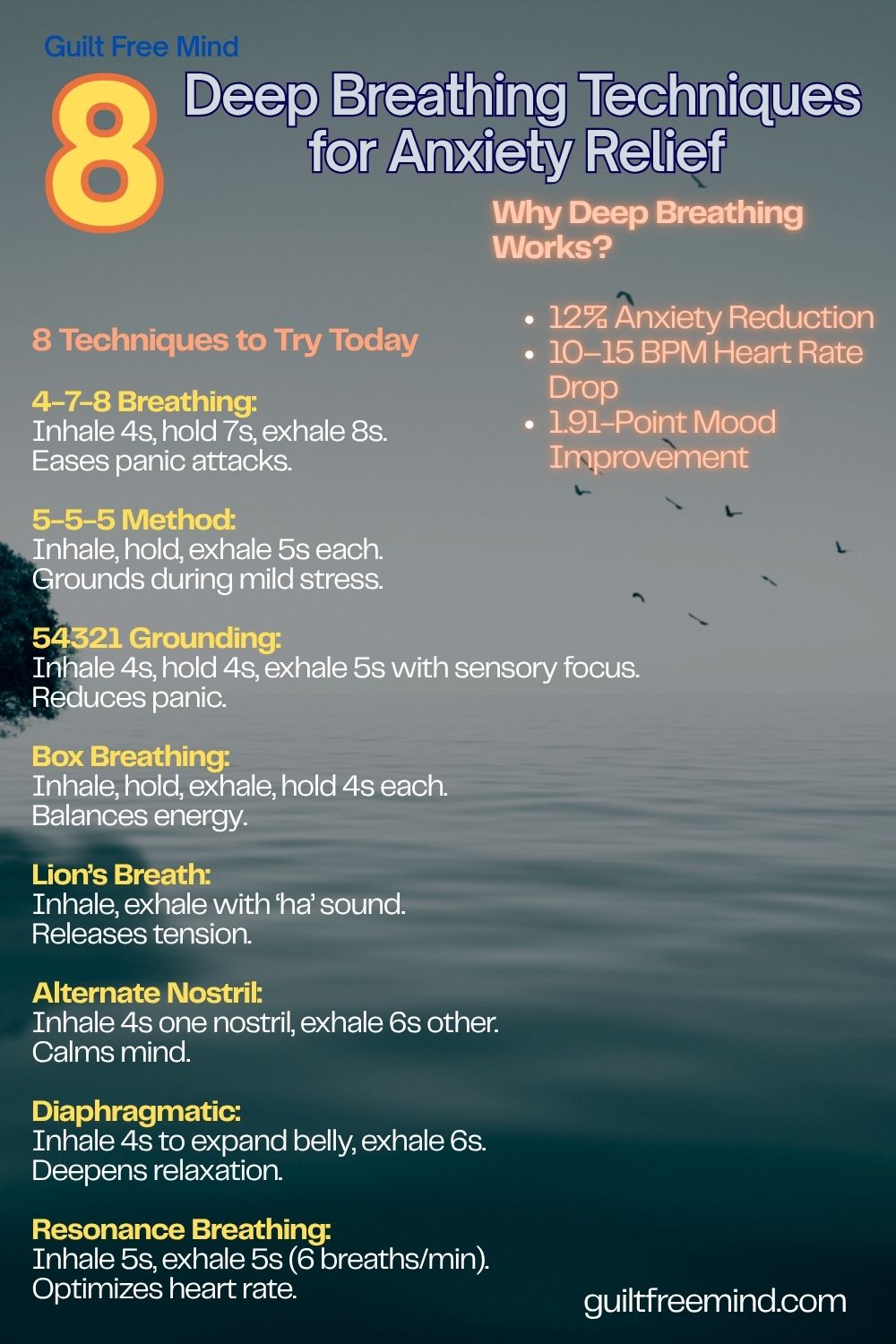
- Steps: Inhale quietly through your nose for 4 seconds, hold for 7, exhale for 8. Repeat 4 times.
- Benefits: Slows your breathing and can help during panic attacks.
Practicing slow breathing regularly, not only in a crisis, tends to bring the most benefit, because your body learns the calm response over time.
5-5-5 Method
- Steps: Inhale for 5 seconds, hold for 5, exhale for 5. Repeat 5 times.
- Benefits: Grounds you during mild stress, such as travel delays.
54321 Grounding Breath
- Steps: Inhale for 4, hold for 4, exhale for 5 while naming 5 things you see, 4 you touch, 3 you hear, 2 you smell, 1 you taste.
- Benefits: Eases panic by engaging your senses.
Advanced Techniques
Box Breathing
- Steps: Inhale for 4 seconds, hold for 4, exhale for 4, hold for 4. Repeat 5 cycles.
- Benefits: Simple, easy to remember and widely taught to people in high-pressure jobs; helpful for acute anxiety.
Lion’s Breath
- Steps: Inhale deeply through your nose, then exhale forcefully through your mouth with a “ha” sound, opening your eyes and mouth wide. Repeat 3–5 times.
- Benefits: Releases tension and can lift your mood.
Alternate Nostril Breathing
- Steps: Close your right nostril, inhale through the left for 4 seconds, close the left, exhale through the right for 6. Switch and repeat 5 times.
- Benefits: Calms the mind; many people find it grounding during conflict.
Diaphragmatic Breathing
- Steps: Lie down, place a hand on your belly, inhale for 4 seconds to expand your belly, exhale for 6. Repeat for 5 minutes.
- Benefits: Deepens relaxation and eases stress.
Resonance Breathing
- Steps: Inhale for 5 seconds, exhale for 5 seconds, aiming for 6 breaths per minute. Repeat for 5 minutes.
- Benefits: Optimizes heart rate variability, reducing anxiety.
Slow breathing at around six breaths per minute (resonance breathing) is linked to higher heart rate variability, a sign of a calmer, more flexible nervous system (Zaccaro et al., 2018).
Pursed-Lip Breathing
- Steps: Inhale through nose for 2 seconds, exhale through pursed lips for 4 seconds. Repeat 5 times.
- Benefits: Slows your breathing rate and can help when you feel short of breath. Cleveland Clinic explains it is often used to make breathing easier, especially for people with COPD.
Pin this article for later:
Calming Techniques Using Deep Breathing: Beyond the Basics
Calming techniques using deep breathing go beyond the basics. The 5-5-5 method involves inhaling for 5 seconds, holding for 5 and exhaling for 5, which suits moments of mild stress. Another technique, alternate nostril breathing, switches nostrils with each breath, and many people find it grounding during conflict. WebMD highlights its versatility for different anxiety levels.
Deep Breathing Routine for Stress Management: Build Your Habit
A deep breathing routine for stress management can transform your day. Start with 5 minutes morning and evening:
- Morning: Start with 4-7-8 breathing for 5 minutes to set a calm tone.
- Midday break: Use the 5-5-5 method for 2 minutes during lunch to reset.
- Evening: End with diaphragmatic breathing for 5 minutes to unwind.
Consistency matters: a short daily practice tends to help more than occasional long sessions.
Deep Breathing Anxiety Exercises: Techniques to Try
Deep breathing anxiety exercises give you options. Box breathing (inhale 4, hold 4, exhale 4, hold 4) works well for acute anxiety, for example during a flight delay or before a difficult conversation. Its simplicity makes it usable anywhere.
Scientific Backing
Deep breathing is science-supported:
- A meta-analysis of randomized trials found breathwork led to small-to-medium reductions in self-reported stress and anxiety (Fincham et al., 2023).
- In a one-month study, five minutes a day of exhale-focused cyclic sighing improved mood and lowered breathing rate more than mindfulness meditation (Balban et al., 2023).
- Slow breathing at around six breaths per minute is linked to higher heart rate variability and greater “rest and digest” (parasympathetic) activity (Zaccaro et al., 2018).
Belly Breathing for Anxiety: A Deeper Dive
Deep belly breathing engages the diaphragm for deeper calm. Inhale, letting your belly expand, then exhale fully. A meta-analysis of randomized trials found that breathwork led to small-to-medium reductions in self-reported stress and anxiety (Fincham et al., 2023).
Comparison Table: Deep Breathing vs. Other Anxiety Techniques
Wondering how deep breathing for anxiety compares? This table helps my readers choose:
| Technique | Steps | Benefits | Best For |
|---|---|---|---|
| 4-7-8 | Inhale 4, hold 7, exhale 8 | Slows the breath; little research on 4-7-8 itself | Winding down, sleep |
| 5-5-5 | Inhale, hold, exhale 5 | Grounds during mild stress | Daily stress |
| 5-4-3-2-1 grounding | Name 5 things you see, 4 you can touch, 3 you hear, 2 you smell and 1 you taste, while breathing slowly | Moves attention from anxious thoughts to the present (a grounding skill, not a breathing pattern) | Acute anxiety |
| Box Breathing | Inhale, hold, exhale, hold 4 | Gives the breath a steady, predictable rhythm | Acute anxiety |
| Lion’s Breath | Inhale, exhale with “ha” | Releases face and jaw tension | Tension relief |
| Resonance | Inhale 5, exhale 5 (6 breaths/min) | Linked to higher heart rate variability (Zaccaro et al., 2018) | Chronic stress |
| Pursed-Lip | Inhale 2, exhale 4 through pursed lips | Slows breathing; often taught for breathlessness in COPD | Feeling short of breath |
| Meditation | 5-minute mindfulness focus | Builds the habit of noticing thoughts without reacting | Daily practice |
| Journaling | Write thoughts for 10 minutes | Helps you put worries into words | Emotional clarity |
Deep breathing shines for its ease, per WebMD.
Everyday Moments to Use Deep Breathing
Here are a few everyday moments where these techniques can help:
- During a child’s tantrum, 4-7-8 breathing can help a parent stay composed.
- Before an exam or interview, box breathing can ease nerves.
- After difficult news, the 5-5-5 method can help you steady yourself.
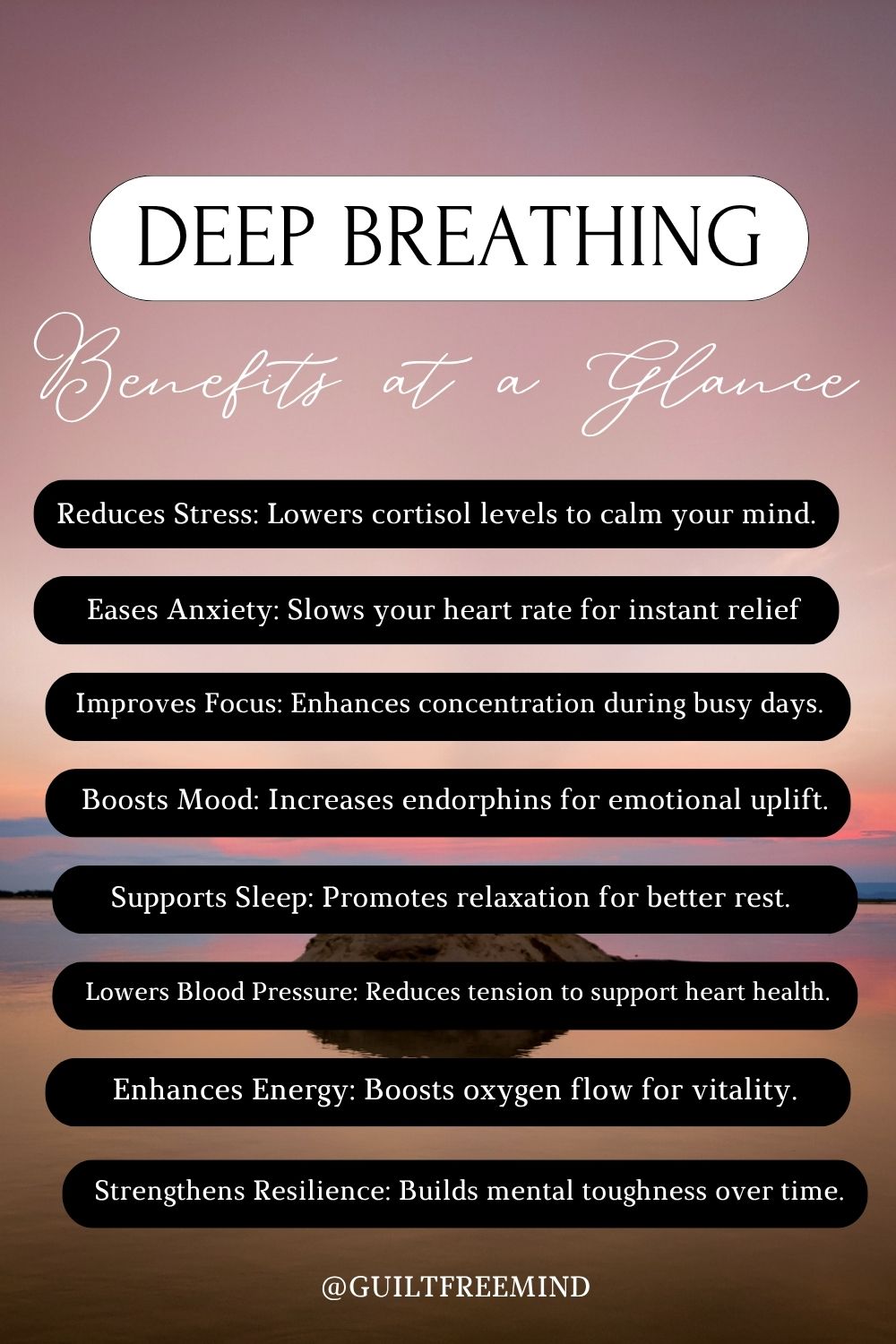
Deep Breathing Benefits at a Glance
The infographic below sums up the main benefits: a calmer body, steadier focus and less stress. Research supports these effects, with breathwork producing small-to-medium reductions in stress and anxiety in randomized trials (Fincham et al., 2023).
Expert Insights on Deep Breathing for Anxiety
Dr. Andrew Weil, a pioneer in integrative medicine who popularized the 4-7-8 technique, describes it as a natural tranquilizer for the nervous system. Research on 4-7-8 specifically is still limited, but slow-breathing practices in general show consistent calming effects (Zaccaro et al., 2018).
When Not to Use Deep Breathing
While deep breathing for anxiety is a powerful tool for most, it’s not always suitable for everyone. Here are a few instances to approach with caution:
- Pregnancy: Gentle slow breathing is usually fine, but skip long breath-holds and ask your midwife or doctor if you are unsure which exercises suit you.
- Asthma, COPD or other lung conditions: Some techniques, such as pursed-lip breathing, are often taught for COPD, while long breath-holds may not suit everyone. Ask your doctor or respiratory team which exercises are right for you.
- Recent surgery or injury: Ask your care team which breathing exercises suit your recovery, especially after chest or abdominal surgery.
- Panic Attack Peak: If anxiety escalates to hyperventilation, slow breathing may initially feel overwhelming—try grounding techniques first.
- Dizziness or more anxiety: If a breathing exercise makes you light-headed, tingly or more anxious, stop and let your breathing return to its normal rhythm.
If you’re unsure, always put your safety first and talk to a healthcare professional, so that deep breathing works as a safe, supportive practice for you.
When to Get Help
Breathing exercises are a useful self-help skill, but on their own they are not a treatment for an anxiety disorder. Talk to a doctor or mental health professional if anxiety or panic attacks happen often, stop you doing everyday things, or keep getting worse. Cognitive behavioral therapy for anxiety has the strongest evidence, and breathing skills fit well inside it.
If you are in crisis or thinking about harming yourself, please reach out now:
- United States: call or text 988 (Suicide & Crisis Lifeline)
- India: Tele-MANAS 14416 (free, 24/7); emergency 112
- UK and Ireland: Samaritans 116 123
- Elsewhere: your local emergency number
Explore More on Guilt Free Mind
I’m not just here to teach you deep breathing for anxiety — I’m here to guide you toward a guilt-free, empowered mind with comprehensive mental wellness resources.
- ✔️ Mindful Productivity and Focus Hub: Enhance focus for a stress-free life
- ✔️ Stress Depression and Anxiety Hub: Learn proven techniques to reduce stress
- ✔️ Emotional Recovery and Resilience Hub: Build resilience for a balanced mind
- ✔️ Creative Healing and Therapy Hub: Deepen your knowledge of mental well-being
- ✔️ Self-Care and Wellness Hub: Nurture your mind with daily practices
- ✔️ Understanding Personality Disorders Hub: Nurture your mind with daily practices
These resources complement your journey with deep breathing for anxiety, offering tools to foster mental clarity, resilience, and peace through Guilt Free Mind’s holistic approach.
Breathe Easy with Guilt Free Mind
I’d love to hear your experiences! Have you tried deep breathing for anxiety? Share your story in the comments below—your insights could inspire others on their journey. Ready to make deep breathing part of your self-care routine? 🌿 You deserve a guilt-free mind, and I’m here to help! Download my Free Deep Breathing for Anxiety tracker and start practicing today. Subscribe to my blog for weekly mental health insights, and join my YouTube channel, Guilt Free Mind, for curated playlists and self-care videos. Start your calm journey with deep breathing today—your peace awaits! ✨
FAQs About Deep Breathing for Anxiety
Deep breathing for anxiety can’t eliminate it fully but significantly reduces its intensity. Research suggests regular breathwork leads to small-to-medium reductions in stress and anxiety, so it can offer real relief when practiced regularly.
The 4-7-8 technique is a slow-breathing pattern many people use to wind down before sleep or a stressful moment; research on 4-7-8 itself is limited. Inhale for 4 seconds, hold for 7, exhale for 8. Many people use it to calm pre-exam or pre-meeting nerves.
The 5-5-5 method involves inhaling, holding, and exhaling for 5 seconds each, ideal for mild anxiety.
The 3-3-3 trick is naming 3 things you see, hear, and touch while breathing deeply.
The 54321 theory is a grounding exercise: name 5 things you see, 4 you can touch, 3 you hear, 2 you smell, 1 you taste, paired with deep breathing.
There is no single best technique. Slow breathing with a longer exhale, such as cyclic sighing or resonance breathing (about six breaths a minute), has the most research behind it, and grounding skills like 5-4-3-2-1 can help too.
Practice 5-10 minutes daily, or as needed during anxiety spikes. Morning and evening sessions are easy times to build the habit.
About the Author
Hi, I’m Dr. Shruti Bhattacharya, a Ph.D. in Immunology, mental health advocate, and the sole creator behind Guilt Free Mind. My doctoral research explored how stress-related immune proteins like Tenascin C and MRP8/14 influence chronic spinal conditions such as spondyloarthropathy—research that deepened my understanding of how the body’s stress response affects overall well-being. I now use this scientific insight to craft practical, evidence-based mental health content focused on emotional healing, resilience, and self-care. Every article is personally researched, written, and reviewed by me to maintain accuracy and compassion. Guilt Free Mind follows strict self-imposed editorial standards, and your privacy is protected under our SSL-secured policy.

References
- Balban, M. Y., Neri, E., Kogon, M. M., et al. (2023). Brief structured respiration practices enhance mood and reduce physiological arousal. Cell Reports Medicine, 4(1), 100895. https://doi.org/10.1016/j.xcrm.2022.100895
- Bentley, T. G. K., D’Andrea-Penna, G., Rakic, M., Arce, N., LaFaille, M., Berman, R., Cooley, K., & Sprimont, P. (2023). Breathing practices for stress and anxiety reduction: Conceptual framework of implementation guidelines based on a systematic review of the published literature. Brain Sciences, 13(12), 1612. https://doi.org/10.3390/brainsci13121612
- Fincham, G. W., Strauss, C., Montero-Marin, J., & Cavanagh, K. (2023). Effect of breathwork on stress and mental health: A meta-analysis of randomised-controlled trials. Scientific Reports, 13, 432. https://doi.org/10.1038/s41598-022-27247-y
- Zaccaro, A., Piarulli, A., Laurino, M., et al. (2018). How breath-control can change your life: A systematic review on psycho-physiological correlates of slow breathing. Frontiers in Human Neuroscience, 12, 353. https://doi.org/10.3389/fnhum.2018.00353
