


Last Updated On: January 18, 2026
I never thought I’d write about this topic, but after receiving hundreds of messages from readers sharing their experiences on dealing with psychopaths, I realized we need to have this conversation. These weren’t just stories about difficult colleagues or challenging relationships – they revealed patterns that went far deeper and were far more disturbing.
Table of Contents
Dealing with Psychopaths: Why This Matters to Everyone
Let me share Anna’s story, which arrived in my inbox last month. “I always prided myself on seeing the best in people,” she wrote. “That’s how I ended up working closely with someone who nearly destroyed our entire department. They were brilliant at managing impressions – senior management loved them. But behind the scenes, they systematically undermined everyone who could expose their tactics. By the time we realized what was happening, they’d already secured a promotion and left a trail of broken relationships behind.”

Anna’s experience isn’t unique. In fact, dealing with psychopaths is more common than most people realize, and it doesn’t always look like what we see in movies or true crime documentaries (UChicago News, 2025).
I think a lot of psychopaths are just geniuses who drove so fast that they lost control.”
Criss Jami (Philosopher and Author)
At a Glance: Dealing with Psychopaths
| Aspect | Key Takeaways | Quick Action / Reminder |
|---|---|---|
| Prevalence | ~1% show strong psychopathic traits globally; up to 15% show subclinical patterns | In a group of 100 people, several may display these behaviors |
| Core Red Flags | Superficial charm, inconsistent stories, boundary testing, love bombing, no genuine remorse | Trust your gut feeling — it often notices before your mind does |
| Manipulation Cycle | 1. Assessment → 2. Manipulation (create dependency) → 3. Exploitation (gaslight & discard) | The cycle repeats unless you interrupt it early |
| Most Common Workplace Signs | Credit stealing, high team turnover, charm only for superiors, zero accountability | Document everything — patterns protect you more than words |
| Best Protection Strategies | Document interactions, set firm boundaries, control information flow, focus on actions not promises | No contact is usually the safest long-term path |
| Can They Change? | Core traits (lack of empathy, remorse) are highly resistant to change in adults | Focus on your safety and healing — not on fixing them |
| Recovery Focus | Validate your experience, rebuild self-trust, release guilt, strengthen boundaries | Healing is possible — be gentle with yourself |
| When to Seek Help | Immediate danger, severe anxiety, self-doubt, or if patterns escalate | Contact trusted support, HR (work), or a mental health professional |
| One Most Important Truth | You are not crazy, too sensitive, or to blame — manipulation is designed to make you doubt yourself | Your peace is worth protecting |
Understanding the Reality of Psychopathic Behavior
Here’s what surprised me most during my research: psychologists estimate that about 1% of the population shows strong psychopathic traits, but up to 15% exhibit what they call “subclinical” psychopathic behaviors. As per 2025 stats, the prevalence of significant psychopathic traits is 1-5% in adults, with genetics accounting for 50%. A 2025 meta-analysis estimates 4.5% in general population. The 2026 projections state that mental health impacts from psychopathy-like traits contribute to broader disorders affecting over 1 billion globally, with calls for early intervention (WHO, 2025).
Think about that – in a typical office of 100 people, up to 15 individuals might display these concerning patterns of behavior.
In the United States specifically, research from the American Psychological Association estimates that about 1.2% of adult men and 0.3–0.7% of adult women show clinically significant levels of psychopathic traits. A comprehensive meta-analysis of studies puts the overall prevalence in the general adult population at around 4.5%, though this can drop to about 1.2% when using the most rigorous assessment tools like the PCL-R. These numbers remind us that while the traits are not extremely common, they do appear in everyday settings — including workplaces — more often than most people realize.
Check out this web story for a quick overview:
What I’ve learned from both research and hundreds of reader stories:
- Psychopathic behavior exists on a spectrum – not everyone who shows these traits is a criminal.
- Many successful professionals with these traits are experts at creating positive first impressions.
- The damage they cause often isn’t obvious until you’ve already been pulled into their orbit (Daniel Rousseau, 2025).
- Their influence can be particularly devastating in professional settings where reputation matters.
“Psychopaths juggle multiple partners in their tireless pursuit of their top goals: pleasure, dominance and entertainment.”
Dr. Paul Babiak (Co-author of ‘Snakes in Suits’)
US-based research on workplace dynamics has found that traits like boldness and manipulativeness — often linked to psychopathy — tend to be over-represented among corporate leaders and executives compared to the average population. This can contribute to toxic team environments and high turnover in departments they lead.
Psychopathy vs Sociopathy: Understanding the Distinctions
While often used interchangeably, key differences exist:
- Psychopathy: Innate traits; calculated, charming, and organized; low anxiety; blends in well (e.g., corporate roles).
- Sociopathy: Often environmentally influenced (e.g., trauma); impulsive, erratic, and prone to rage; struggles with attachments. Both fall under Antisocial Personality Disorder, but psychopathy is more genetic (50% heritability per studies), while sociopathy is nurture-based (Simply Psychology, 2024).
The Real-World Impact
Consider James’s experience in a startup environment: “This new team leader joined and immediately became everyone’s favorite person. They had an answer for everything, charmed every investor, and seemed to work miracle hours. Six months later, we discovered they’d been taking credit for other people’s work, manipulating performance metrics, and playing team members against each other. When confronted with evidence, they showed zero remorse – instead, they had perfectly crafted explanations that made the whistleblowers look like the problem.”
This isn’t just about dealing with difficult people or office politics. We’re talking about systematic patterns of manipulation that can affect every aspect of your life – professional, personal, and everything in between.
Something else I’ve noticed from the hundreds of stories I’ve received: victims often blame themselves. “I should have seen it sooner,” they say. But here’s the truth: these individuals are experts at manipulation, and self-doubt is one of their most powerful weapons.
In the next section, I’ll share specific signs to watch for and practical strategies to protect yourself. Because while we can’t change how these people operate, we can certainly get better at recognizing and dealing with psychopaths in our daily lives.
Part 2: Identifying Psychopathic Behavior – Beyond the Surface Charm
After receiving overwhelming responses to the first part of this series, I want to share something that struck me: almost every story began with “They seemed so perfect at first.” This pattern isn’t a coincidence – it’s actually one of the most reliable warning signs when dealing with psychopaths in everyday situations.

The Mask of Normality
Last week, I spoke with Rachel, a small business owner who nearly lost everything to a seemingly perfect business partner. “They swept in like a whirlwind of charisma and big ideas,” she recalled. “Within weeks, they knew everyone’s personal stories and vulnerabilities. Looking back, I realize they were gathering ammunition, not building friendships.”
Signs of a Corporate Psychopath
In workplace settings, psychopaths often thrive due to their charisma and ruthlessness. Based on reader stories and research, here are key signs:
- Superficial Charm in Meetings: They excel at impressing superiors with polished presentations but show disdain for peers.
- Credit-Stealing and Sabotage: Frequently take ideas from others or undermine colleagues to advance.
- Lack of Accountability: When projects fail, they blame teams or external factors without remorse.
- Manipulative Networking: Build alliances with influential figures while isolating potential threats.
- High Turnover in Their Teams: Departments they lead often see high employee burnout or resignations due to toxic dynamics (Research Gate, 2021; PMC, 2021).
From 2025 studies, up to 4% of corporate leaders may exhibit these traits, contributing to toxic work cultures.
Here’s what experts and real experiences tell us to watch for:
Immediate Red Flags
- Love bombing: Excessive flattery and attention that feels too good to be true
- Inconsistent stories: Details change depending on who they’re talking to. (https://www.psychologytoday.com/us/blog/mindmelding/201706/9-clues-that-you-may-be-dealing-with-a-psychopath)
- Status obsession: Treating people differently based on their perceived usefulness
- Boundary testing: Small violations that gradually escalate
Mark, a corporate manager, shared his experience: “I noticed they’d throw subtle jabs disguised as jokes, always testing how much they could get away with. When called out, they’d say ‘You’re too sensitive’ or ‘Can’t you take a joke?’ Classic manipulation.”
The Pattern of Manipulation
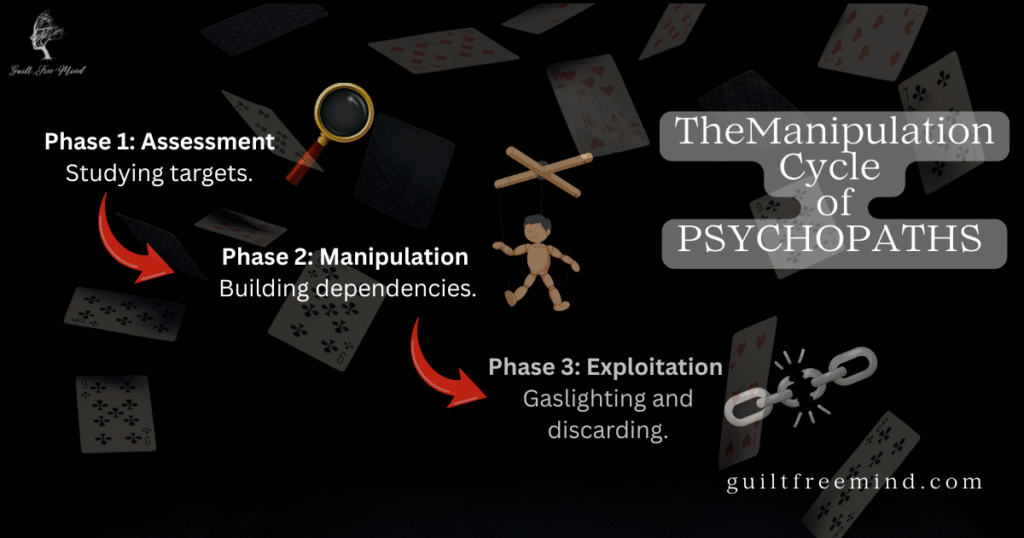
Understanding how psychopaths operate means recognizing their typical behavioral patterns. From countless reader experiences and expert research, here’s what emerges:

Phase 1: Assessment
They study their environment and potential targets, particularly focusing on:
- Who has power or influence
- Who seems vulnerable or lonely
- Who might become a potential threat
Phase 2: Manipulation
- Creating dependencies through favors or emotional support
- Isolating targets from their support systems
- Using gathered information as leverage
- Playing people against each other
Phase 3: Exploitation
- Taking credit for others’ work
- Using people’s vulnerabilities against them
- Gaslighting when confronted
- Discarding people who no longer serve a purpose
“Psychopaths view any social exchange as a ‘feeding opportunity,’ a contest or a test of wills in which there can be only one winner. Their motives are to manipulate and take what they want.”
Dr. Robert Hare (Psychopathy Expert
Real Signs in Everyday Situations
Sarah, a team leader at a tech company, shared this insight: “I started documenting everything when I noticed how meetings would go one way, but their follow-up emails would tell a completely different story. It wasn’t misunderstanding – it was a deliberate manipulation of facts.”
Key behaviors to watch for:
- Actions consistently contradicting words
- Selective mistreatment of those with less power
- Inability to accept criticism or blame
- Superficial charm that doesn’t extend to genuine kindness
- Strategic friendship-building with influential people
The Gut Feeling You Shouldn’t Ignore
Here’s something fascinating from recent research: many people report feeling physically uncomfortable around psychopaths before consciously recognizing any problems. Scientists suggest this might be an evolved response to recognize predatory behavior.

Linda, a career counselor, described it perfectly: “My stomach would knot up every time they entered the room, even though they were unfailingly polite to me. I dismissed these feelings as irrational until I discovered they’d been systematically sabotaging their colleagues’ projects.”
Am I Dealing with a Psychopath?
This quick quiz is based on common signs from reader stories and research. It’s not a clinical diagnosis—seek professional help if concerned. Answer yes/no to each question.

Psychopathy vs. Narcissism: Key Differences
| Aspect | Psychopathy | Narcissism |
|---|---|---|
| Core Traits | Lack of empathy, remorse, or guilt; manipulative, calculated, and bold; often fearless and impulsive. | Excessive need for admiration, grandiosity, fragile self-esteem; may show some selective empathy towards those who boost their ego. |
| Emotional Response | Emotionally shallow; rarely forms genuine attachments; views relationships as opportunities for exploitation. | Emotionally reactive to criticism (narcissistic injury); seeks validation and may rage when not admired. |
| Behavior Style | Charming but cold; plans long-term manipulation; can blend in socially without remorse. | Attention-seeking; boasts and exaggerates achievements; manipulation often stems from insecurity rather than pure dominance. |
| Origins | Often innate (genetic/biological factors); consistent across environments. | Can be developed through upbringing (e.g., excessive praise or neglect); more environmentally influenced. |
| Empathy | Complete absence; unable to feel others’ emotions. | Limited or selective; can understand emotions but disregards them if inconvenient. |
| Response to Confrontation | Denies, gaslights, or discards without emotion; no self-reflection. | Defensive, angry, or vengeful; may seek revenge to protect ego. |
| Prevalence (Approx.) | 1-5% of population with significant traits (from 2025 studies). | 0.5-1% clinical NPD, but traits common in 6-10% (general estimates). |
Part 3: Protection Strategies – Practical Steps for Dealing with Psychopaths
The most common question I receive from readers isn’t “How do I identify a psychopath?” but rather “I know what I’m dealing with – now what do I do?” Let’s dive into practical strategies that actual survivors have used successfully.
The Foundation: Understanding Your Position
Before sharing specific tactics, I need to emphasize something crucial: if you’re in immediate danger or dealing with criminal behavior, contact appropriate authorities immediately. The strategies we’re discussing here are for handling subclinical psychopaths in professional and personal settings.

1. Document Everything
Maya, a project manager, shared how documentation saved her career: “They would give verbal instructions, then deny everything when things went wrong. I started summarizing every conversation in emails with ‘As discussed…’ They hated it, but couldn’t dispute it.”
Essential documentation practices for dealing with psychopaths:
- Keep written records of all significant interactions
- Save emails and text messages
- Note dates, times, and witnesses to incidents
- Record any pattern of behavior that seems concerning
2. Build a Strong Support Network
“Isolation is their weapon of choice,” explains David, a corporate consultant. “I maintained strong relationships with colleagues across departments. When the manipulation started, I wasn’t facing it alone.”
Protective networking strategies for dealing with psychopaths:
- Maintain professional relationships outside your immediate team
- Stay connected with mentors who can offer perspective
- Build alliances with colleagues who’ve noticed similar patterns
- Keep your support system informed of concerning situations
3. Set and Maintain Clear Boundaries
Jennifer’s experience in sales taught her the importance of boundaries: “They kept pushing for ‘quick favors’ that violated company policy. I learned to say ‘I’ll need to check our policy on that’ instead of giving an immediate yes or no. It removed their ability to manipulate on the spot.”
Effective boundary-setting techniques for dealing with psychopaths:
- Be clear and consistent about your limits
- Document your standard operating procedures
- Avoid sharing personal information that could be used against you
- Keep relationships professional and task-focused (Oreate AI Blog, 2026)

4. Control the Information Flow
“Information is currency to them,” shares Michael, a team leader. “I learned to be strategic about what I shared and when. They can’t manipulate what they don’t know.”
Strategic information management for dealing with psychopaths:
- Share information on a need-to-know basis
- Be cautious about revealing personal vulnerabilities
- Keep your future plans private
- Document what information you’ve shared and with whom
5. Focus on Actions, Not Words
Lisa, an HR director, offers this insight: “I started evaluating people solely on their actions and patterns, not their explanations or promises. It completely changed how I handled workplace issues.”
Action-focused strategies for dealing with psychopaths:
- Look for patterns of behavior over time
- Pay attention to how they treat others, especially subordinates
- Notice discrepancies between promises and actions
- Track the outcomes of their projects, not just their claims
6. Create Win-Win Scenarios
Tom, a business owner, shared his approach: “I realized they were less likely to sabotage projects where their success was tied to mine. I restructured our work to create mutual benefits, making it harder for them to undermine without hurting themselves.”
Implementation strategies:
- Structure projects with built-in accountability
- Create transparent success metrics
- Establish clear mutual benefits
- Keep records of agreed-upon terms

How to Deal with a Psychopath at Work
Navigating a psychopath in a professional environment requires strategy to protect your career and wellbeing. From survivor experiences:
- Minimize Direct Interaction: Keep communications email-based and cc relevant parties to create accountability.
- Focus on Performance Metrics: Tie all discussions to measurable outcomes, reducing room for manipulation.
- Build Alliances Quietly: Share concerns with trusted HR or mentors without gossiping.
- Avoid Emotional Reactions: Stay neutral; they feed on drama.
- Prepare an Exit Plan: Update your resume and network externally if the situation escalates. Recent 2025 data shows workplace psychopathy affects up to 5% of employees, leading to higher stress levels.
The Exit Strategy
Sometimes, the best strategy is to leave. Amanda, a former marketing executive, explains: “I spent months trying to manage the situation before realizing I was in a losing battle. Planning my exit while maintaining professional relationships was the smartest move I made.”
If you’re planning to leave:
- Secure your professional references
- Document your accomplishments
- Maintain your network
- Plan your transition carefully
- Protect your reputation (Stationery Pal, 2025)
There is no dealing with a corporate psychopath. You need to get out.”
Dr. Martha Stout (Author of ‘The Sociopath Next Door’)
Recovery and Moving Forward
The process of recovering from encounters with psychopathic individuals requires time, support, and structured approaches to healing. This section explores the essential steps in recovery while building stronger psychological defenses for the future.
Healing Process
Recovering from interactions with psychopaths often involves addressing both emotional and psychological trauma. The manipulation and toxic behavior characteristic of psychopathic individuals can leave lasting impacts on mental wellbeing. Professional support through counseling or therapy proves invaluable during this stage, as therapists can help process the complex emotions and psychological distress that often follow such encounters (Sci Am, 2025).
Key aspects of the healing process include:
- Acknowledging and validating your experience
- Processing feelings of betrayal or self-doubt
- Rebuilding trust in your own judgment
- Understanding that the manipulation wasn’t your fault
- Developing healthy coping mechanisms
Building Resilience
Resilience development becomes crucial for long-term recovery and protection against future encounters with individuals displaying psychopathic traits. This involves strengthening personal boundaries and developing a deeper understanding of one’s own emotional needs and limits.
Essential components of building resilience include:
- Strengthening self-trust and decision-making abilities
- Developing stronger personal boundaries
- Creating and maintaining support networks
- Practicing emotional regulation techniques
- Engaging in regular self-care activities
Preventive Measures
Prevention focuses on recognizing early warning signs and implementing protective strategies before significant harm occurs. This involves developing a keen awareness of behavioral patterns that might indicate psychopathic traits, particularly in workplace relationships and personal interactions.

Quick Tips for Recovery
- Daily Journaling: Track triggers and progress to rebuild self-trust.
- Mindfulness Practices: Use apps for 10-minute meditations to manage anxiety.
- Set Small Goals: Start with one boundary-setting exercise per week.
- Seek Community: Join online support groups for shared experiences.
- Professional Check-Ins: Schedule monthly therapy to monitor resilience.
From 2026 projections, recovery rates improve with early support, reducing long-term PTSD in 60% of cases.
Effective preventive measures include:
- Learning to identify manipulation tactics early
- Maintaining professional documentation of concerning interactions
- Establishing clear boundaries in all relationships
- Developing a strong support system of trusted individuals
- Regular self-assessment and awareness practices
Long-term Protection Strategies
To maintain long-term protection against potential future encounters with psychopaths, consider implementing these ongoing practices:
- Regular boundary assessment and reinforcement
- Continued education about manipulation tactics and antisocial behavior
- Maintenance of support networks and professional relationships
- Development of workplace protection protocols
- Regular mental health check-ins and professional support as needed
Creating Sustainable Change
The final stage of recovery involves implementing sustainable changes that protect against future psychological distress while maintaining healthy relationships. This includes:
- Establishing healthy relationship patterns
- Maintaining strong professional boundaries
- Developing trust in new relationships at an appropriate pace
- Regular self-reflection and personal growth practices
- Ongoing education about toxic behavior and protection strategies

How to Deal with Psychopaths: Practical Protection Strategies
Step-by-step guide to protecting yourself when dealing with psychopaths in personal or professional settings, based on survivor experiences and research.
Supplies Needed:
Notebook or digital app for documentation
Support network contacts
Tools Needed:
Email or messaging app for records
- Document Everything
Keep written records of all significant interactions, save emails and texts, note dates/times/witnesses, and record patterns.
- Build a Strong Support Network
Maintain relationships outside your team, connect with mentors, build alliances, and keep your support system informed.
- Set and Maintain Clear Boundaries
Be clear about limits, document procedures, avoid sharing personal info, and keep relationships professional.
- Control the Information Flow
Share on a need-to-know basis, be cautious with vulnerabilities, keep plans private, and document shared info.
- Focus on Actions, Not Words
Look for patterns over time, observe treatment of others, notice discrepancies, and track outcomes.
- Create Win-Win Scenarios
Structure projects with accountability, create transparent metrics, establish mutual benefits, and keep records.
Looking Forward
Recovery from encounters with psychopathic individuals marks the beginning of a stronger, more resilient future. By implementing these strategies while maintaining awareness of psychopathic traits and manipulation tactics, individuals can move forward with confidence in their ability to protect themselves and maintain healthy relationships.
Remember that healing is not linear, and each person’s journey through recovery will be unique. The key is to remain patient with the process while consistently implementing protective strategies and maintaining strong support networks.
Explore more on Guilt Free Mind
Whether it’s recognizing manipulation patterns early, rebuilding trust in your own judgment after toxic encounters, or creating stronger boundaries for lasting peace, these resources help you protect your heart and mind—one gentle step at a time.
🧘♀️ Self-Care and Emotional Safety
Discover gentle routines that help you feel grounded and safe again after difficult interactions. Learn simple daily practices like breathwork, grounding exercises, and self-compassion rituals to calm your nervous system and restore inner peace without pressure or guilt.
🧠 Understanding Personality Disorders & Manipulation
Gain clarity on emotional patterns such as gaslighting, love bombing, and subtle control tactics. These articles offer realistic ways to spot red flags, understand the psychology behind them, and protect your energy when dealing with narcissistic, psychopathic, or high-conflict personalities.
🎨 Creative Healing and Journaling
Unlock expressive tools—journal prompts, art therapy ideas, and reflective writing exercises—to process betrayal, confusion, or self-doubt in a kind, non-judgmental way. These creative outlets turn painful experiences into pathways for clarity, healing, and reclaiming your voice.
💡 Mindful Boundaries & Protection Strategies
Stay calm and empowered even when energy vampires or manipulative dynamics appear. This category shares practical, low-stress hacks for setting firm boundaries, documenting interactions safely, limiting information sharing, and maintaining your focus and peace amid challenging people.
💪 Emotional Recovery and Resilience
Build your inner strength after encounters that left you drained or questioning yourself. Find resilience-building exercises, validation techniques, and gentle steps to rebuild self-trust, release guilt, and transform difficult experiences into deeper wisdom and emotional freedom.
😌 Stress, Anxiety, and Depression Toolkit
Your gentle resource for immediate support when anxiety, self-doubt, or emotional exhaustion arise from toxic interactions. Filled with calming techniques, boundary scripts, no-contact reminders, and mindset shifts to ease the weight and help you feel safe again.
Conclusion
The journey of understanding, identifying, and recovering from encounters with psychopaths represents a complex but manageable challenge. Through understanding psychopathic traits and implementing effective protection strategies, individuals can not only recover from past experiences but emerge stronger and better equipped to handle future interactions.
The comprehensive approach outlined in this guide – from recognizing manipulative behavior to building resilience and establishing protective boundaries – provides a framework for both personal and professional protection. Remember that dealing with psychopaths, particularly in corporate environments or workplace relationships, requires vigilance, strong boundaries, and consistent implementation of protective strategies.

Do you wish to lead a more positive and worry-free life? If yes, then subscribe to Guilt Free Mind. The subscription option is present in the sidebar. If you like watching videos, subscribe to the YouTube channel of Guilt Free Mind. Remember to ring the notification bell and set it to ALL so that YouTube does not miss out on notifying you when a new video is released from the channel.
See you in my next blog post
Pin this article for later

About the Author
Dr. Shruti Bhattacharya is the founder and heart of Guilt Free Mind, where she combines a Ph.D. in Immunology with advanced psychology training to deliver science-backed mental health strategies. Her mission is to empower readers to overcome stress, anxiety, and emotional challenges with practical, evidence-based tools. Dr. Bhattacharya’s unique blend of expertise and empathy shapes her approach to wellness:
- Academic & Scientific Rigor – Holding a Ph.D. in Immunology and a Bachelor’s degree in Microbiology, Dr. Bhattacharya brings a deep understanding of the biological foundations of mental health, including the gut-brain connection. Her completion of psychology courses, such as The Psychology of Emotions: An Introduction to Embodied Cognition, from University of Cambridge enhances her ability to bridge science and emotional well-being.
- Dedicated Mental Health Advocacy – With over 15 years of experience, Dr. Bhattacharya has supported hundreds of individuals through online platforms and personal guidance, helping them navigate mental health challenges with actionable strategies. Her work has empowered readers to adopt holistic practices, from mindfulness to nutrition, for lasting resilience.
- Empathetic Connection to Readers – Known for her compassionate and relatable voice, Dr. Bhattacharya is a trusted guide in mental health, turning complex research into accessible advice. Her personal journey as a trauma survivor fuels her commitment to helping others find calm and confidence.
- Lifelong Commitment to Wellness – Dr. Bhattacharya lives the principles she shares, integrating science-based habits like balanced nutrition and stress management into her daily life. Her personal exploration of mental health strategies inspires Guilt Free Mind’s practical, reader-focused content.
🏆 Guilt Free Mind was named one of the Top 100 Mental Health Blogs on Feedspot in 2025.

Follow me on:
Disclaimer: This content is for informational purposes only and is not a substitute for professional medical advice.
Frequently Asked Questions
While only mental health professionals can make an official diagnosis, there are distinct patterns to watch for. True psychopathic traits include consistent manipulation, lack of empathy, superficial charm, and an inability to form genuine emotional connections. Unlike someone who is simply difficult, a psychopath shows these behaviors consistently across different situations and relationships, without genuine remorse or the ability to change when confronted (Verywell Mind, 2025).
Research indicates that psychopathic traits are highly resistant to change. While some behavioral modifications may occur, the fundamental aspects of psychopathy – such as lack of empathy and manipulative tendencies – typically persist. This is why the focus should be on protection strategies rather than attempting to change or “fix” the person displaying psychopathic traits (Science Focus, 2025).
First, begin documenting all interactions and maintaining clear communication records. Establish strong professional boundaries and build a network of trusted colleagues. Consider developing an exit strategy while maintaining professionalism. If the behavior crosses into harassment or creates a hostile work environment, report it through appropriate channels (HR, legal counsel) with your documented evidence.
No, core psychopathic traits like lack of empathy are highly resistant to change. Therapy may modify behaviors in some cases, but fundamental patterns persist. Focus on self-protection instead. Early intervention in children shows more promise, but for adults, it’s rare—only about 10-20% show minor improvements per 2025 research.
References:
- Hirstein, W. (2025). 9 clues that you may be dealing with a psychopath. Psychology Today.
- Szalavitz, M. (2025). Is it possible to treat psychopathy before it starts? Scientific American.
- How do you deal with a psychopath. Oreate AI.
- How to safely deal with a psychopath. Stationery Pal.
- Rand, P. (Host). (2025). Is there such a thing as a psychopath? With Rasmus Rosenberg Larsen (No. [episode number if available]) [Audio podcast episode]. In Big Brains podcast. University of Chicago News.
- Rousseau, D. (2025). Child psychopathy and the role of trauma in development and treatment. Boston University Sites.
- Morin, A. (2025). What is a psychopath? Verywell Mind.
- Willmoth, H. (2025). Here’s how you could be a psychopath and never know it. BBC Science Focus Magazine.
- World Health Organization. (2025). World mental health today.
- McLeod, S. (2024). How sociopaths are different from psychopaths. Simply Psychology.
- Veal, R., & Ogloff, J. R. P. (2021). The concept of psychopathy and risk assessment: Historical developments, contemporary considerations, and future directions. In P. B. Marques, M. F. Paulino, & L. Alho (Eds.), Psychopathy and criminal behavior: Current trends and challenges (pp. 1-25). Academic Press.
- Thomson, N. D., Matlasz, T. M., & Salekin, R. T. (2025). The role of psychopathy in subtypes of aggression and gun violence. Journal of Psychopathology and Behavioral Assessment, 47(3), 69.