

This article is for information only and isn’t a substitute for advice from your doctor or mental health professional.
Table of Contents
Quick Answer
Cognitive behavioral therapy for insomnia (CBT-I) is a short, structured treatment that changes the sleep habits and worried thoughts that keep insomnia going. A typical course runs for about four to eight sessions and combines a set sleep window (sleep restriction), re-training your brain to link bed with sleep (stimulus control), working with anxious thoughts about sleep, relaxation and sleep hygiene. Major guidelines in the US and Europe recommend CBT-I as the first treatment for chronic insomnia in adults, ahead of sleeping pills, and its benefits tend to last after treatment ends.
Few things feel as lonely as lying awake at 3 a.m., doing the math on how many hours are left before the alarm. If that happens to you night after night, you’re not alone, and you’re not doing anything “wrong.” Insomnia is one of the most common sleep problems, and the good news is that it’s also one of the most treatable.
Insomnia is usually called chronic when trouble falling asleep, staying asleep or waking too early happens at least three nights a week for three months or more, and it affects how you feel or function during the day. For this kind of insomnia, the treatment experts recommend first isn’t a pill. It’s a specific kind of therapy called cognitive behavioral therapy for insomnia, or CBT-I.
In this guide, I’ll walk you through what CBT-I is, why insomnia gets stuck, the five core parts of treatment, what a course looks like, what the research says, how it compares with sleeping pills and how to find a trained provider. It’s part of my series on cognitive behavioral therapy, so you may also like my guides to CBT for anxiety and CBT for depression.
What Is Cognitive Behavioral Therapy for Insomnia (CBT-I)?
CBT-I is a form of cognitive behavioral therapy built specifically for sleep. General CBT looks at the links between thoughts, feelings and behaviors. CBT-I applies the same idea to the night: it targets the habits, routines and beliefs about sleep that keep insomnia going, and it rebuilds your body’s natural drive to sleep.
It isn’t the same as a list of sleep hygiene tips. Good sleep habits are part of it, but on their own they’re rarely enough for chronic insomnia. The American Academy of Sleep Medicine’s 2021 guideline strongly recommends full, multicomponent CBT-I for chronic insomnia in adults, while suggesting that clinicians do not use sleep hygiene as a stand-alone treatment (Edinger et al., 2021).
| CBT-I at a glance | What to know |
|---|---|
| What it treats | Chronic insomnia: trouble falling asleep, staying asleep or waking too early, with effects on your day |
| How long it takes | Usually about four to eight weekly sessions, with practice between sessions |
| How it’s delivered | One-to-one, in a group, by video or through a digital program |
| Main tools | A sleep diary, a set sleep window, stimulus control, work on sleep worries, relaxation and sleep hygiene |
| Who recommends it | The American College of Physicians (2016), the American Academy of Sleep Medicine (2021) and the European Insomnia Guideline (2017) |
How Insomnia Gets Stuck
Insomnia often starts for an understandable reason: a stressful stretch at work, an illness, grief, a new baby or travel. Most people sleep badly for a few nights after events like these and then recover. So why does it sometimes last for months, long after the trigger has passed?
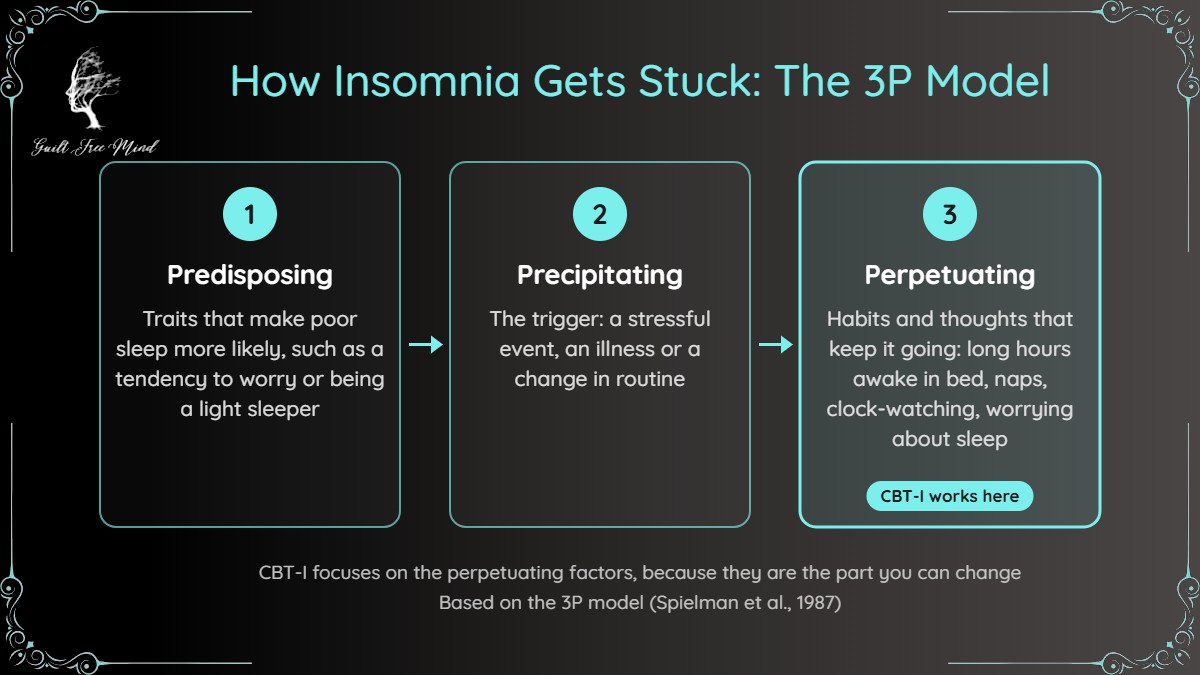
A helpful way to understand this is the “3P” model described by sleep researcher Arthur Spielman and colleagues (Spielman et al., 1987). It looks at three kinds of factors:
- Predisposing factors: things that make some people more prone to poor sleep, such as a tendency to worry or being a light sleeper.
- Precipitating factors: the trigger, such as a stressful event, an illness or a change in routine.
- Perpetuating factors: the habits and thoughts that keep insomnia going after the trigger has passed, such as going to bed early to “catch up,” lying awake in bed for hours, napping, sleeping in, clock-watching and worrying about sleep.
Many of those perpetuating habits are completely natural responses to a bad night. The problem is that they backfire. Spending long hours awake in bed weakens your sleep drive and teaches your brain that bed is a place for being awake, frustrated and alert. CBT-I focuses on these perpetuating factors because they’re the part you can change.
Researchers also describe chronic insomnia as a state of hyperarousal: studies have found higher levels of activation in the body and brain of people with insomnia, both at night and during the day. This arousal combines with sleep habits that work against you, learned links between bed and wakefulness, and a tendency to worry or ruminate (Riemann et al., 2010). If a racing mind is a big part of your nights, my guide to overthinking may help too.
The 5 Core Parts of CBT-I
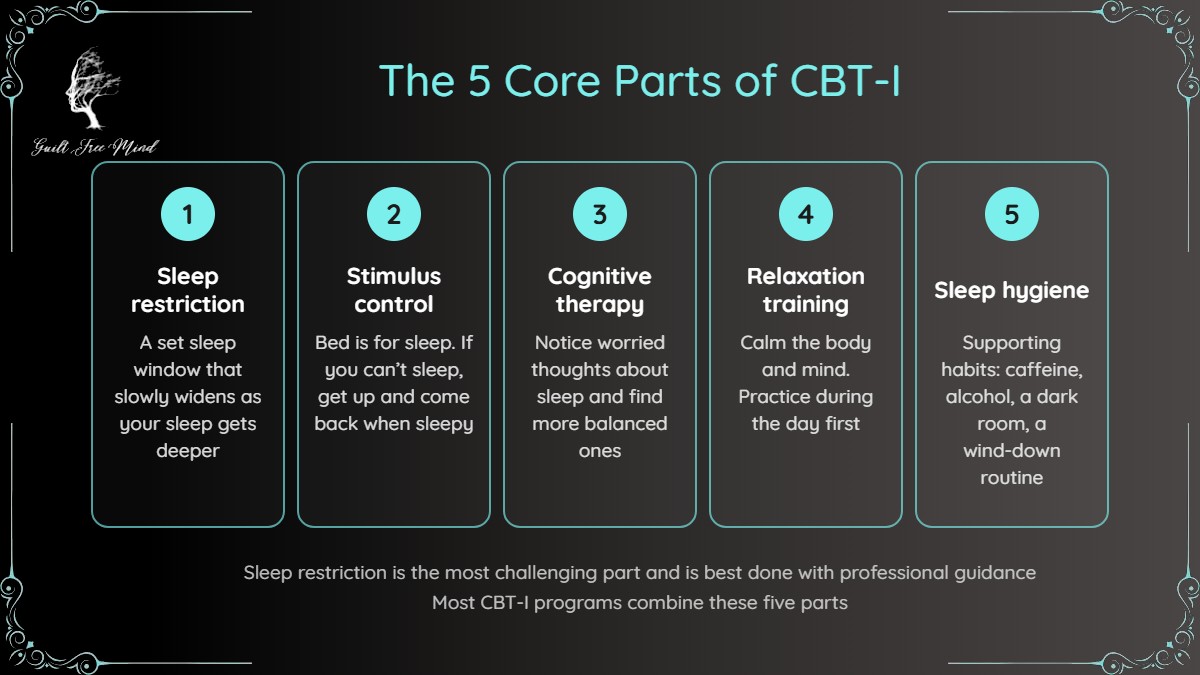
CBT-I is a package of techniques. Different programs combine them in slightly different ways, but most include these five parts.
1. Sleep Restriction: Setting a Sleep Window
Despite the name, sleep restriction isn’t about sleeping less. It limits the time you spend in bed to roughly the amount of time you’re actually sleeping, based on your sleep diary, and then gradually widens that window as your sleep becomes deeper and more solid. Less time lying awake builds up your natural sleep drive, so you fall asleep faster and wake less in the night.
An illustrative example: if your diary shows you spend about 9 hours in bed but sleep only about 6 of them, your clinician might set a starting window close to 6 hours, with the same wake-up time every day. Once you’re asleep for most of the time you spend in bed, the window is widened a little, often by about 15 minutes at a time. Your clinician also sets a safe minimum, so the window never gets too short.
This is the most challenging part of CBT-I, and it helps to know why. In one study of people starting sleep restriction, objectively measured sleep time dropped during the first weeks, and daytime sleepiness and alertness got worse, even while people reported that their insomnia was improving (Kyle et al., 2014). For most people this is temporary, but it’s why sleep restriction is best done with professional guidance, and why you should never drive or use machinery when you feel drowsy.
2. Stimulus Control: Teaching Your Brain That Bed Means Sleep
Stimulus control rebuilds the link between your bed and sleep. The usual rules are:
- Go to bed only when you feel sleepy (heavy eyelids, nodding off), not just tired.
- Use your bed only for sleep and sex. No scrolling, TV, work or problem-solving in bed.
- If you can’t fall asleep within about 20 minutes, or you wake and can’t get back to sleep, get up. Go to another dimly lit room and do something calm until you feel sleepy, then go back to bed. Estimate the time rather than checking the clock.
- Get up at the same time every morning, including weekends, however you slept.
- Avoid daytime naps, or keep them short and early if your clinician says that’s OK.
The AASM guideline suggests stimulus control as one of the single techniques that can help on its own, as well as being part of full CBT-I (Edinger et al., 2021).
3. Cognitive Therapy: Working With Sleep Worries
When you’ve had insomnia for a while, it’s easy to develop thoughts about sleep that make nights more tense. You might predict disaster after a poor night, or feel you have to “try harder” to sleep. These thoughts raise arousal, which is the opposite of what sleep needs. CBT-I helps you notice them, check how accurate they are and find more balanced alternatives, using the same skills as a thought record for anxiety.
| Unhelpful sleep thought (example) | A more balanced thought |
|---|---|
| “If I don’t get eight hours, tomorrow will be a disaster.” | “I’ve got through days after poor nights before. I may feel tired, but I can cope.” |
| “I need to try harder to fall asleep.” | “Sleep can’t be forced. My job is to rest and let sleep come when it’s ready.” |
| “Tonight will be terrible again.” | “One night doesn’t predict the next. I’m building better sleep step by step.” |
| “My insomnia is ruining my health.” | “Insomnia is treatable, and I’m doing something about it.” |
These are illustrative examples of common thoughts, not quotes from real people. Many CBT-I programs also use a “worry time” earlier in the evening: you spend 10 to 15 minutes writing down what’s on your mind and a possible next step, so you’re not trying to solve it at midnight. A simple notebook works well, and these journaling ideas can help you start.
4. Relaxation Training
Relaxation techniques calm the hyperarousal that keeps you awake. Options include progressive muscle relaxation, slow, deep breathing, body scans and guided imagery. The AASM guideline also suggests relaxation therapy as a single technique with evidence behind it (Edinger et al., 2021).
Practice during the day first, when there’s no pressure. If relaxation becomes one more thing you “have to get right” at bedtime, it can backfire. Gentle relaxation music or a steady background sound can be part of your wind-down routine too.
5. Sleep Hygiene: The Supporting Habits
- Keep caffeine to the morning and early afternoon, since it stays in your system for hours.
- Go easy on alcohol in the evening. It may help you drift off, but it tends to disturb sleep later in the night.
- Keep your bedroom cool, dark and quiet. Earplugs, an eye mask or white noise can help.
- Put screens away before bed and avoid late-night doomscrolling.
- Move your body during the day, but avoid hard exercise close to bedtime.
- Build a short, calming wind-down routine for the last 30 to 60 minutes of the evening.
These habits matter, but they’re the supporting act, not the main treatment. For more ideas, see my tips to improve sleep quality.
What a CBT-I Course Looks Like
Every program is a little different, but a typical course of CBT-I with a therapist follows a pattern like this:
| Stage | What usually happens |
|---|---|
| Before you start | A full sleep history, checks for other sleep problems (such as sleep apnea or restless legs) and one to two weeks of sleep diary |
| Early sessions | Learning how sleep works, setting your sleep window and starting stimulus control |
| Middle sessions | Reviewing your diary each week, adjusting the window, working with sleep worries and practicing relaxation |
| Final sessions | Fine-tuning, planning for setbacks and knowing what to do if insomnia comes back |
The sleep diary is the backbone of CBT-I. Each morning you note roughly when you went to bed, how long it took to fall asleep, how often and how long you woke in the night, when you woke up and got up, any naps, caffeine and alcohol, and how rested you feel. Estimates are fine; you don’t need to watch the clock. From the diary, your clinician works out your sleep efficiency: the share of your time in bed that you actually spend asleep. That number guides when your sleep window is widened.
Research suggests that face-to-face programs with at least four sessions tend to work better than self-help or shorter courses (van Straten et al., 2018). Many people notice changes within a few weeks, often after a harder first week or two while their body adjusts to the new schedule.
Does CBT-I Work? What the Research Says
CBT-I is one of the best-studied treatments in sleep medicine. A 2015 meta-analysis of randomized trials of face-to-face CBT-I in adults with chronic insomnia found that, after treatment, people fell asleep about 19 minutes faster, spent about 26 minutes less time awake during the night and had sleep efficiency about 10 percentage points higher. Total sleep time rose only slightly (by about 8 minutes, a change that wasn’t statistically clear). The improvements seemed to last at later follow-ups, and no adverse outcomes were reported (Trauer et al., 2015).
A larger 2018 meta-analysis found moderate to large improvements in insomnia severity, sleep efficiency, sleep quality, waking during the night and the time it takes to fall asleep, with the smallest effect on total sleep time. Results were similar for people with or without other health conditions, for younger and older adults, and whether or not people were taking sleep medication (van Straten et al., 2018).
That pattern is worth noticing: CBT-I tends to make sleep deeper, more solid and less of a struggle, rather than adding lots of extra hours. For many people, that’s what makes the biggest difference to how they feel.
CBT-I When You Also Have Anxiety, Depression or Another Condition
Insomnia often travels with other conditions, and CBT-I still helps. In a meta-analysis of trials in people whose insomnia came alongside psychiatric or medical conditions, 36% of people who had CBT-I were in remission from insomnia after treatment, compared with about 17% in the comparison groups. CBT-I also had small to medium benefits for the other condition, with larger effects for psychiatric conditions than for medical ones (Wu et al., 2015). If low mood is part of your picture, my guides to the signs of depression and CBT for depression may help.
What the Guidelines Say
- American College of Physicians (2016): recommends that all adults receive CBT-I as the initial treatment for chronic insomnia disorder (strong recommendation, moderate-quality evidence) (Qaseem et al., 2016).
- American Academy of Sleep Medicine (2021): strongly recommends multicomponent CBT-I for chronic insomnia in adults (Edinger et al., 2021).
- European Insomnia Guideline (2017): recommends CBT-I as the first-line treatment for chronic insomnia in adults of any age (strong recommendation, high-quality evidence) (Riemann et al., 2017).
CBT-I vs Sleeping Pills
Sleeping pills have a place, but they work differently from CBT-I. Medicines act on brain chemistry to bring on sleep, while CBT-I changes the patterns that keep insomnia going. Psychological approaches like CBT-I are recommended first partly because they can bring lasting benefits without the risk of tolerance or side effects linked with sleep medicines (Trauer et al., 2015).
| CBT-I | Sleeping pills | |
|---|---|---|
| How it works | Changes sleep habits, schedules and thoughts about sleep | Acts on brain chemistry to bring on or maintain sleep |
| How fast it helps | Usually over a few weeks, sometimes after a harder start | Often within days |
| Over the long term | Benefits tend to last after treatment ends | Evidence mainly supports short-term use (up to about four weeks) |
| Main downsides | Takes time and effort; temporary daytime sleepiness during sleep restriction | Next-day drowsiness and, with some medicines, tolerance or dependence |
| Where it fits | First-line treatment for chronic insomnia | An option when CBT-I isn’t enough or isn’t available, decided with your doctor |
In a systematic review comparing the two directly, low to moderate-quality evidence suggested CBT-I works better than sleeping pills in the long term, while very low-quality evidence suggested benzodiazepine medicines may work better in the short term (Mitchell et al., 2012). The European guideline describes benzodiazepines, benzodiazepine receptor agonists (such as the “Z-drugs”) and some antidepressants as effective for short-term use of up to about four weeks, and as an option when CBT-I isn’t effective enough or isn’t available (Riemann et al., 2017).
You don’t always have to choose one or the other. In a randomized trial, adding the sleep medicine zolpidem to CBT gave extra benefit during the first weeks of treatment, but long-term results were best when the medicine was stopped while CBT continued (Morin et al., 2009). The American College of Physicians suggests that you and your doctor talk through the benefits, harms and costs before deciding whether to add a short course of medicine if CBT-I alone hasn’t worked (Qaseem et al., 2016).
Important: if you take a prescribed sleep medicine, don’t stop it suddenly on your own. Some need to be reduced gradually. Talk to your doctor about a plan, ideally alongside CBT-I.
Digital and App-Based CBT-I
Trained CBT-I therapists can be hard to find, so digital programs that deliver CBT-I online or through an app are now widely used, and the evidence for them is encouraging.
- A 2016 meta-analysis of internet-delivered CBT-I found improvements in insomnia severity, sleep efficiency, sleep quality, time to fall asleep, waking in the night and total sleep time. The effects were comparable to face-to-face CBT-I and were generally maintained at follow-ups of 4 to 48 weeks. Longer programs with more personal support tended to work better (Zachariae et al., 2016).
- A 2020 meta-analysis of 33 randomized trials with more than 9,000 participants found that digital CBT-I lowered scores on the Insomnia Severity Index by about 5 points compared with control groups, and the improvement held at short-term follow-up (Soh et al., 2020).
- In a large trial of 1,711 adults, a digital CBT-I program improved everyday functioning, psychological well-being and sleep-related quality of life compared with sleep hygiene education (Espie et al., 2019).
In the US, the Department of Veterans Affairs offers two free apps based on CBT-I: CBT-i Coach, designed to be used alongside CBT-I with a health care provider, and Insomnia Coach, a self-guided five-week training plan. Both are free for everyone, not only veterans. In England, NICE recommended the digital CBT-I program Sleepio in 2022, but whether it’s offered on the NHS depends on where you live, so ask your GP.
When choosing an app, look for one that includes the core parts of CBT-I (a sleep diary, a sleep window, stimulus control and work on sleep worries), not just sleep sounds or tracking. If you have another health condition, are pregnant or might have a different sleep disorder, check with your doctor first.
Who Should Be Careful With CBT-I
CBT-I is safe for most adults, but some parts, especially sleep restriction, need extra care or medical guidance in certain situations:
- Bipolar disorder: losing sleep can trigger hypomania or mania. A small study found that sleep restriction and stimulus control could be used safely in bipolar disorder when mood and daytime sleepiness were carefully monitored, and that simply keeping regular bedtimes and wake times was often enough to improve sleep at first (Kaplan & Harvey, 2013). Work with your psychiatrist.
- Epilepsy: sleep loss can make seizures more likely in some people, so talk to your neurologist before trying sleep restriction.
- Driving or safety-critical work: sleep restriction can make you sleepier during the first weeks (Kyle et al., 2014). Don’t drive or operate machinery when drowsy, and plan the hardest weeks carefully.
- Possible sleep apnea or another sleep disorder: loud snoring, gasping or choking at night, very sleepy days or an urge to move your legs in the evening need a medical check. A sleep study can be used when another sleep disorder is suspected (Riemann et al., 2017).
- Pregnancy, older age or a high risk of falls: getting out of bed at night and changing your schedule may need to be adapted, so talk to your clinician first.
How to Find a CBT-I Provider
- Start with your doctor. Your primary care doctor can check for other causes of poor sleep and refer you to a sleep clinic, psychologist or therapist trained in CBT-I.
- In the US: the Society of Behavioral Sleep Medicine keeps a directory of behavioral sleep medicine providers, including many who offer CBT-I by telehealth. Veterans can ask their VA care team about CBT-I.
- In the UK: ask your GP what is available locally, including digital CBT-I.
- In India: ask a psychiatrist or clinical psychologist whether they offer CBT-I specifically. For mental health support and guidance, you can call Tele-MANAS on 14416.
Useful questions to ask a provider: Do you offer CBT-I specifically, rather than general talk therapy? Will we use a sleep diary and a sleep window? How many sessions do you usually recommend? Some providers also hold a certification in behavioral sleep medicine, which shows specialist training.
Try Tonight: CBT-I Basics You Can Start Now
A full course works best with guidance, but these steps are safe for most people to start on their own:
- Choose a fixed wake-up time and keep it seven days a week.
- Start a simple sleep diary in a notebook or on your phone.
- Go to bed only when you feel sleepy.
- If you’ve been awake for what feels like 20 minutes, get up and do something calm in dim light until you feel sleepy.
- Keep your bed for sleep and sex only.
- Turn the clock away from you.
- Write down your worries and a next step earlier in the evening.
- After a bad night, resist the urge to sleep in or take a long nap. Keep your wake-up time.
Leave sleep restriction until you have professional guidance, especially if any of the points in “Who Should Be Careful With CBT-I” apply to you.
When to Get Help
See your doctor if poor sleep has lasted more than a few weeks, is affecting your work, mood or relationships, or comes with loud snoring, gasping, restless legs, low mood or anxiety. Talk to someone too if you’ve started relying on alcohol, cannabis or sleeping pills to get through the night. Sleep and mental health are closely linked, and long stretches of poor sleep can also feed into burnout.
If you are struggling or having thoughts of harming yourself, please reach out now: in the US, call or text 988; in India, call Tele-MANAS on 14416 (or 112 in an emergency); in the UK and Ireland, call Samaritans on 116 123. If alcohol or drug use is part of the picture, the SAMHSA National Helpline (1-800-662-4357) offers free, confidential support in the US.
Keep Reading on Guilt Free Mind
- Cognitive Behavioral Therapy for Anxiety: How It Works and What to Expect
- Cognitive Behavioral Therapy for Depression
- Cognitive Behavioral Therapy: A guide
- 16 tips to improve sleep quality
- Progressive Muscle Relaxation: A guide
- Deep Breathing for Anxiety: Simple Techniques and What the Research Says
- Overthinking: Why It Happens and 12 Science-Backed Ways to Stop
- How can white noise help boost productivity?
- Relaxation Music for Self-Care & Calm
- Burnout Symptoms: 15 Signs of Burnout and How to Recover
Final Thoughts
Insomnia can make nights feel endless and days feel heavy, and it’s easy to start blaming yourself. Please don’t. Insomnia is a common, well-understood problem, and CBT-I gives you practical skills that keep working long after treatment ends. Start small: a steady wake-up time and a simple sleep diary are a good first step, and a trained CBT-I provider can guide you through the rest.
Have you tried any of these techniques? Tell me in the comments what has helped you sleep better, and if you’d like gentle, science-backed mental health tips in your inbox, join my newsletter.
See you in my next blog post,
Dr. Shruti
Frequently Asked Questions
Cognitive behavioral therapy for insomnia (CBT-I) is a short, structured treatment for chronic insomnia. It combines a set sleep window, stimulus control, work on worried thoughts about sleep, relaxation and sleep hygiene to change the habits and thoughts that keep insomnia going.
A typical course runs for about four to eight sessions. Many people notice changes within a few weeks, often after a harder first week or two while they adjust to a new sleep schedule.
Guidelines in the US and Europe recommend CBT-I as the first treatment for chronic insomnia. Research suggests sleeping pills may work faster in the short term, while CBT-I works better in the long term because its benefits tend to last after treatment ends.
Digital and app-based CBT-I programs have good evidence behind them, and programs with more support tend to work better. If you have bipolar disorder, epilepsy, a job that involves driving or signs of another sleep disorder, get professional guidance first, especially for sleep restriction.
For most adults, yes, when it’s done with guidance. It can cause extra daytime sleepiness in the first weeks, so avoid driving when drowsy. People with bipolar disorder, epilepsy or some other conditions should only try it with medical supervision.
Yes. Research shows CBT-I improves insomnia in people who also have psychiatric or medical conditions, and it can ease symptoms of the other condition too, with larger benefits for mental health conditions than for physical ones.
About the Author
Dr. Shruti Bhattacharya is the founder and heart of Guilt Free Mind, where she combines a Ph.D. in Immunology with training in psychology to deliver science-backed mental health strategies. Her mission is to empower readers to overcome stress, anxiety, and emotional challenges with practical, evidence-based tools. Dr. Bhattacharya’s unique blend of expertise and empathy shapes her approach to wellness:
- Academic & Scientific Rigor – Holding a Ph.D. in Immunology and a Bachelor’s degree in Microbiology, Dr. Bhattacharya brings a deep understanding of the biological foundations of mental health, including the gut-brain connection. Her completion of psychology courses, such as The Psychology of Emotions: An Introduction to Embodied Cognition, enhances her ability to bridge science and emotional well-being.
- Dedicated Mental Health Advocacy – With over 15 years of experience, Dr. Bhattacharya has supported hundreds of individuals through online platforms and personal guidance, helping them navigate mental health challenges with actionable strategies. Her work has empowered readers to adopt holistic practices, from mindfulness to nutrition, for lasting resilience.
- Empathetic Connection to Readers – Known for her compassionate and relatable voice, Dr. Bhattacharya is a trusted guide in mental health, turning complex research into accessible advice. Her personal journey as a trauma survivor fuels her commitment to helping others find calm and confidence.
- Lifelong Commitment to Wellness – Dr. Bhattacharya lives the principles she shares, integrating science-based habits like balanced nutrition and stress management into her daily life. Her personal exploration of mental health strategies inspires Guilt Free Mind’s practical, reader-focused content.
🏆 Guilt Free Mind was named one of the Top 100 Mental Health Blogs on Feedspot.

Disclaimer: This content is for informational purposes only and is not a substitute for professional medical advice.
References
- Edinger, J. D., Arnedt, J. T., Bertisch, S. M., Carney, C. E., Harrington, J. J., Lichstein, K. L., Sateia, M. J., Troxel, W. M., Zhou, E. S., Kazmi, U., Heald, J. L., & Martin, J. L. (2021). Behavioral and psychological treatments for chronic insomnia disorder in adults: An American Academy of Sleep Medicine clinical practice guideline. Journal of Clinical Sleep Medicine, 17(2), 255–262. https://doi.org/10.5664/jcsm.8986
- Espie, C. A., Emsley, R., Kyle, S. D., Gordon, C., Drake, C. L., Siriwardena, A. N., Cape, J., Ong, J. C., Sheaves, B., Foster, R., Freeman, D., Costa-Font, J., Marsden, A., & Luik, A. I. (2019). Effect of digital cognitive behavioral therapy for insomnia on health, psychological well-being, and sleep-related quality of life: A randomized clinical trial. JAMA Psychiatry, 76(1), 21–30. https://doi.org/10.1001/jamapsychiatry.2018.2745
- Kaplan, K. A., & Harvey, A. G. (2013). Behavioral treatment of insomnia in bipolar disorder. American Journal of Psychiatry, 170(7), 716–720. https://doi.org/10.1176/appi.ajp.2013.12050708
- Kyle, S. D., Miller, C. B., Rogers, Z., Siriwardena, A. N., MacMahon, K. M., & Espie, C. A. (2014). Sleep restriction therapy for insomnia is associated with reduced objective total sleep time, increased daytime somnolence, and objectively impaired vigilance: Implications for the clinical management of insomnia disorder. Sleep, 37(2), 229–237. https://doi.org/10.5665/sleep.3386
- Mitchell, M. D., Gehrman, P., Perlis, M., & Umscheid, C. A. (2012). Comparative effectiveness of cognitive behavioral therapy for insomnia: A systematic review. BMC Family Practice, 13, 40. https://doi.org/10.1186/1471-2296-13-40
- Morin, C. M., Vallières, A., Guay, B., Ivers, H., Savard, J., Mérette, C., Bastien, C., & Baillargeon, L. (2009). Cognitive behavioral therapy, singly and combined with medication, for persistent insomnia: A randomized controlled trial. JAMA, 301(19), 2005–2015. https://doi.org/10.1001/jama.2009.682
- Qaseem, A., Kansagara, D., Forciea, M. A., Cooke, M., & Denberg, T. D. (2016). Management of chronic insomnia disorder in adults: A clinical practice guideline from the American College of Physicians. Annals of Internal Medicine, 165(2), 125–133. https://doi.org/10.7326/M15-2175
- Riemann, D., Spiegelhalder, K., Feige, B., Voderholzer, U., Berger, M., Perlis, M., & Nissen, C. (2010). The hyperarousal model of insomnia: A review of the concept and its evidence. Sleep Medicine Reviews, 14(1), 19–31. https://doi.org/10.1016/j.smrv.2009.04.002
- Riemann, D., Baglioni, C., Bassetti, C., Bjorvatn, B., Dolenc Groselj, L., Ellis, J. G., Espie, C. A., Garcia-Borreguero, D., Gjerstad, M., Gonçalves, M., Hertenstein, E., Jansson-Fröjmark, M., Jennum, P. J., Leger, D., Nissen, C., Parrino, L., Paunio, T., Pevernagie, D., Verbraecken, J., … Spiegelhalder, K. (2017). European guideline for the diagnosis and treatment of insomnia. Journal of Sleep Research, 26(6), 675–700. https://doi.org/10.1111/jsr.12594
- Soh, H. L., Ho, R. C., Ho, C. S., & Tam, W. W. (2020). Efficacy of digital cognitive behavioural therapy for insomnia: A meta-analysis of randomised controlled trials. Sleep Medicine, 75, 315–325. https://doi.org/10.1016/j.sleep.2020.08.020
- Spielman, A. J., Caruso, L. S., & Glovinsky, P. B. (1987). A behavioral perspective on insomnia treatment. Psychiatric Clinics of North America, 10(4), 541–553. https://doi.org/10.1016/S0193-953X(18)30532-X
- Trauer, J. M., Qian, M. Y., Doyle, J. S., Rajaratnam, S. M. W., & Cunnington, D. (2015). Cognitive behavioral therapy for chronic insomnia: A systematic review and meta-analysis. Annals of Internal Medicine, 163(3), 191–204. https://doi.org/10.7326/M14-2841
- van Straten, A., van der Zweerde, T., Kleiboer, A., Cuijpers, P., Morin, C. M., & Lancee, J. (2018). Cognitive and behavioral therapies in the treatment of insomnia: A meta-analysis. Sleep Medicine Reviews, 38, 3–16. https://doi.org/10.1016/j.smrv.2017.02.001
- Wu, J. Q., Appleman, E. R., Salazar, R. D., & Ong, J. C. (2015). Cognitive behavioral therapy for insomnia comorbid with psychiatric and medical conditions: A meta-analysis. JAMA Internal Medicine, 175(9), 1461–1472. https://doi.org/10.1001/jamainternmed.2015.3006
- Zachariae, R., Lyby, M. S., Ritterband, L. M., & O’Toole, M. S. (2016). Efficacy of internet-delivered cognitive-behavioral therapy for insomnia – A systematic review and meta-analysis of randomized controlled trials. Sleep Medicine Reviews, 30, 1–10. https://doi.org/10.1016/j.smrv.2015.10.004
