

Last Updated: April 6, 2026
That familiar knot in your stomach when you think about pulling out summer clothes — that’s summer body anxiety. Many readers tell me they start feeling it as soon as the weather warms up. Suddenly, mirrors feel harsher, social media scrolls bring comparison, and the thought of wearing shorts or a swimsuit triggers waves of self-criticism.
You are not alone, and there is nothing wrong with you for feeling this way. Summer body anxiety is a real, seasonal spike in body image dissatisfaction that research has documented across years and hemispheres. The good news? You can move through it with kindness instead of shame. This guide brings together science-backed insights and practical steps so you can enjoy the season without the mental weight.
| Aspect | What You Need to Know |
|---|---|
| What It Is | Seasonal spike in body shame and anxiety when warmer weather arrives and more skin is on display |
| When It Peaks | June, July & August – strongest in July |
| Why It Feels So Intense | Harsh mirror thoughts, social media comparison, and fear of being judged |
| Who It Affects | Most common in women, but anyone can experience it |
| Core Problem | The pressure to have a “perfect summer body” |
| Best Approach | Self-compassion + body neutrality (not dieting or fixing) |
| Quick Tool | 30-second Emergency Shame Reset |
| Long-Term Solution | Change your relationship with your body, not its appearance |
| Free Printable | Guilt-Free Summer Body Reflection Sheet |
| Key Takeaway | You are allowed to take up space exactly as you are this summer |
Table of Contents
Summer Body Anxiety
Summer body anxiety often creeps in because warmer months mean more skin on display — tank tops, shorts, swimsuits, beach days. Social media fills with “summer shred” posts and filtered bodies. Even casual conversations turn to “getting beach ready.”
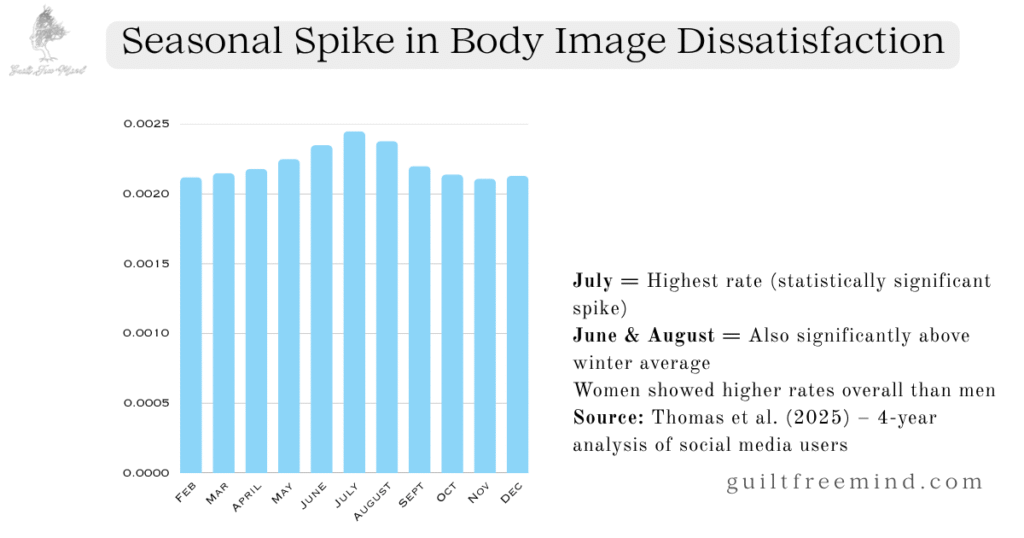
One large analysis of social media users over four years found clear seasonal spikes in body image dissatisfaction. In the Northern Hemisphere, expressions of body dissatisfaction rose significantly in July, with June and August also above average. The pattern mirrored in the Southern Hemisphere during their summer months. Women showed higher rates than men overall (Eating and Weight Disorders, 2025).
In everyday life, this shows up in small but painful moments.
- You avoid pool parties because the idea of a swimsuit feels unbearable.
- You stand in front of the mirror pinching areas you wish looked different before a barbecue.
- You scroll past friends’ vacation photos and feel your chest tighten.
These experiences connect directly to broader patterns. Research consistently links body image concerns with higher anxiety and depression symptoms. A rigorous systematic review highlighted the strong relationship between negative body image and both anxiety and depression (PubMed, 2025).
Another systematic review explored how body image, self-esteem, emotion regulation, and eating behaviors intertwine in adults. Poor body image often fuels shame cycles that affect daily mood and choices (Neuropsychiatrie, 2025).
On a global note: Similar seasonal patterns appear in studies from various countries, including noticeable body image pressures reported in Indian urban youth during festival and summer clothing seasons, though exact prevalence varies by cultural context.
Why Do These Body Thoughts Feel So Intense?
On introspection, many readers tell me the anxiety feels bigger than just “I don’t like how I look.” It’s as if something deeper is missing — like losing connection with yourself in that moment. The mirror suddenly becomes a harsh judge instead of a neutral reflection, and the body you see stops feeling like you.
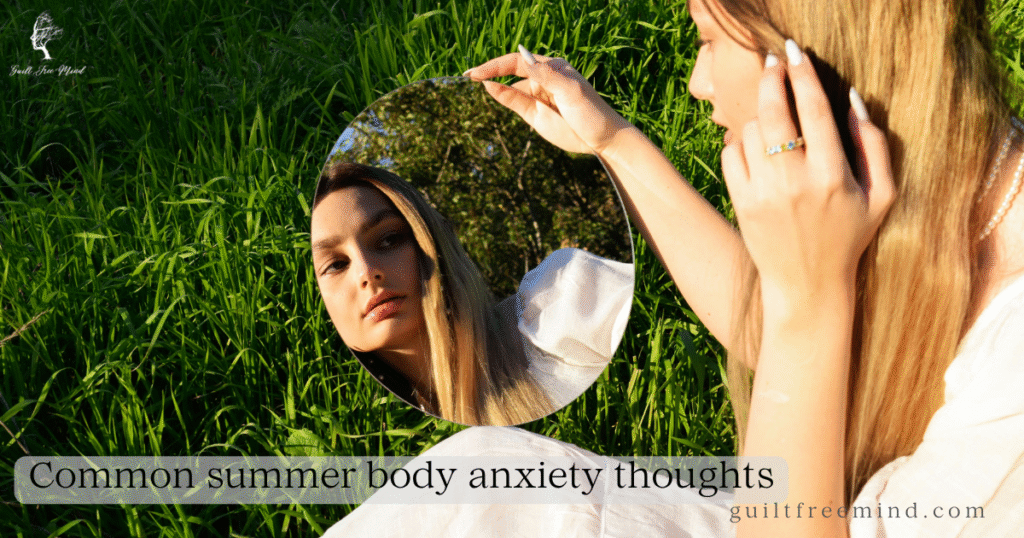
Picture this: You’re standing in front of the mirror, trying on a swimsuit or summer outfit before heading to the beach or a pool party. One of these thoughts pops into your head. Has this ever happened to you?
- “I can’t go out like this — my stomach looks huge.”
- “My thighs are too big / too jiggly for this swimsuit.”
- “Everyone will stare and judge how I look.”
- “I’m not beach-ready. I should have worked harder.”
- “I look disgusting / ugly / not good enough in this.”
- “Why can’t my body look like the ones on social media?”
- “I need to cover up or hide — I don’t want anyone to see me.”
These automatic, piercing thoughts hit hard because they’re not just about appearance. They carry years of learned shame, comparison, and the fear of being seen and rejected. In summer, with more skin showing and more social events, the volume gets turned up. The body stops feeling like home — it starts feeling like a problem that needs fixing before you’re allowed to enjoy life.
If any of these phrases (or similar ones) have crossed your mind while getting ready, you’re not alone and there’s nothing wrong with you. This is summer body anxiety in action — and recognizing it is the first compassionate step toward loosening its grip.
Real-Life Scenarios
Sarah, a reader who reached out last year, loved hiking but started skipping group trails once shorts season arrived. She worried others would judge her thighs. The avoidance left her feeling isolated and more anxious.
Or take Mike — he turned down beach invitations with friends because he felt self-conscious about his softer midsection. He spent evenings alone, scrolling fitness accounts that only made the shame louder.
These stories repeat in different forms for so many readers. The pressure is not just internal. Social media plays a big role. One study on body talk on social networking sites found that appearance-related conversations increased appearance anxiety among college students, with self-objectification acting as a mediator (Frontiers in Psychology, 2025).
A narrative review of the last decade’s evidence confirmed that greater social media use correlates with more negative body image and body weight concerns across observational and experimental studies (Behavioral Sciences, 2026).
Systematic reviews also show varied effects across genders, with social media often amplifying dissatisfaction through comparison and idealized images (SAGE Open, 2025).
Quick Check: How Strong Is Your Summer Body Anxiety?
Before diving into the tools, many readers like you find it helpful to pause and gently understand where they stand right now. This short quiz isn’t about labeling or fixing yourself — it’s a compassionate mirror to help you see how summer body anxiety is showing up in your life this season. Take a quiet moment, answer honestly, and remember: wherever you land, you’re in the right place to begin feeling lighter.
[Image Placeholder 6: Soft illustration of a peaceful mirror reflection with kind words overlaid. Alt text: “Mirror moment illustration for summer body anxiety quiz”]

Traditional Summer Body Advice vs. Guilt-Free Approach
Before we dive into the practical tools, it can be helpful to see the clear difference between the usual “summer body” pressure most of us have absorbed and a gentler, more sustainable way forward.
The table below contrasts the common advice you’ll often see with the guilt-free approach we explore here at Guilt Free Mind. Notice how one path focuses on fixing the body while the other focuses on freeing the mind.
| Aspect | Traditional Advice | Guilt-Free Approach (Guilt Free Mind) |
|---|---|---|
| Goal | Change your body for summer | Change your relationship with your body |
| Focus | Diets, workouts, “beach body” goals | Self-compassion, mindfulness, body neutrality |
| Social media | Follow fitspo and before/after posts | Curate body-positive and neutral feeds |
| Movement | Intense workouts to “earn” summer | Move for how it feels, not how it looks |
| Mirror moments | Criticize and fix flaws | Notice the thought and respond with kindness |
| Outcome | Temporary confidence tied to scale | Lasting freedom from shame, even if body stays the same |
The Role of Self-Compassion in Releasing Summer Body Anxiety
The path out of summer body anxiety does not require changing your body. It asks for a kinder relationship with the one you already have.
Self-compassion
Treating yourself with the same warmth you would offer a good friend, acts as a powerful buffer. A longitudinal study in Chinese adolescents found that self-compassion moderated the link between body image concerns and eating disorder symptoms, psychosocial impairment, and psychological distress. Higher self-compassion weakened those harmful connections. (Body Image, 2025)
Anxiety triggers inflammation
My background in immunology has shown me how chronic shame from summer body anxiety triggers low-grade inflammation and disrupts the gut-brain axis, which can intensify anxiety and emotional distress. That’s why practices like self-compassion and mindfulness are so effective — they don’t just feel good; they calm the body’s biological stress response at its source.
Compassion-Focused Therapy
In a randomized controlled trial, Compassion-Focused Therapy (CFT) significantly reduced body weight shame and self-criticism while increasing self-compassion in individuals with obesity. Participants in the CFT group also showed notable improvements in depression symptoms compared to the control group.
“Compassion-Focused Therapy had a significant positive impact… reducing body weight shame (internal and external), increasing self-compassion, and reducing self-criticism.”
— Carter et al. (2023) (Behavior Therapy, 2023)
Acceptance and Commitment Therapy
Another helpful approach comes from Acceptance and Commitment Therapy (ACT). A case study illustrated how ACT fostered psychological flexibility and self-compassion, helping someone transform deep shame into greater self-acceptance. (Journal of Clinical Psychology, 2025)
Adress shame thorugh self compassion
A practical article on addressing shame through self-compassion further supports these methods for everyday use. The authors explain that self-compassion is not just a soft skill — it actively helps interrupt the cycle of shame by encouraging us to treat ourselves with the same kindness we would offer a close friend in pain. This approach has been shown to reduce self-criticism and create space for emotional healing, making it especially useful when summer body anxiety triggers harsh inner talk. (Journal of Lifestyle Medicine, 2025).
Evidence-Based Ways to Ease Summer Body Anxiety
You don’t need another strict diet, intense workout plan, or “summer shred” challenge to feel lighter this season. The gentle approaches below come straight from peer-reviewed studies on body image, self-compassion, mindfulness, and seasonal body dissatisfaction. They focus on shifting your relationship with your body rather than trying to change its appearance.
Many readers who come to Guilt Free Mind share that these small, consistent practices helped them move through summer body anxiety with far less shame and more freedom to actually enjoy warm days.
Curate Your Social Media Feed with Intention
Social media often turns up the volume on summer body anxiety. Endless “beach body ready” posts, filtered vacation photos, and appearance-focused comments can trigger quick comparisons and self-objectification.
Research shows that switching to body-positive content can make a real difference. One study found that exposure to body-positive social media content improved body image perception in the short term (Journal of Eating Disorders, 2025).
How to apply it practically:
- Take 10–15 minutes to unfollow or mute accounts that leave you feeling tight or “not enough.”
- Follow creators who show real bodies enjoying summer — swimming, walking, laughing — without perfect posing or editing.
- Create a simple rule: If a post sparks self-criticism, hide it right away and replace it with something kinder.
Real-life anecdote: Payton, a reader from last summer, used to scroll for hours before family beach outings and often ended up canceling. After intentionally curating her feed for just two weeks, the automatic shame thoughts quieted down. She went to the beach anyway — and spent more time laughing with her family than worrying about how she looked.
Build Self-Compassion as Your Daily Anchor
Self-compassion is one of the most powerful tools against summer body anxiety. It helps soften shame and weakens the connection between harsh body thoughts and bigger emotional struggles.
A longitudinal study found that higher self-compassion reduced the impact of negative body image on eating concerns, daily impairment, and distress. A randomized controlled trial using Compassion-Focused Therapy also showed strong results: it significantly lowered body weight shame (both internal and external), increased self-compassion, reduced self-criticism, and eased depression symptoms for many participants.
Simple practice you can start right now:
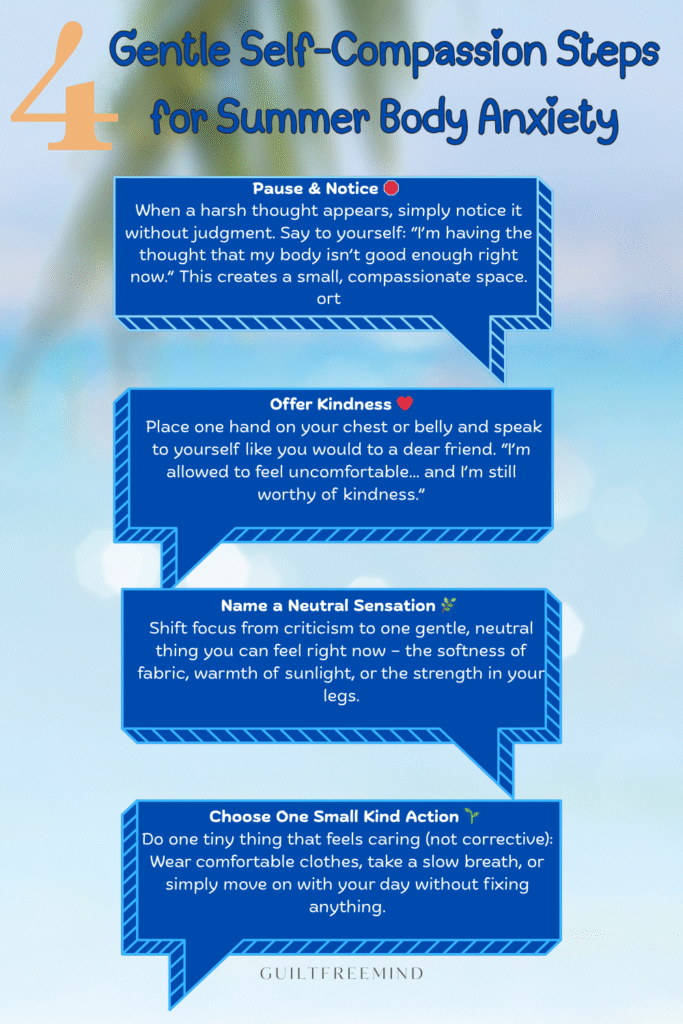
- When a critical thought shows up (“My arms look awful in this top”), pause and speak to yourself like you would to a dear friend: “It’s okay to feel uncomfortable. This body has carried me through so much — it deserves kindness, not judgment.”
- Try a quick self-compassion break: Place one hand gently on your chest or belly, breathe slowly for 60 seconds, and repeat: “I am allowed to take up space exactly as I am this summer.”
Reader story: Rohan avoided every pool party for three summers because of intense self-criticism about his stomach. After using these short compassionate responses daily for a month, he attended one gathering. The nerves were still there at first, but the heavy shame didn’t take over. He left feeling proud that he showed up for himself with kindness.
Practice Mindful Body Awareness Instead of Judgment
Mindfulness helps you notice body-related thoughts without letting them pull you into a shame spiral. A 2025 scoping review (registered on Open Science Framework and following PRISMA-ScR guidelines) concluded that mindfulness-based interventions appear to improve body image acceptance and support healthier eating behaviors in adolescents (Journal of Eating Disorders, 2025).
Easy ways to bring this into summer days:
- While getting dressed or in the shower, gently scan your body and notice one neutral or pleasant sensation (“The sun feels warm on my shoulders” or “My legs feel strong after that walk”).
- When summer body anxiety hits in front of the mirror, use the “notice and name” technique: “I’m having the thought that my thighs are too big right now.” This tiny pause creates space.
- Try a short 5-minute guided mindfulness practice focused on body neutrality (plenty of free options are available).
Anika, another reader, used to spend 20 frustrating minutes changing outfits before every summer plan. Adding brief mindful check-ins cut that time way down. She started feeling more present with her friends instead of trapped in her own head.
How to Gently Ease Summer Body Anxiety (Step-by-Step Guide)
If you’re tired of summer body anxiety stealing the joy from warmer days, here’s a simple, compassionate step-by-step approach you can start using today. This gentle method combines self-compassion, mindfulness, and body neutrality — tools backed by research — to help you feel more at peace in your body without pressure or shame.
Time needed: 1 minute
When summer body anxiety hits hard in front of a mirror or before leaving the house:
- Steady Yourself
Place one hand on your chest.
- Reframe your thoughts
Breathe out slowly and say: “This feeling is real, but it doesn’t define me.”
- Be Kind
Name one kind fact: “I am allowed to take up space exactly as I am.”
- Proceed
Move on with your day.
Use this anytime the shame wave rises — it interrupts the spiral before it takes over.
Move Your Body for How It Feels, Not How It Looks
Movement can support a kinder body image when the focus stays on enjoyment, energy, or capability rather than changing appearance. Research on youth showed that physical activity was linked to improved body image and lower anxiety when the emphasis was on feeling good rather than looking a certain way (Journal of Clinical Medicine, 2025).
Gentle summer-friendly options:
- Take evening walks while noticing the breeze, birds, or neighborhood sounds instead of tracking steps or calories.
- Put on your favorite music and dance freely in your room — no mirror needed.
- Try gentle stretching or swimming if it’s accessible, paying attention to how the water or movement feels on your skin.
Maya used to push herself into hard workouts purely out of fear of “not being summer-ready.” When she switched to movement that simply felt good (like slow morning yoga), her body started feeling more like a friend than an enemy. The grip of summer body anxiety loosened noticeably.
Use Brief Digital Tools and Interventions
Short digital practices and self-guided tools can help reduce body dissatisfaction. A systematic review and meta-analysis found that digital interventions showed positive effects on body image concerns in children and emerging adults (Interactive Journal of Medical Research, 2025).
Simple ways to use them:
- Try free apps or short online exercises that offer self-compassion prompts or body-neutrality reminders.
- End your day with a quick phone note: one kind observation about your body and one small summer moment you enjoyed without focusing on looks.
Reframe Mirror and Clothing Moments
These everyday triggers often fuel summer body anxiety. A small language shift can interrupt the old pattern gently.
Instead of “I look awful in these shorts,” try: “These shorts feel comfortable right now, and I’m choosing comfort over criticism today.” Pairing this with the self-compassion phrases above helps many readers build a new, kinder habit over time.
These approaches work best when you treat them as kind experiments, not strict rules. Choose just one or two that feel easiest and try them for a week. Notice any small increase in ease or freedom — not by forcing constant positivity, but by simply observing what feels lighter.
The real goal isn’t to suddenly love every inch of your body. It’s to stop letting summer body anxiety steal the simple joys of sunny days, cool evenings, and being fully present in your life.
How to Handle Summer Body Shame at the Beach
When the idea of a swimsuit or changing in public triggers summer body anxiety, prepare one gentle phrase in advance: “I’m here to enjoy the water and the moment, not to be on display.” Pair it with a 30-second self-compassion breath before you step out. Many readers say this single shift lets them stay present instead of hiding.
How to Stop Summer Body Anxiety from Ruining Outfits and Photos
Before trying on summer clothes or posing for photos, do a quick body scan: name one neutral sensation (“These shorts feel soft on my skin”). Then take the photo anyway. Over time this rewires the automatic shame response.
Summer Body Anxiety in Social Settings: What to Say to Others
If someone comments on your body or asks about your “summer goals,” have a calm reply ready: “I’m focusing on enjoying the season rather than my looks right now.” Then redirect the conversation. Self-compassion helps you recover internally even if the comment stings.
Exploring Other Guilt Free Mind Categories
Whether you’re feeling the heavy grip of summer body anxiety, noticing how shame quietly steals joy from sunny days, or simply looking for kinder ways to exist in your body without pressure or self-judgment, these resources from Guilt Free Mind are here to support you — one gentle, guilt-free step at a time.
Discover daily practices that honor your body exactly as it is — movement that feels good rather than punitive, rest that restores without guilt, and small rituals that help you feel safe and present even when summer clothes or mirror moments trigger discomfort.
🧠 Understanding Personality Disorders
Explore how deep-rooted patterns of self-worth and inner criticism can sometimes amplify summer body anxiety. These articles offer compassionate insight into old emotional wiring without turning your experience into a diagnosis or something that needs to be “fixed.”
🎨 Creative Healing and Therapy
Use art, journaling, digital painting, or gentle somatic practices to externalize the shame and anxiety that arise around your body. Giving shape to these feelings — whether through color, words, or movement — creates distance and kindness instead of staying trapped in harsh self-talk.
💡 Mindful Productivity and Focus
Learn how to protect your peace on days when summer body anxiety makes it hard to focus or enjoy simple plans. Find micro-strategies that work with your nervous system rather than demanding you push through shame or comparison.
💪 Emotional Recovery and Resilience
Build quiet inner anchors that help you recover from shame spirals and body-related triggers. These pieces support you in rebuilding self-trust so that your worth no longer feels conditional on how your body looks in summer clothes.
😌 Stress, Anxiety, and Depression Toolkit
This is where today’s article lives. Here you’ll find more tools for working with seasonal anxiety, body shame, and the emotional weight that often accompanies warmer months — always with science-backed insights and a deep commitment to guilt-free healing.
“Compassion-Focused Therapy had a significant positive impact at postintervention compared to the control group for body weight shame (internal and external), increasing self-compassion, reducing fears of compassion… and reducing self-criticism.”
— Carter, A. et al, 2023
Printable Resource
Free Printable: Guilt-Free Summer Body Reflection Sheet
Summer body anxiety can feel heavy and repetitive. Instead of trying to push the thoughts away or “fix” your body, this simple one-page reflection sheet helps you meet difficult mirror moments and shame thoughts with gentleness and honesty.
Use it weekly, or anytime summer body anxiety shows up strongly. It’s not about becoming more positive overnight — it’s about building a kinder relationship with yourself, one honest reflection at a time.
You Deserve a Summer Without the Shame
Summer body anxiety doesn’t have to steal another sunny day from you. You’ve already taken the first brave step by reading this far. Now it’s time to choose kindness over criticism — starting today.
Pick one single thing from this article and do it this week: curate your feed, try the self-compassion break in front of the mirror, or go for a walk where you focus only on how your body feels, not how it looks.
You are allowed to exist in this body exactly as it is — in shorts, in a swimsuit, in whatever makes you comfortable. No apology needed. No “summer body” required.
If this message landed with you, take the next step:
→ Head over to my YouTube channel Guilt Free Mind and watch the gentle 10-minute self-compassion practice created specifically for body anxiety and seasonal shame. It’s free, no fluff, and many readers say it’s the reset they needed.
While you’re there, hit subscribe and turn on notifications. New videos drop every week with practical tools for anxiety, emotional recovery, and building a guilt-free mind.
Share this article with any friend or family member who quietly dreads summer clothes or avoids photos — your small share could be the reminder they need to drop the shame.
You are already enough. Let this summer be the one where you finally believe it.
Frequently Asked Questions
Yes. Seasonal shifts in body image dissatisfaction are well-documented, with many people experiencing heightened concern during warmer months due to clothing, social activities, and media exposure.
Evidence from multiple studies, including randomized trials and longitudinal research, shows that building self-compassion lowers shame, self-criticism, and the emotional impact of negative body image.
No. The strategies that bring lasting relief focus on changing the relationship with your body rather than its size. Many readers report more freedom when they drop the pursuit of a “perfect” summer body.
Prepare a gentle boundary phrase such as “I’m focusing on enjoying the season rather than my looks right now.” Self-compassion helps you recover internally even if external comments sting.
A 2025 scoping review found that mindfulness-based interventions support improved body image acceptance and healthier eating behaviors in adolescents.
Reach out for professional support when needed. The tools here complement therapy, and resources in the Stress, Anxiety, and Depression Toolkit can help while you seek additional care.
About the Author
Dr. Shruti Bhattacharya is the founder and heart of Guilt Free Mind, where she combines a Ph.D. in Immunology with advanced psychology training to deliver science-backed mental health strategies. Her mission is to empower readers to overcome stress, anxiety, and emotional challenges with practical, evidence-based tools. Dr. Bhattacharya’s unique blend of expertise and empathy shapes her approach to wellness:
- Academic & Scientific Rigor – Holding a Ph.D. in Immunology and a Bachelor’s degree in Microbiology, Dr. Bhattacharya brings a deep understanding of the biological foundations of mental health, including the gut-brain connection. Her completion of psychology courses, such as The Psychology of Emotions: An Introduction to Embodied Cognition, from University of Cambridge enhances her ability to bridge science and emotional well-being.
- Dedicated Mental Health Advocacy – With over 15 years of experience, Dr. Bhattacharya has supported hundreds of individuals through online platforms and personal guidance, helping them navigate mental health challenges with actionable strategies. Her work has empowered readers to adopt holistic practices, from mindfulness to nutrition, for lasting resilience.
- Empathetic Connection to Readers – Known for her compassionate and relatable voice, Dr. Bhattacharya is a trusted guide in mental health, turning complex research into accessible advice. Her personal journey as a trauma survivor fuels her commitment to helping others find calm and confidence.
- Lifelong Commitment to Wellness – Dr. Bhattacharya lives the principles she shares, integrating science-based habits like balanced nutrition and stress management into her daily life. Her personal exploration of mental health strategies inspires Guilt Free Mind’s practical, reader-focused content.
🏆 Guilt Free Mind was named one of the Top 100 Mental Health Blogs on Feedspot in 2025.

Follow me on:
Disclaimer:
This article is for informational and educational purposes only. It is not a substitute for professional mental health advice, diagnosis, or treatment. Please consult a qualified mental health professional for personalized support.
References
- Thomas, J., Regan, T., Samad, R., Aljedawi, Y., AlJuboori, D., & Wells, A. (2025). Seasonal body image dissatisfaction: A bi-hemispheric panel analysis of social media users across 4 years. Eating and Weight Disorders, 30(1), 72. https://doi.org/10.1007/s40519-025-01782-9 (PMC version: https://pmc.ncbi.nlm.nih.gov/articles/PMC12399709/)
- Body image and its relationship with anxiety and depression: A rigorous systematic review of current evidence. [Journal], 39(4), 26–32. PMID: 40700531. https://pubmed.ncbi.nlm.nih.gov/40700531/
- Abdoli, M., Schiechtl, E., Rosato, M.S., et al. (2025). Body image, self-esteem, emotion regulation, and eating disorders in adults: A systematic review. Neuropsychiatrie, 39, 118–132. https://doi.org/10.1007/s40211-025-00544-4
- Jiménez-García, A.M., et al. (2025). Impact of body-positive social media content on body image perception. Journal of Eating Disorders, 13(1), 153. https://doi.org/10.1186/s40337-025-01286-y
- [Authors]. (2025). Body talk on social networking sites and appearance anxiety among college students… Frontiers in Psychology. https://doi.org/10.3389/fpsyg.2025.1513923
- [Authors]. (2026). Association of body image, body weight and social media use: A narrative review… Behavioral Sciences, 16(3), 422. https://doi.org/10.3390/bs16030422
- Xu, J., et al. (2025). Examining the varied effects of social media on body image across genders… SAGE Open. https://doi.org/10.1177/21582440251374734
- [Authors]. (2025). A case study on transforming shame: The role of Acceptance and Commitment Therapy… Journal of Clinical Psychology, 81(9), 878–887. https://doi.org/10.1002/jclp.23810
- Cepni, A.B., et al. (2025). Addressing shame through self-compassion. American Journal of Lifestyle Medicine. PMC11556665. https://pmc.ncbi.nlm.nih.gov/articles/PMC11556665/
- Pan, Z., et al. (2025). How self-compassion moderates the associations of body image… Body Image, 55, 101989. https://doi.org/10.1016/j.bodyim.2025.101989
- Carter, A., et al. (2023). Compassion-Focused Therapy to reduce body weight shame… Behavior Therapy, 54(5), 747–764. https://doi.org/10.1016/j.beth.2023.02.001
- Błachnio, A., & Liberska, H. (2025). Mirror within: Exploring the impact of physical activity on body image and anxiety in youth. Journal of Clinical Medicine, 14(23), 8484. https://doi.org/10.3390/jcm14238484
- Bacalhau, S.P.O.S., et al. (2025). Mindfulness-based interventions and their relationships with body image… Journal of Eating Disorders, 13(1), 77. https://doi.org/10.1186/s40337-025-01238-6
- Liu, L., et al. (2025). Digital interventions for improving body dissatisfaction… Interactive Journal of Medical Research, 14, e72231. https://doi.org/10.2196/72231
