

This article is for information only and isn’t a substitute for advice from your doctor or mental health professional.
Table of Contents
Quick Answer
Cognitive behavioral therapy (CBT) for anxiety is a structured, short-term talk therapy that helps you notice the thoughts that keep fear going, test them against reality, and gradually face what you have been avoiding. It is one of the most thoroughly researched treatments for anxiety disorders: in placebo-controlled trials it works better than placebo, roughly half of people respond, and for many the gains are still there a year later. A typical course for generalized anxiety is 12–15 weekly one-hour sessions, and guided online CBT has done about as well as face-to-face therapy in head-to-head trials.
Anxiety is one of the most common mental health problems. In the United States, an estimated 19.1% of adults had an anxiety disorder in the past year, according to the National Institute of Mental Health. If you are one of them, you have probably been told to “try CBT.” But what is cognitive behavioral therapy for anxiety, what actually happens in the sessions, and how well does it work?
This guide explains how CBT for anxiety works, its core techniques, how it is tailored to generalized anxiety, panic and social anxiety, what the research honestly shows, and how to find a qualified therapist. For the bigger picture, see our guide to cognitive behavioral therapy, or read about the causes of anxiety. Not sure what kind of anxiety you’re dealing with? Our guides to anxiety disorders, the types of anxiety disorders and the signs of an anxiety disorder are a good place to start.
What Is Cognitive Behavioral Therapy for Anxiety?
CBT is a structured, goal-focused talk therapy. Instead of spending most sessions on the past, you and your therapist work on what keeps anxiety going today, and you practise new skills between sessions. The two most widely used ingredients for anxiety are cognitive therapy, which works with anxious thoughts, and exposure, which means gradually facing feared situations (Kaczkurkin & Foa, 2015).
The idea behind CBT is that thoughts, feelings, body sensations and actions feed into each other. Anxiety is a normal alarm system, but in anxiety disorders the alarm goes off too often or too loudly—and some of the very things we do to feel safe keep it ringing.
The anxiety cycle CBT works on
- A trigger — a situation, a body sensation or a thought.
- An anxious prediction — “Something bad will happen and I won’t cope.”
- The body alarm — racing heart, tight chest, tense muscles, a churning stomach (see when anxiety feels physical).
- Avoidance or a safety behaviour — leaving, checking, seeking reassurance, rehearsing what to say.
- Short-term relief — which teaches your brain that the danger was real and that avoiding it is what saved you.
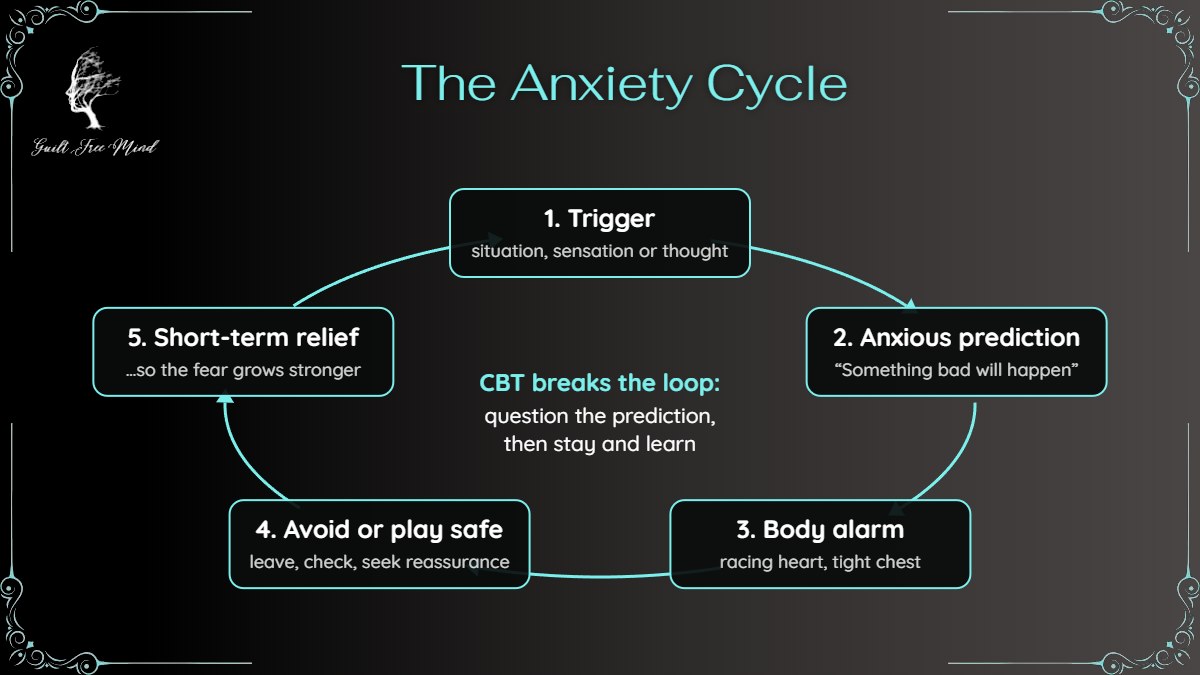
CBT breaks this loop at two points: it helps you question the prediction, and it helps you stay with the situation long enough to learn something new.
How CBT for Anxiety Works: The Core Techniques
1. Understanding your anxiety
Early sessions explain what anxiety is, why the body reacts the way it does, and how avoidance keeps fear going. This is called psychoeducation, and for many people it eases the feeling that something is “wrong” with them.
2. Cognitive restructuring
You learn to catch anxious predictions and look at them like a scientist: How likely is this, really? What is the evidence for and against it? If it did happen, how would I cope? A written “thought record” is the classic tool.
Example (illustrative): “If I speak up in the meeting, everyone will think I’m stupid” (belief: 90%). Evidence: the last time I spoke up, a colleague agreed with my point. A more balanced thought: “Some people may disagree, and I can handle that” (belief in the original thought now: 40%).
3. Exposure: facing fears step by step
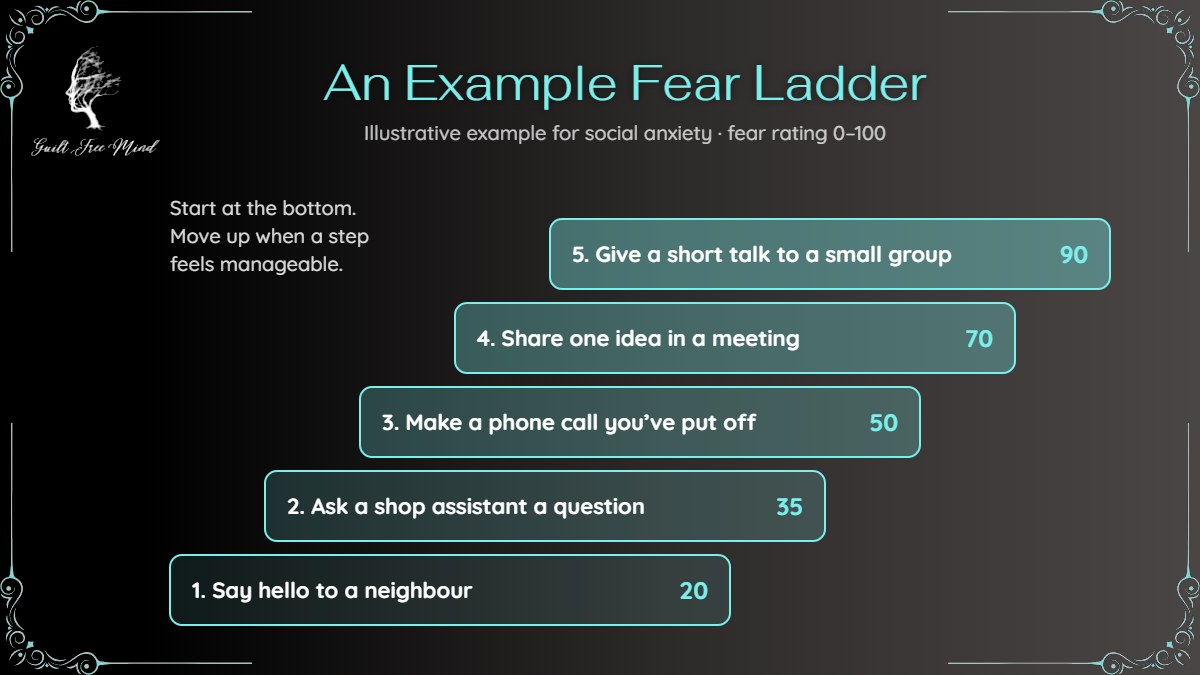
Exposure means gradually and deliberately approaching what you fear—situations, places, memories or body sensations—without escaping. You and your therapist build a “fear ladder,” starting with steps that feel challenging but manageable.
Research on how exposure works suggests the goal is not simply to wait for anxiety to fade, but to learn that the feared outcome doesn’t happen, or that you can cope if it does. Therapists strengthen this learning by designing exposures that test a specific prediction, removing safety behaviours and practising in different places (Craske et al., 2014).
4. Dropping safety behaviours
Safety behaviours are the small things we do to stop a feared outcome—gripping a rail, avoiding eye contact, carrying water “just in case,” checking your pulse. They bring short-term relief but stop you from discovering that you would have been fine. CBT helps you drop them one at a time.
5. Behavioral experiments
A behavioral experiment is a planned test of an anxious belief. You write down what you predict will happen, carry out the experiment, then compare the result with your prediction.
6. Relaxation and breathing skills
Some programmes teach applied relaxation—learning to spot early signs of tension and relax quickly—and NICE lists it as an alternative to CBT for generalized anxiety. Slow breathing can also calm the body’s alarm; see our guide to deep breathing for anxiety and progressive muscle relaxation. In CBT, these skills help you stay in a situation, not escape it.
7. Working with worry
For people who worry constantly, CBT targets the worry habit itself: noticing when worry has become a chain of “what ifs,” telling solvable problems from hypothetical ones, problem-solving the solvable ones and learning to live with uncertainty about the rest. If your mind tends to loop, our guide to overthinking and our post on talk therapy for overthinking may help.
CBT for Different Types of Anxiety
CBT is not one-size-fits-all. Therapists use versions developed for each anxiety disorder, and the UK’s National Institute for Health and Care Excellence (NICE) gives typical course lengths in its guidelines on generalized anxiety and panic disorder and social anxiety disorder.
| Type of anxiety | What CBT focuses on | Typical course (NICE) |
|---|---|---|
| Generalized anxiety disorder | Persistent worry, “what if” thinking, difficulty tolerating uncertainty, tension | CBT or applied relaxation: usually 12–15 weekly one-hour sessions |
| Panic disorder | Catastrophic misreading of body sensations (“I’m having a heart attack”), avoiding places and sensations | About 7–14 hours in total, over no more than four months |
| Social anxiety disorder | Fear of judgement, self-focus, safety behaviours, replaying events afterwards | Individual CBT designed for social anxiety (Clark and Wells or Heimberg model): up to 14–16 sessions over about four months |
| Specific phobias | Fear and avoidance of a particular object or situation | Exposure-based therapy; length varies |
Related conditions have their own versions too: obsessive-compulsive disorder is usually treated with a form of CBT called exposure and response prevention, and post-traumatic stress disorder with trauma-focused CBT or EMDR (see our guide to EMDR therapy for anxiety). For a closer look at one specific phobia, read about phasmophobia, the fear of ghosts.
CBT for social anxiety
For social anxiety, a large network meta-analysis of 101 trials (13,164 participants) found that individual CBT had the largest effect of the psychological treatments studied, and it was one of only two treatment types that beat a placebo (the other was SSRI or SNRI antidepressants compared with a pill placebo). The authors concluded that individual CBT should be regarded as the best initial treatment (Mayo-Wilson et al., 2014). NICE recommends individual rather than group CBT as the first choice. Read more about social anxiety disorder, or try our social anxiety self-tests.
CBT for panic attacks
In panic disorder, CBT targets the fear of the sensations themselves. Alongside cognitive work, therapists often use interoceptive exposure—safely bringing on sensations such as a fast heartbeat or dizziness, for example by running on the spot or spinning in a chair—so you learn they are uncomfortable but not dangerous. Do this with a professional, especially if you have a heart or lung condition. Learn more about panic attack symptoms and how anxiety differs from a panic attack.
CBT for generalized anxiety
With generalized anxiety, the main target is chronic worry. CBT for generalized anxiety disorder showed some of the larger placebo-controlled effects in a 2018 meta-analysis (Carpenter et al., 2018), and its benefits were still measurable a year or more after treatment ended (van Dis et al., 2020). Read more about generalized anxiety disorder.
How Effective Is Cognitive Behavioral Therapy for Anxiety?
CBT has been tested in a very large number of trials, and the overall picture is encouraging—though more modest than headlines often suggest.
Key studies at a glance
| Study | What it looked at | What it found |
|---|---|---|
| Hofmann & Smits, 2008 | 27 placebo-controlled trials in adults | CBT beat placebo; strongest effects for OCD and acute stress disorder, weakest for panic disorder |
| Carpenter et al., 2018 | 41 placebo-controlled trials, 2,843 people | Moderate benefit over placebo overall; large effects for OCD, generalized anxiety and acute stress disorder; odds of responding about three times higher than with placebo |
| Cuijpers et al., 2016 | 144 trials of CBT for depression, generalized anxiety, panic and social anxiety | Large effects against waiting lists, but small to moderate against usual care or pill placebo; only 17.4% of trials were high quality |
| Loerinc et al., 2015 | 87 studies reporting response rates | 49.5% responded by the end of treatment and 53.6% at follow-up |
| Springer et al., 2018 | 100 studies reporting remission | Average remission rate of 51% |
| van Dis et al., 2020 | 69 trials, 4,118 outpatients (mostly low-quality trials) | Benefits lasted 6–12 months; beyond 12 months still seen for generalized anxiety, social anxiety and PTSD, but not panic disorder |
| Carlbring et al., 2018 | 20 trials comparing guided internet CBT with face-to-face CBT (1,418 people) | Equivalent overall effects |
| James et al., 2020 (Cochrane) | 87 trials, 5,964 children and teenagers | Remission in 49.4% with CBT vs 17.8% on waiting lists |
Two honest caveats. First, many trials compared CBT with a waiting list, which makes almost any active treatment look good; against stronger comparisons the benefit is smaller (Cuijpers et al., 2016). Second, “about half respond” also means about half don’t respond fully. If CBT hasn’t helped you, it doesn’t mean you have failed—your therapist may adjust the approach, or you may combine it with medication.
CBT or Medication for Anxiety?
Both can work, and neither suits everyone. For generalized anxiety and panic disorder, NICE advises offering either a high-intensity psychological therapy (CBT or applied relaxation) or medication, guided by your preference, because there is no evidence that one is better than the other. For social anxiety disorder, NICE recommends individual CBT first and notes that antidepressants are usually not as helpful.
A large 2015 meta-analysis found bigger average before-and-after improvements with medication than with psychotherapies, and large improvements when CBT and medication were combined (Bandelow et al., 2015). But before-and-after changes also include placebo effects and natural recovery, so they are not a fair head-to-head test. Medication can have side effects, and some people prefer skills they can keep using. If you take medication for anxiety, don’t stop or change it without your doctor. For an overview of other options, see our guide to anxiety treatments.
What to Expect in CBT Sessions
- Assessment: your therapist asks about your symptoms, triggers and goals, and may use short questionnaires to track progress.
- A shared plan: you agree on goals and roughly how many sessions you will need.
- Structured sessions: each one usually starts by reviewing the past week and setting an agenda.
- Practice between sessions: thought records, exposure steps or behavioral experiments. Much of the change happens here.
- A relapse-prevention plan: near the end, you write down what to do if anxiety creeps back.
Sessions can be face to face, by video or through guided online programmes. In a review of 64 trials, internet-delivered CBT for depression, panic disorder, social anxiety and generalized anxiety was effective, and the gains held at follow-up (Andrews et al., 2018).
Expect some discomfort. Exposure is meant to feel challenging—but a good therapist moves at a pace you agree to and never forces you.
CBT Techniques You Can Try at Home
Self-help is not a substitute for therapy when anxiety is severe, but these CBT-based steps are a gentle place to start:
- Catch the prediction. When anxiety rises, write down exactly what you fear will happen and how strongly you believe it (0–100%).
- Check the evidence. What happened the last few times you felt this way? What would you tell a friend with the same worry?
- Build a small fear ladder. List the situations you avoid, from easiest to hardest, and start with one near the bottom.
- Drop one safety behaviour. Try the situation without your usual “just in case” habit and notice what actually happens.
- Compare prediction and result. After each step, write down what you learned, not just how anxious you felt.
- Steady the body, then stay. Use slow breathing to settle yourself, then stay in the situation rather than leaving.
If your anxiety is linked to trauma, or exposure feels overwhelming, work through it with a therapist rather than alone. A journal makes these steps easier — see how to start journaling or our daily journaling prompts.
How to Find a CBT Therapist
Look for a licensed mental health professional trained in CBT for your type of anxiety. Useful questions to ask: Which CBT approach do you use for my problem? Does treatment include exposure? How many sessions do you expect, and how will we measure progress?
- United States: the Association for Behavioral and Cognitive Therapies (ABCT) runs a Find a CBT Therapist directory. ABCT doesn’t certify therapists, so check the person’s licence with your state board.
- United Kingdom: in England, NHS Talking Therapies offers CBT for anxiety, and you can usually refer yourself.
- India: look for an RCI-registered clinical psychologist or a psychiatrist; Tele-MANAS (14416) can help you find support.
New to therapy? Our guide to counselling explains what to expect. To see how the same approach is used for low mood, read our guide to cognitive behavioral therapy for depression.
Is CBT Right for You?
CBT tends to suit people who want a practical, skills-based approach and are willing to practise between sessions. If you are also dealing with severe depression, substance use or recent trauma, tell your therapist—treatment may need to start there or be adapted. Other options include medication, applied relaxation and other therapies; what matters most is finding an approach, and a therapist, you trust.
Keep Reading on Guilt Free Mind
- Anxiety disorders: a complete guide
- 6 types of anxiety disorders
- 15 signs of anxiety disorder
- 22 Tips To Treat Anxiety Disorders
- Combat everyday stress: 25 brilliant strategies
- Causes of anxiety: a complete guide
- When Anxiety Feels Physical: Immune Signals
- Cognitive Behavioral Therapy: A guide
- Cognitive Behavioral Therapy for Depression
When to Get Help
Talk to a doctor or mental health professional if anxiety lasts for weeks, gets in the way of work, school or relationships, makes you avoid places or people, or comes with panic attacks. Anxiety disorders are common and treatable, and you don’t have to wait until things feel unbearable.
If you are struggling or having thoughts of harming yourself, please reach out now: in the US, call or text 988; in India, call Tele-MANAS on 14416 (or 112 in an emergency); in the UK and Ireland, call Samaritans on 116 123.
Frequently Asked Questions
A structured, short-term talk therapy that helps you spot and question anxious predictions and gradually face what you avoid, so you learn that feared situations are safer and more manageable than they feel.
It depends on the problem. NICE suggests 12–15 weekly one-hour sessions for generalized anxiety, about 7–14 hours over up to four months for panic disorder, and up to 14–16 sessions over about four months for social anxiety.
In research reviews, about half of people respond to CBT and around half reach remission, and for many the benefits last at least 6–12 months. It works better than placebo, though the advantage is smaller than against a waiting list.
Self-help and guided online CBT programmes can help; in head-to-head trials, guided internet CBT did about as well as face-to-face therapy. If anxiety is severe or linked to trauma, work with a therapist.
Not necessarily. For generalized anxiety and panic disorder, NICE treats CBT and medication as equal options chosen by preference. For social anxiety, individual CBT is the recommended first choice. Never stop medication without your doctor.
Usually a check-in on the past week, an agenda, work on one skill, such as questioning a thought or planning an exposure step, and practice to do before the next session.
About the Author
Dr. Shruti Bhattacharya is the founder and heart of Guilt Free Mind, where she combines a Ph.D. in Immunology with training in psychology to deliver science-backed mental health strategies. Her mission is to empower readers to overcome stress, anxiety, and emotional challenges with practical, evidence-based tools. Dr. Bhattacharya’s unique blend of expertise and empathy shapes her approach to wellness:
- Academic & Scientific Rigor – Holding a Ph.D. in Immunology and a Bachelor’s degree in Microbiology, Dr. Bhattacharya brings a deep understanding of the biological foundations of mental health, including the gut-brain connection. Her completion of psychology courses, such as The Psychology of Emotions: An Introduction to Embodied Cognition, enhances her ability to bridge science and emotional well-being.
- Dedicated Mental Health Advocacy – With over 15 years of experience, Dr. Bhattacharya has supported hundreds of individuals through online platforms and personal guidance, helping them navigate mental health challenges with actionable strategies. Her work has empowered readers to adopt holistic practices, from mindfulness to nutrition, for lasting resilience.
- Empathetic Connection to Readers – Known for her compassionate and relatable voice, Dr. Bhattacharya is a trusted guide in mental health, turning complex research into accessible advice. Her personal journey as a trauma survivor fuels her commitment to helping others find calm and confidence.
- Lifelong Commitment to Wellness – Dr. Bhattacharya lives the principles she shares, integrating science-based habits like balanced nutrition and stress management into her daily life. Her personal exploration of mental health strategies inspires Guilt Free Mind’s practical, reader-focused content.
🏆 Guilt Free Mind was named one of the Top 100 Mental Health Blogs on Feedspot.

Disclaimer: This content is for informational purposes only and is not a substitute for professional medical advice.
References
- Andrews, G., Basu, A., Cuijpers, P., Craske, M., McEvoy, P., English, C., & Newby, J. (2018). Computer therapy for the anxiety and depression disorders is effective, acceptable and practical health care: An updated meta-analysis. Journal of Anxiety Disorders, 55, 70–78. https://doi.org/10.1016/j.janxdis.2018.01.001
- Bandelow, B., Reitt, M., Röver, C., Michaelis, S., Görlich, Y., & Wedekind, D. (2015). Efficacy of treatments for anxiety disorders. International Clinical Psychopharmacology, 30(4), 183–192. https://doi.org/10.1097/YIC.0000000000000078
- Carlbring, P., Andersson, G., Cuijpers, P., Riper, H., & Hedman-Lagerlöf, E. (2018). Internet-based vs. face-to-face cognitive behavior therapy for psychiatric and somatic disorders: an updated systematic review and meta-analysis. Cognitive Behaviour Therapy, 47(1), 1–18. https://doi.org/10.1080/16506073.2017.1401115
- Carpenter, J. K., Andrews, L. A., Witcraft, S. M., Powers, M. B., Smits, J. A. J., & Hofmann, S. G. (2018). Cognitive behavioral therapy for anxiety and related disorders: A meta‐analysis of randomized placebo‐controlled trials. Depression and Anxiety, 35(6), 502–514. https://doi.org/10.1002/da.22728
- Craske, M. G., Treanor, M., Conway, C. C., Zbozinek, T., & Vervliet, B. (2014). Maximizing exposure therapy: An inhibitory learning approach. Behaviour Research and Therapy, 58, 10–23. https://doi.org/10.1016/j.brat.2014.04.006
- Cuijpers, P., Cristea, I. A., Karyotaki, E., Reijnders, M., & Huibers, M. J. (2016). How effective are cognitive behavior therapies for major depression and anxiety disorders? A meta‐analytic update of the evidence. World Psychiatry, 15(3), 245–258. https://doi.org/10.1002/wps.20346
- Hofmann, S. G., & Smits, J. A. J. (2008). Cognitive-behavioral therapy for adult anxiety disorders: A meta-analysis of randomized placebo-controlled trials. The Journal of Clinical Psychiatry, 69(4), 621–632. https://doi.org/10.4088/JCP.v69n0415
- James, A. C., Reardon, T., Soler, A., James, G., & Creswell, C. (2020). Cognitive behavioural therapy for anxiety disorders in children and adolescents. Cochrane Database of Systematic Reviews, 2020(11), CD013162. https://doi.org/10.1002/14651858.CD013162.pub2
- Kaczkurkin, A. N., & Foa, E. B. (2015). Cognitive-behavioral therapy for anxiety disorders: an update on the empirical evidence. Dialogues in Clinical Neuroscience, 17(3), 337–346. https://doi.org/10.31887/DCNS.2015.17.3/akaczkurkin
- Loerinc, A. G., Meuret, A. E., Twohig, M. P., Rosenfield, D., Bluett, E. J., & Craske, M. G. (2015). Response rates for CBT for anxiety disorders: Need for standardized criteria. Clinical Psychology Review, 42, 72–82. https://doi.org/10.1016/j.cpr.2015.08.004
- Mayo-Wilson, E., Dias, S., Mavranezouli, I., Kew, K., Clark, D. M., Ades, A. E., & Pilling, S. (2014). Psychological and pharmacological interventions for social anxiety disorder in adults: a systematic review and network meta-analysis. The Lancet Psychiatry, 1(5), 368–376. https://doi.org/10.1016/S2215-0366(14)70329-3
- National Institute for Health and Care Excellence. (2011, updated 2020). Generalised anxiety disorder and panic disorder in adults: management (Clinical guideline CG113). https://www.nice.org.uk/guidance/cg113
- National Institute for Health and Care Excellence. (2013). Social anxiety disorder: recognition, assessment and treatment (Clinical guideline CG159). https://www.nice.org.uk/guidance/cg159
- National Institute of Mental Health. Any anxiety disorder. https://www.nimh.nih.gov/health/statistics/any-anxiety-disorder
- Springer, K. S., Levy, H. C., & Tolin, D. F. (2018). Remission in CBT for adult anxiety disorders: A meta-analysis. Clinical Psychology Review, 61, 1–8. https://doi.org/10.1016/j.cpr.2018.03.002
- van Dis, E. A. M., van Veen, S. C., Hagenaars, M. A., Batelaan, N. M., Bockting, C. L. H., van den Heuvel, R. M., Cuijpers, P., & Engelhard, I. M. (2020). Long-term outcomes of cognitive behavioral therapy for anxiety-related disorders: A systematic review and meta-analysis. JAMA Psychiatry, 77(3), 265–273. https://doi.org/10.1001/jamapsychiatry.2019.3986
