
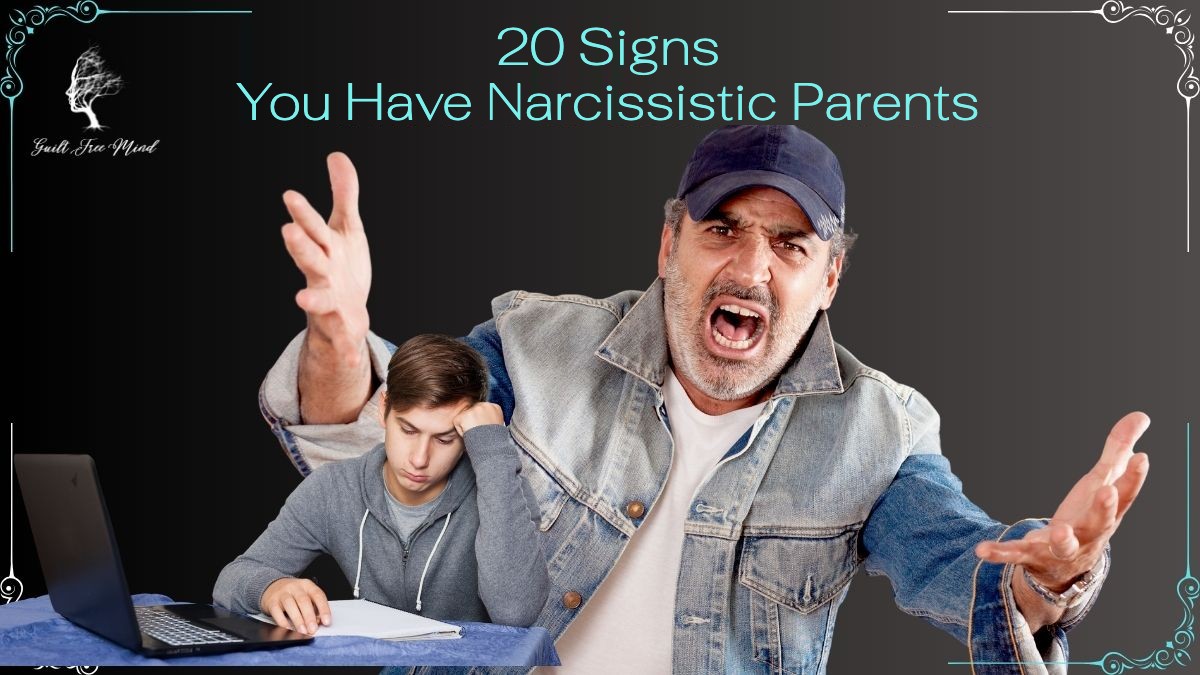

Quick answer: Narcissistic parents treat their child as an extension of themselves. Their needs, image and feelings come first, love feels conditional, and the child’s independence is seen as a threat. Common signs include constant control, guilt-tripping, gaslighting, the silent treatment, comparisons and jealousy of your success. Growing up this way is linked with anxiety, depression and fragile self-esteem — but with boundaries, support and self-compassion, you can heal.
Every parent is self-centred sometimes. Every parent gets things wrong. But some people grow up with a parent whose love always seemed to come with conditions — a parent who needed to be admired, who couldn’t bear to be wrong, and who made the child’s feelings smaller so their own could be bigger. If you’re reading this, a part of you may be wondering whether that was your childhood.
In this post, I’ll walk you through what narcissistic parenting looks like, 20 signs to watch for, what research says about how it affects children, and — most importantly — how to protect yourself and heal.
Table of Contents
At a Glance: Narcissistic Parents
| Question | Short answer |
|---|---|
| What is a narcissistic parent? | A parent with strong narcissistic traits who puts their own needs, image and feelings above the child’s |
| How common is it? | Narcissistic personality disorder affects about 1% of adults on average (0–6.2% across studies); narcissistic traits are more common and exist on a spectrum |
| Key signs | Control, conditional love, guilt-tripping, gaslighting, silent treatment, comparisons, jealousy, no apologies |
| Effects on children | Linked with anxiety, depression, unstable self-esteem, people-pleasing and self-doubt |
| Can they change? | Rarely without the person wanting help; it is safer to focus on what you can control |
| What helps | Boundaries, managing contact, support, therapy and self-compassion |
| Get help now if | You feel unsafe, overwhelmed or are thinking about harming yourself |
What Is a Narcissistic Parent?
Narcissism exists on a spectrum. At one end are ordinary, healthy levels of self-confidence. At the other is narcissistic personality disorder (NPD), a mental health condition marked by grandiosity, a need for admiration and a lack of empathy. A systematic review of community studies found that NPD affects about 1% of adults on average, with estimates ranging from 0% to 6.2% (Dhawan et al., 2010). Many more people have strong narcissistic traits without meeting the criteria for a disorder.
Only a qualified professional can diagnose NPD — and you don’t need a diagnosis to recognise a painful pattern. A “narcissistic parent”, in everyday language, is a parent whose narcissistic traits shape how they raise their child: the child exists to meet the parent’s needs, rather than the other way round.
High expectations, strictness or a bad temper on their own don’t make a parent narcissistic. The difference is that a narcissistic parent struggles to see you as a separate person with your own feelings, needs and right to grow up and away.
Two Faces of a Narcissistic Parent: Grandiose and Vulnerable
Researchers describe two broad forms of narcissism (Pincus & Lukowitsky, 2010; Miller et al., 2011):
- Grandiose: loud, dominant, boastful and controlling. This parent needs to be the centre of attention and is openly critical.
- Vulnerable: fragile, easily hurt, resentful and prone to sulking or playing the victim. This parent may seem shy or anxious, yet still makes everything about their own feelings.
Many parents show a mix of both. The vulnerable form is easier to miss, because it can look like sensitivity rather than self-centredness.
20 Signs You Have Narcissistic Parents
Most of these behaviours happen in every family now and then. What matters is the overall pattern: how often they happen, how long they’ve gone on, and how they leave you feeling.
They Make Your Life About Them
- 1. They live through you. Your grades, career or marriage are treated as their trophies. You’re expected to think, want and choose what they would.
- 2. Their feelings always come first. If you’re upset, the conversation soon becomes about how they feel about you being upset.
- 3. Every conversation circles back to them. You share news, and within minutes you’re listening to their story.
- 4. They take credit for your successes — “You got that from me” — but your failures are yours alone.
They Need Control
- 5. They expect total obedience. Disagreeing is treated as disrespect or betrayal, even when you’re an adult.
- 6. They try to control your choices — your studies, career, friends, partner, clothes or where you live.
- 7. They don’t respect boundaries. They read your messages, drop in uninvited, share your private news or keep pushing after you’ve said no.
- 8. They monopolise your time and make you feel guilty for having a life of your own.
- 9. They set impossible standards — and then blame you for not meeting them.
Their Love Feels Conditional
- 10. Love depends on performance. You feel loved when you obey or achieve, and cold-shouldered when you don’t.
- 11. Your emotional needs are ignored. Fear, sadness or anger are dismissed as “drama” or “overreacting”.
- 12. They use the silent treatment as punishment — sometimes for days, weeks or even years.
- 13. They’re hot and cold. Affectionate one minute, cutting or furious the next, so you never quite feel safe.
Research shows why conditional love hurts so much. In studies of mothers and their adult daughters, and of college students, people who felt their parents’ approval depended on meeting expectations had less stable self-esteem and felt more resentment towards their parents — and mothers who had grown up with conditional regard were more likely to use it with their own daughters (Assor, Roth & Deci, 2004). Being ignored hurts too: even brief experiences of being shut out threaten our sense of belonging, self-esteem and control, and long-term ostracism is linked with depression and helplessness (Williams, 2007).
They Manipulate and Blame
- 14. They gaslight you. “That never happened.” “You’re too sensitive.” Gaslighting is a form of psychological abuse that aims to make someone seem or feel “crazy” (Sweet, 2019) — and in childhood, it can teach you to distrust your own memory.
- 15. They guilt-trip and play the victim. “After everything I’ve done for you…” Some parents suddenly feel unwell or fall apart whenever you set a limit. (Always take real health concerns seriously — the pattern to notice is illness that appears on cue and disappears once you give in.)
- 16. They never admit fault. Apologies are rare, and when something goes wrong, it’s somehow your fault.
- 17. They compare you and play favourites. You’re measured against siblings, cousins or the neighbour’s child — and one child may be idealised while another is blamed for everything.
They Care About Image — and Compete With You
- 18. Image is everything. The family looks perfect in public, but behaves very differently behind closed doors.
- 19. They can dish out criticism but can’t take it. They mock or humiliate you — often as a “joke” — yet react furiously to the gentlest feedback.
- 20. They’re jealous of your success. Instead of celebrating your achievements, they belittle them, change the subject or compete with you.
How Narcissistic Parenting Affects Children
Growing up with a parent like this can leave a deep mark. Here’s what research suggests — with an important caveat: most of these studies show links, not proof of cause and effect, and many people from these families go on to live full, loving lives.
- Anxiety and depression. In a study of 409 young adults and both their parents, parents’ narcissism was related to their children’s depression and anxiety, partly through the way the children remembered being raised (Dentale et al., 2015).
- Being the family scapegoat. In a study of 504 young adults, those who saw their parents as more narcissistic were more likely to report being scapegoated, and scapegoating was linked with more anxiety and depression (Vignando & Bizumic, 2023).
- Psychological control. Parenting that controls through guilt, shame and withdrawal of love consistently predicts depression in young people (Barber, 1996).
- Growing up too fast. Children who become their parent’s emotional caretaker — known as “parentification” — show a small but reliable link with mental health difficulties in adulthood (Hooper et al., 2011).
- Emotional abuse and neglect. A large meta-analysis of 192 samples found that emotional abuse and emotional neglect had the strongest links with depression of any form of childhood maltreatment (Humphreys et al., 2020).
Interestingly, narcissistic traits can be passed on. In a study that followed 565 children over 18 months, children whose parents overvalued them — treating them as more special than others — developed more narcissistic traits, while children who received parental warmth developed healthier self-esteem (Brummelman et al., 2015). Warmth, not praise for being special, is what builds a secure sense of self.
Patterns Many Adult Children Recognise
- People-pleasing and difficulty saying no
- Constant self-doubt, or second-guessing your own memory
- Perfectionism and a harsh inner critic
- Feeling guilty when you rest or put yourself first
- Being highly alert to other people’s moods
- Finding yourself in relationships that feel strangely familiar — if this resonates, my post on being married to a narcissist may help
The “Golden Child” and the “Scapegoat”
You may have heard these terms. In some families, one child is idealised (the “golden child”) and another becomes the target of blame (the “scapegoat”). Scapegoating has now been studied directly and is linked with anxiety and depression (Vignando & Bizumic, 2023). The “golden child” idea is widely used by therapists and survivors but hasn’t been researched in the same way. Both roles hurt: one child learns that love must be earned; the other learns that it can never be earned.
How to Deal with Narcissistic Parents
1. Name the Pattern — to Yourself
You don’t need to diagnose your parent or convince anyone else. Simply recognising “this is a pattern, and it isn’t my fault” can bring huge relief. Writing things down helps — try my daily journaling prompts.
2. Let Go of the Hope That They Will Change
This is often the hardest step. People with strong narcissistic traits rarely change unless they want to, and a review of community studies found no treatment studies for NPD that met its criteria (Dhawan et al., 2010). Grieving the parent you needed — rather than waiting for them to become that parent — frees up energy for your own life.
3. Set Short, Clear Boundaries
- Keep it simple: “I won’t discuss my marriage. If it comes up, I’ll leave.”
- Don’t over-explain — long explanations give them more to argue with.
- Expect pushback: guilt, anger, tears or the silent treatment. That doesn’t mean the boundary is wrong.
- Follow through calmly and consistently.
4. Share Less, React Less
Keep personal news, plans and vulnerabilities on a need-to-know basis. When conversations turn into criticism or drama, many people find it helps to stay calm, brief and factual — sometimes called the “grey rock” approach — so there’s less to fuel the conflict.
5. Build Some Independence
Financial and practical independence — your own income, your own space, your own support network — makes it much easier to hold boundaries without fear.
6. Choose Your Level of Contact
There’s no single right answer. Some people stay in close contact with firm boundaries; others choose shorter, structured visits; some choose low or no contact. In many Indian families, respect and duty towards parents run deep, and stepping back can feel unthinkable. Boundaries don’t have to be disrespectful: a shorter visit with a plan to leave, a phone call at a set time, or saying “Let’s not discuss this” are all ways of protecting yourself while staying connected.
If the situation involves violence or threats, your safety comes first. And if you are still a child or teenager living at home, please talk to a trusted adult — a relative, teacher or school counsellor.
If you are in danger, call your local emergency number (112 in India). If you are a child or teenager in India, you can call Childline on 1098. Tele-MANAS (14416) offers free mental health support in India any time of day. In the US, call or text 988; in the UK, call Samaritans on 116 123.
How to Heal from Narcissistic Parents
- Validate your experience. What happened to you was real. You weren’t too sensitive, and it wasn’t your fault.
- Be kind to yourself. Self-compassion is strongly linked with better mental health — a meta-analysis found a large association between higher self-compassion and fewer symptoms of anxiety, depression and stress (MacBeth & Gumley, 2012).
- Quiet the inner critic. Compassion-focused therapy (CFT), designed for people with high shame and self-criticism, has been shown to improve self-compassion and reduce self-criticism and depression (Millard et al., 2023).
- Consider trauma-focused therapy if memories still feel overwhelming. For adults with post-traumatic stress after childhood abuse, trauma-focused treatments work better than other approaches (Ehring et al., 2014). My post on talk therapy explains what to expect.
- Find your people. Friends, partners, support groups or online communities who believe you can help you rebuild trust.
- Break the cycle. If you’re a parent now, worrying about repeating the pattern is itself a good sign. Warmth, listening and letting your child be their own person matter more than praise for being “special” (Brummelman et al., 2015).
For more support, read healing from emotional abuse, gaslighting: signs and how to cope and signs you are being manipulated. If the parent in your life seems more cold and calculating than self-absorbed, my post on the psychopathic mother may resonate — and if the problem is your partner’s parent, see the narcissistic mother-in-law.
Quick Self-Check: Did You Grow Up with a Narcissistic Parent?
This isn’t a diagnosis — just a way to organise your thoughts. Notice how many of these feel true:
- I often felt I had to earn my parent’s love.
- My feelings were dismissed, mocked or turned into something about them.
- My parent rarely, if ever, apologised.
- I was compared with others or treated very differently from a sibling.
- My parent reacted with anger, tears or silence when I set a limit.
- My achievements were either ignored or taken over.
- As an adult, I still feel guilty, anxious or small around them.
If several of these ring true and they still affect you today, talking to a mental health professional can help you make sense of it. You deserve support.
Conclusion
Narcissistic parents live, in many ways, for themselves — and their children grow up learning to shrink, please and doubt. But the patterns you learned in childhood are not a life sentence. Naming what happened, setting boundaries, choosing your level of contact and treating yourself with the kindness you didn’t always receive are powerful steps towards a life that is truly your own. If you’d like to share your experience, you’re welcome to leave a comment below.
Do you wish to lead a more positive and worry-free life? Subscribe to Guilt Free Mind — the subscription option is in the sidebar. If you like watching videos, subscribe to the Guilt Free Mind YouTube channel too.
See you in my next blog post,
Dr. Shruti
Frequently Asked Questions
Common signs include treating you as an extension of themselves, needing to control your choices, love that depends on obedience or achievement, guilt-tripping, gaslighting, the silent treatment, constant comparisons, never apologising, caring mostly about their public image and being jealous of your success. What matters is a long-standing pattern, not one bad day.
A strict parent may have high standards and firm rules, but still sees you as a separate person and cares about your feelings and wellbeing. A narcissistic parent puts their own needs, image and feelings first, struggles to accept your independence and uses love, guilt or shame to control you.
Research links narcissistic parenting with higher anxiety and depression in adult children, and with less stable self-esteem. Many adult children also notice people-pleasing, perfectionism, self-doubt and guilt when putting themselves first. These are associations, not certainties, and they can improve with support.
People with strong narcissistic traits rarely change unless they recognise the problem and want help, and there is little research on treating narcissistic personality disorder. It is usually healthier to focus on your own boundaries and healing than to wait for a parent to change.
In some families with a narcissistic parent, one child is idealised (the golden child) and another is blamed for everything (the scapegoat). Research has linked being scapegoated with anxiety and depression. Both roles can be harmful, because love depends on the role rather than on who the child really is.
It depends on your situation, safety and values. Some people keep close contact with firm boundaries, others choose low or structured contact, and some choose no contact. There is no single right answer. A therapist can help you think it through, and if you are ever unsafe, your safety comes first.
About the Author
Dr. Shruti Bhattacharya is the founder and heart of Guilt Free Mind, where she combines a Ph.D. in Immunology with advanced psychology training to deliver science-backed mental health strategies. Her mission is to empower readers to overcome stress, anxiety, and emotional challenges with practical, evidence-based tools. Dr. Bhattacharya’s unique blend of expertise and empathy shapes her approach to wellness:
- Academic & Scientific Rigor – Holding a Ph.D. in Immunology and a Bachelor’s degree in Microbiology, Dr. Bhattacharya brings a deep understanding of the biological foundations of mental health, including the gut-brain connection. Her completion of psychology courses, such as The Psychology of Emotions: An Introduction to Embodied Cognition, from University of Cambridge enhances her ability to bridge science and emotional well-being.
- Dedicated Mental Health Advocacy – With over 15 years of experience, Dr. Bhattacharya has supported hundreds of individuals through online platforms and personal guidance, helping them navigate mental health challenges with actionable strategies. Her work has empowered readers to adopt holistic practices, from mindfulness to nutrition, for lasting resilience.
- Empathetic Connection to Readers – Known for her compassionate and relatable voice, Dr. Bhattacharya is a trusted guide in mental health, turning complex research into accessible advice. Her personal journey as a trauma survivor fuels her commitment to helping others find calm and confidence.
- Lifelong Commitment to Wellness – Dr. Bhattacharya lives the principles she shares, integrating science-based habits like balanced nutrition and stress management into her daily life. Her personal exploration of mental health strategies inspires Guilt Free Mind’s practical, reader-focused content.
🏆 Guilt Free Mind was named one of the Top 100 Mental Health Blogs on Feedspot in 2025.

Follow me on:
Disclaimer: This content is for informational purposes only and is not a substitute for professional medical advice.
References
- Assor, A., Roth, G., & Deci, E. L. (2004). The emotional costs of parents’ conditional regard: A self-determination theory analysis. Journal of Personality, 72(1), 47–88. https://doi.org/10.1111/j.0022-3506.2004.00256.x
- Barber, B. K. (1996). Parental psychological control: Revisiting a neglected construct. Child Development, 67(6), 3296–3319. https://doi.org/10.1111/j.1467-8624.1996.tb01915.x
- Brummelman, E., Thomaes, S., Nelemans, S. A., Orobio de Castro, B., Overbeek, G., & Bushman, B. J. (2015). Origins of narcissism in children. Proceedings of the National Academy of Sciences, 112(12), 3659–3662. https://doi.org/10.1073/pnas.1420870112
- Dentale, F., Verrastro, V., Petruccelli, I., Diotaiuti, P., Petruccelli, F., Cappelli, L., & San Martini, P. (2015). Relationship between parental narcissism and children’s mental vulnerability: Mediation role of rearing style. International Journal of Psychology and Psychological Therapy, 15(3), 337–347. ijpsy.com
- Dhawan, N., Kunik, M. E., Oldham, J., & Coverdale, J. (2010). Prevalence and treatment of narcissistic personality disorder in the community: A systematic review. Comprehensive Psychiatry, 51(4), 333–339. https://doi.org/10.1016/j.comppsych.2009.09.003
- Ehring, T., Welboren, R., Morina, N., Wicherts, J. M., Freitag, J., & Emmelkamp, P. M. G. (2014). Meta-analysis of psychological treatments for posttraumatic stress disorder in adult survivors of childhood abuse. Clinical Psychology Review, 34(8), 645–657. https://doi.org/10.1016/j.cpr.2014.10.004
- Hooper, L. M., DeCoster, J., White, N., & Voltz, M. L. (2011). Characterizing the magnitude of the relation between self-reported childhood parentification and adult psychopathology: A meta-analysis. Journal of Clinical Psychology, 67(10), 1028–1043. https://doi.org/10.1002/jclp.20807
- Humphreys, K. L., LeMoult, J., Wear, J. G., Piersiak, H. A., Lee, A., & Gotlib, I. H. (2020). Child maltreatment and depression: A meta-analysis of studies using the Childhood Trauma Questionnaire. Child Abuse & Neglect, 102, 104361. https://doi.org/10.1016/j.chiabu.2020.104361
- MacBeth, A., & Gumley, A. (2012). Exploring compassion: A meta-analysis of the association between self-compassion and psychopathology. Clinical Psychology Review, 32(6), 545–552. https://doi.org/10.1016/j.cpr.2012.06.003
- Millard, L. A., Wan, M. W., Smith, D. M., & Wittkowski, A. (2023). The effectiveness of compassion focused therapy with clinical populations: A systematic review and meta-analysis. Journal of Affective Disorders, 326, 168–192. https://doi.org/10.1016/j.jad.2023.01.010
- Miller, J. D., Hoffman, B. J., Gaughan, E. T., Gentile, B., Maples, J., & Campbell, W. K. (2011). Grandiose and vulnerable narcissism: A nomological network analysis. Journal of Personality, 79(5), 1013–1042. https://doi.org/10.1111/j.1467-6494.2010.00711.x
- Pincus, A. L., & Lukowitsky, M. R. (2010). Pathological narcissism and narcissistic personality disorder. Annual Review of Clinical Psychology, 6, 421–446. https://doi.org/10.1146/annurev.clinpsy.121208.131215
- Sweet, P. L. (2019). The sociology of gaslighting. American Sociological Review, 84(5), 851–875. https://doi.org/10.1177/0003122419874843
- Vignando, M., & Bizumic, B. (2023). Parental narcissism leads to anxiety and depression in children via scapegoating. The Journal of Psychology, 157(2), 121–141. https://doi.org/10.1080/00223980.2022.2148088
- Williams, K. D. (2007). Ostracism. Annual Review of Psychology, 58, 425–452. https://doi.org/10.1146/annurev.psych.58.110405.085641

3 Comments
I read the whole article. very well written Shruti covering each and every point comprehensively
Thank you so much!! I really appreciate it.
Thanks for sharing. I read many of your blog posts, cool, your blog is very good.