


This article is for information only and isn’t a substitute for advice from your doctor or mental health professional.
Table of Contents
Quick Answer
Positive affirmations are short, positive statements about yourself that you say, think or write down, such as “I can handle this.” They can help some people feel calmer and more confident, especially when they are believable and linked to what matters to them. But big, hard-to-believe statements can backfire: in one study, people with low self-esteem who repeated “I’m a lovable person” felt worse, not better (Wood et al., 2009). The form with the most research behind it is reflecting on your own core values, known as self-affirmation (Cohen & Sherman, 2014).
You have probably heard the saying “if you believe it, you can achieve it.” That is a kind of positive affirmation. Here are a few simple examples:
- Today will be a good day.
- I believe in myself.
- I am going to give this project my best.
These are simple statements that are easy to remember. Used well, they can help you shift your focus from your perceived failures towards your strengths. Used badly, they can leave you feeling like a fraud. In this guide, I explain what positive affirmations are, how they may work, what the research really says, when they can backfire, and how to write affirmations you can actually believe.
What Are Positive Affirmations?
When we keep telling ourselves that we are not good enough, those thoughts can start to feel like facts. They can drag us down in our relationships, our careers and our personal lives.
Positive affirmations are phrases you repeat to yourself, out loud or in your head, to build yourself up. They can be especially useful when you feel low, when a day is going badly, or before something that makes you nervous. The idea is not to pretend everything is perfect, but to give your mind a more balanced and encouraging message to hold on to.
Are Positive Affirmations Just Wishful Thinking?
Many people are skeptical, and that is understandable. One helpful way to think about affirmations is like exercise. You don’t expect one workout to change your body, but regular training adds up. In the same way, regularly practicing kinder, more realistic ways of talking to yourself can slowly change how you approach challenges. The research, as you’ll see below, suggests that affirmations are not magic, but the right kind can make a real difference for some people.
How Positive Affirmations May Work
Your brain keeps changing in response to experience throughout life. That is one reason you don’t think the same way you did as a child. Our surroundings shape us too. If you are surrounded by negativity, or someone keeps putting you down, it is easy to lose focus and stop believing in yourself.
Self-Affirmation and Your Core Values
Psychologists have studied a specific kind of affirmation called self-affirmation. Instead of repeating a slogan, people usually write about a value that matters deeply to them, such as family, kindness, honesty or creativity. This seems to give people a broader sense of who they are, so a single threat, like a tough review or a mistake, feels less overwhelming. Studies have linked timely self-affirmations with better outcomes in education, health and relationships, sometimes lasting for months or even years (Cohen & Sherman, 2014).
What Happens in the Brain
In a brain-imaging study, people who did a self-affirmation task showed more activity in brain systems involved in thinking about the self and in reward and valuing, particularly when they reflected on their core values in relation to the future. That brain activity also predicted how much less time people later spent sitting during a separate physical activity program (Cascio et al., 2016).
Using Mental Imagery
Many people combine affirmations with mental imagery. If you have an interview coming up, you might picture yourself walking in calmly, answering questions and shaking hands at the end. Imagining a situation going reasonably well can help you rehearse and feel more prepared, alongside real preparation.
From a Negative Thought to a Balanced One
Suppose you have a thought like this: “I’m terrible at interviews. Last time I froze. There’s no way I’ll get this job, so why bother preparing?”
Now try replacing it with something kinder that you can still believe: “I have the qualifications for this role, and I’m preparing well. I might feel nervous, and that’s okay. I can still answer clearly and show what I can do.”
Notice that this doesn’t claim you are the perfect candidate. It is encouraging, but realistic. That balance matters, as the research below shows.
Action Is the Key
Repeating an affirmation on its own won’t change much. It can boost your confidence and motivation, but it is a stepping stone, not the change itself. You still need to take action.
Imagine you live with a parent who wants to know every detail of your day, and the questions leave you frustrated. You can’t simply leave home right now. You might tell yourself, “I can stay calm inside, even when the questions annoy me.” Then pair that with action: practice slow breathing before you walk in (try the techniques in my guide to deep breathing for anxiety), answer a couple of questions, and then politely excuse yourself. The affirmation helped, but the breathing and the plan did a lot of the work too.
What the Research Says About Positive Affirmations
Problem-Solving Under Stress
In one experiment, 80 university students rated how stressed they had felt over the past month and were then randomly assigned to a self-affirmation task or a control task before solving difficult problems under time pressure, in front of an evaluator. Self-affirmation improved problem-solving in chronically stressed students who were otherwise underperforming (Creswell et al., 2013). Taking a few minutes to reflect on your values before a stressful moment, such as a review or an important meeting, is one way to use this idea.
Healthier Habits
A meta-analysis of 144 experiments found that self-affirmation had small but reliable effects on how open people were to health advice, how much they intended to change, and whether they actually changed their behavior (Epton et al., 2015). So if you have been meaning to eat better or move more, reflecting on what matters to you may make it a little easier to act on that advice.
Mood and Self-Esteem
This is where the evidence calls for care. In the study I mentioned earlier, people with high self-esteem who repeated “I’m a lovable person” felt slightly better, but people with low self-esteem felt worse (Wood et al., 2009). So if you are living with depression, anxiety or very low self-esteem, sweeping positive statements are not a treatment, and they may not feel helpful at all. Gentle, believable statements and values-based reflection are safer places to start, and therapy such as cognitive behavioral therapy can help you work on harsh self-talk in a structured way.
You may also like my video on why it matters to love yourself, on the Guilt Free Mind YouTube channel:
When Positive Affirmations Can Backfire
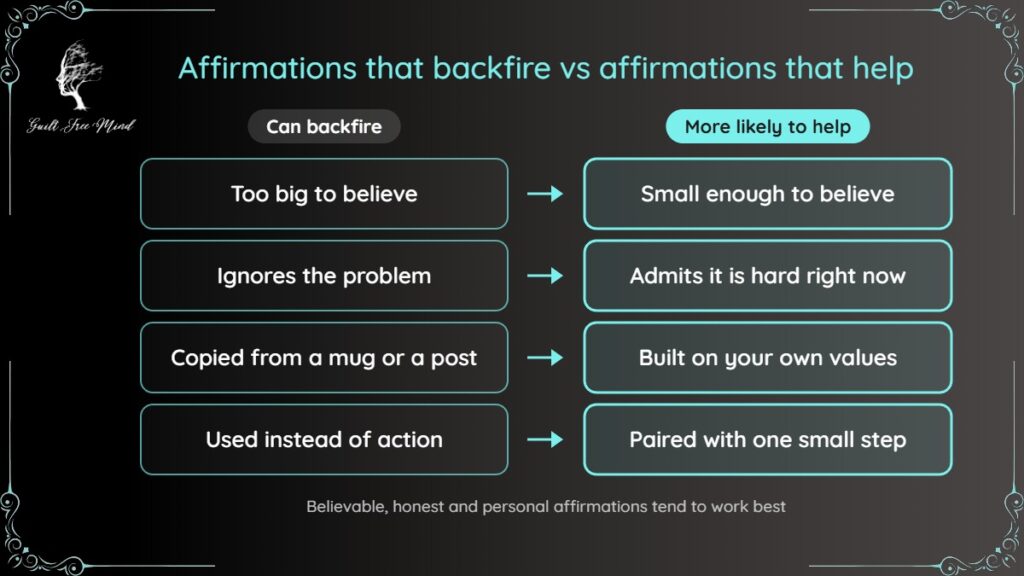
Why would a positive statement make someone feel worse? One explanation is that a statement that feels clearly untrue can remind you of the gap between where you are and where you want to be. In the same study, people with low self-esteem felt better when they were allowed to think about how the statement was both true and not true for them, rather than only how it was true (Wood et al., 2009).
That is why affirmations like these may not work very well:
- “I am the best-looking person in the world.”
- “I am amazing at everything.”
- “Everyone loves me and wants to spend time with me.”
They push you towards toxic positivity, where real feelings are brushed aside. Affirmations that admit your reality, stay believable and connect to your values are much more likely to help.
When to Use Positive Affirmations
You can use affirmations in any part of your life where you want to make a change, for example to:
- Steady your nerves before an important meeting or presentation
- Manage feelings like anger, frustration or impatience
- Speak to yourself more kindly after a mistake
- Keep going with a project you have started
- Support a habit you are trying to build or break
How to Write Positive Affirmations That Work
1. Choose an Area That Really Matters to You
Start by deciding what you want to work on. Maybe you want to manage your anger, be more patient, build closer friendships or feel more focused at work. Write your ideas down and pick the one that matters most. Affirmations work best when they connect to your own values, because then you feel genuinely motivated to act on them.
2. Make It Believable and Realistic
An affirmation should be grounded in reality. Suppose you are unhappy with your pay and want to ask for a raise, but you can’t find the courage. An affirmation like “I can calmly explain the value I bring” supports that goal. Telling yourself that your boss will double your salary does not, because part of you knows it is unlikely. Affirmations are not a magic spell. If you don’t believe a statement at all, soften it until you can.
3. Turn a Specific Negative Thought Into a Balanced One
Notice the specific thoughts that keep bothering you and write them down. Then write a kinder, more balanced alternative. If you keep thinking that you’re not good enough to progress in your career, you might write: “I am skilled and reliable at my job. I finish my work on time. I deserve to be considered for a promotion.”
4. Use the Present Tense, Gently
Many people find affirmations easier to connect with when they are written in the present tense, as if they are already true. Before a presentation, for example: “I have prepared well and rehearsed. I can handle the questions, and it is okay to pause and think.” If a present-tense statement feels too big, try “I am learning to…” or “I am working on…” instead. It is still positive, and it is easier to believe.
5. Make It Personal, Not Stock
Affirmations are everywhere, on mugs, T-shirts and social media. If one really speaks to you, wonderful. But you will usually get more from an affirmation you write yourself, tailored to your situation and linked to your own values, such as honesty, kindness or dedication.
Suppose your career isn’t going the way you hoped and you are feeling low. You might remind yourself of what you value beyond work: “I have people who care about me. My work matters, even on hard days. I am more than my job title.”
6. Acknowledge the Problem
The best affirmations don’t pretend the problem isn’t there. They name it and remind you of your strength. For example:
- I have handled difficult things before, and I can handle this.
- This situation is hard, but it won’t always feel like this.
7. Say It With Feeling
An affirmation that means nothing to you won’t do much. Choose words that hold real meaning, and take a moment to feel them as you say or write them.
8. Pair It With Action
Thinking positively is not enough on its own. If you often feel that people don’t like you, you might tell yourself, “I am learning to connect with people.” Then pair it with small actions: smile at a colleague, say hello to a neighbor, and when you feel ready, invite someone for a coffee. Each small step gives your affirmation something real to stand on.
How to Practice Affirmations Every Day
- Write them in your journal. If you journal in the morning, add one to three affirmations for the day, perhaps next to a few things you are grateful for. My daily journaling prompts can help you get started.
- Use reminders. Set a phone reminder, or put sticky notes where you will see them, such as your mirror or bedside table.
- Out loud or on paper. Some people find that saying affirmations out loud helps them focus; others prefer writing them down. Choose whatever feels natural to you.
- Keep it short. A few minutes in the morning or before bed is plenty.
- Ask for support. A trusted friend or family member can remind you of your strengths when you forget them.
- Be consistent, not perfect. A regular habit helps, but missing a day doesn’t undo anything. Just start again tomorrow, guilt-free.
It’s Okay to Feel Skeptical
It can feel strange to say kind things to yourself, especially at first. That is normal. If an affirmation makes you cringe or feel worse, it may simply be too big a leap right now. Soften it, make it more specific, or switch to writing about a value that matters to you. Be patient with yourself while new habits take root.
Positive Affirmations Examples
Here are some examples to inspire your own. Change the words until they feel true for you:
- I am allowed to take this one step at a time.
- I have handled hard days before, and I can handle today.
- I am learning to speak to myself with kindness.
- One mistake does not define my worth.
- I can feel nervous and still do this well.
- I have prepared for this, and I will do my best.
- I bring real skills to my team.
- I can ask for help when I need it.
- I am working on my patience, one conversation at a time.
- I value honesty, and I can act on it today.
- Rest is part of doing my best work.
- This feeling is hard, but it will pass.
When Affirmations Aren’t Enough
Sometimes negative beliefs run deep, especially when they grew out of painful experiences or trauma in the past. In that case, affirmations on their own are unlikely to be enough, and that is not a failure on your part.
A therapist can help you work through those experiences and build healthier beliefs. Depending on your situation, that might include cognitive behavioral therapy, or EMDR therapy for trauma-related symptoms, and your therapist may weave affirmations into your work together. For children who have been through something difficult, a therapist may use play-based approaches such as sandplay therapy.
When to Get Help
Please reach out to a doctor, therapist or someone you trust if negative thoughts about yourself are constant, if you feel hopeless, or if low mood or anxiety is getting in the way of daily life. If you have thoughts of harming yourself, contact a crisis line or emergency services straight away.
If you are struggling or having thoughts of harming yourself, please reach out now: in the US, call or text 988; in India, call Tele-MANAS on 14416 (or 112 in an emergency); in the UK and Ireland, call Samaritans on 116 123.
Keep Reading on Guilt Free Mind
- Daily journaling prompts for mental health
- Cognitive behavioral therapy: a guide
- Deep breathing for anxiety
- EMDR therapy for anxiety
- Sandplay therapy
- Emotional support: what to do when it falls short
Final Thoughts
Positive affirmations are not magic, and they are not a replacement for therapy. But when they are believable, personal, linked to what you value and paired with small actions, they can become a gentle daily habit that helps you treat yourself with more kindness. Start small, be honest with yourself, and give it time.
Have you ever tried positive affirmations? Which ones have helped you, and which ones didn’t feel right? Please share your experience in the comments below. Your story may encourage someone else. If you found this article helpful, subscribe to the Guilt Free Mind newsletter so you never miss a new post, and find more videos on the Guilt Free Mind YouTube channel.
See you in my next blog post,
Dr. Shruti
Frequently Asked Questions
They can help some people, especially when they are believable and linked to personal values. Research on self-affirmation, where people reflect on their core values, has found benefits for problem-solving under stress and for health behavior change. But simple positive statements do not work for everyone and can make some people feel worse.
Yes. In one study, people with low self-esteem who repeated a positive statement about being lovable felt worse than those who did not. Statements that feel clearly untrue can highlight the gap between how you feel and what you are saying. Choosing believable, balanced affirmations can help.
There is no set rule. Many people use affirmations for a few minutes in the morning or before bed, or before a stressful event. Regular practice helps you build the habit, but missing a day does not undo your progress.
Either can work. Some people find saying them out loud helps them focus, while others prefer writing them in a journal. Choose the method that feels most natural and meaningful to you.
No. Affirmations can be a helpful self-care habit, but they are not a treatment for depression, anxiety or trauma. If negative thoughts are constant or affecting your daily life, please talk to a doctor or therapist.
About the Author
Dr. Shruti Bhattacharya is the founder and heart of Guilt Free Mind, where she combines a Ph.D. in Immunology with training in psychology to deliver science-backed mental health strategies. Her mission is to empower readers to overcome stress, anxiety, and emotional challenges with practical, evidence-based tools. Dr. Bhattacharya’s unique blend of expertise and empathy shapes her approach to wellness:
- Academic & Scientific Rigor – Holding a Ph.D. in Immunology and a Bachelor’s degree in Microbiology, Dr. Bhattacharya brings a deep understanding of the biological foundations of mental health, including the gut-brain connection. Her completion of psychology courses, such as The Psychology of Emotions: An Introduction to Embodied Cognition, enhances her ability to bridge science and emotional well-being.
- Dedicated Mental Health Advocacy – With over 15 years of experience, Dr. Bhattacharya has supported hundreds of individuals through online platforms and personal guidance, helping them navigate mental health challenges with actionable strategies. Her work has empowered readers to adopt holistic practices, from mindfulness to nutrition, for lasting resilience.
- Empathetic Connection to Readers – Known for her compassionate and relatable voice, Dr. Bhattacharya is a trusted guide in mental health, turning complex research into accessible advice. Her personal journey as a trauma survivor fuels her commitment to helping others find calm and confidence.
- Lifelong Commitment to Wellness – Dr. Bhattacharya lives the principles she shares, integrating science-based habits like balanced nutrition and stress management into her daily life. Her personal exploration of mental health strategies inspires Guilt Free Mind’s practical, reader-focused content.
🏆 Guilt Free Mind was named one of the Top 100 Mental Health Blogs on Feedspot.

Disclaimer: This content is for informational purposes only and is not a substitute for professional medical advice.
References
- Cascio, C. N., O’Donnell, M. B., Tinney, F. J., Lieberman, M. D., Taylor, S. E., Strecher, V. J., & Falk, E. B. (2016). Self-affirmation activates brain systems associated with self-related processing and reward and is reinforced by future orientation. Social Cognitive and Affective Neuroscience, 11(4), 621–629. https://doi.org/10.1093/scan/nsv136
- Cohen, G. L., & Sherman, D. K. (2014). The psychology of change: Self-affirmation and social psychological intervention. Annual Review of Psychology, 65, 333–371. https://doi.org/10.1146/annurev-psych-010213-115137
- Creswell, J. D., Dutcher, J. M., Klein, W. M. P., Harris, P. R., & Levine, J. M. (2013). Self-affirmation improves problem-solving under stress. PLOS ONE, 8(5), e62593. https://doi.org/10.1371/journal.pone.0062593
- Epton, T., Harris, P. R., Kane, R., van Koningsbruggen, G. M., & Sheeran, P. (2015). The impact of self-affirmation on health-behavior change: A meta-analysis. Health Psychology, 34(3), 187–196. https://doi.org/10.1037/hea0000116
- Wood, J. V., Perunovic, W. Q., & Lee, J. W. (2009). Positive self-statements: Power for some, peril for others. Psychological Science, 20(7), 860–866. https://doi.org/10.1111/j.1467-9280.2009.02370.x

4 Comments
I have to thank you for the efforts youve put in penning this site. Im hoping to view the same high-grade blog posts by you later on as well. In fact, your creative writing abilities has encouraged me to get my very own website now 😉
I agree with your point of view, your article has given me a lot of help and benefited me a lot. Thanks. Hope you continue to write such excellent articles.
I have read your article carefully and I agree with you very much. This has provided a great help for my thesis writing, and I will seriously improve it. However, I don’t know much about a certain place. Can you help me?
Your point of view caught my eye and was very interesting. Thanks. I have a question for you.