Ever feel like life’s chaos—tight work deadlines, family responsibilities, or endless worries—leaves you drained? Stress, anxiety and low mood can zap your energy, leaving you searching for simple ways to recharge. That’s where relaxation music comes in, a powerful self-care tool that soothes the mind and restores balance. As a mental health blogger at Guilt Free Mind, I often recommend relaxing music because it can help with everything from calming anxious thoughts to improving sleep. In this post, I’ll guide you through relaxation music, its benefits for anxiety,depression, focus, and more, and share practical steps to make it part of your daily routine. With research and illustrative examples, you’ll discover how relaxing music can be your path to a guilt free mind. Let’s dive in!
Table of Contents
What Is Relaxation Music?
Relaxation music is a genre designed to promote calm, reduce stress, and enhance emotional well-being. It includes instrumental tranquil music, nature sounds, ambient tracks, and meditation music, often characterized by slow tempos and soothing melodies (The River of Calm). Unlike upbeat pop or heavy metal, relaxing music creates a tranquil environment, perfect for self-care practices like meditation, sleep, or focus.
You might hear terms like meditation and music or calming music for sleep used alongside relaxation music. Meditation music often pairs with mindfulness practices, while calming music for sleep targets insomnia relief VeryWellMind. What unites them is their ability to nurture your mental health, making relaxing music a versatile tool for my readers seeking peace in busy lives.
How Relaxation Music Works
Relaxation or tranquil music works by influencing your brain and body, a science-backed self-care practice. Slow tempos (60–80 beats per minute) sync with your heart rate, lowering cortisol levels and calming the nervous system UNR Counseling. It activates the parasympathetic nervous system, promoting relaxation, and boosts dopamine, enhancing mood Cleveland Clinic.
Psychologically, soothing music distracts from racing thoughts, creating a mental space for calm. For my readers, this means a simple way to unwind after a tough day, whether it’s a stressful meeting or parenting chaos. It’s like a warm hug for your mind, nurturing emotional balance through self-care.
Benefits of Relaxation Music?
The benefits of relaxation by music are vast, making it a cornerstone of self-care. Research highlights its impact:
Emotional Regulation: Can help calm strong feelings such as anger, giving you space to respond rather than react.
For my readers, tranquil music is a self-care lifeline, offering a natural way to recharge and thrive.
Pin this article for later:
Best Relaxation Music for Anxiety
When readers ask, what’s the best relaxation music for anxiety? The answer lies in its calming properties. Slow, instrumental soothing music with gentle melodies reduces amygdala activity, easing anxious thoughtsAPA Blog. A meta-analysis of music therapy studies found a medium-to-large overall effect on stress-related outcomes (de Witte et al., 2022).
Research backs this up. In a lab study, people who listened to relaxing music before a stressful task showed a faster recovery of the body’s stress system afterwards (Thoma et al., 2013), and a meta-analysis found that music interventions reduce both physical and psychological signs of stress (de Witte et al., 2022).
Relaxation Music for Bedtime
Struggling to sleep? Relaxation music for bedtime is a game-changer. Slow tempos and nature sounds (e.g., rain, waves) help many people wind down before bed. A Cochrane review found that listening to music may improve subjective sleep quality in adults with insomnia symptoms (Jespersen et al., 2022).
For sleep, a Cochrane review found that listening to music may improve sleep quality in adults with insomnia (Jespersen et al., 2022). Try 30–45 minutes of slow, familiar instrumental music as part of your wind-down routine.
Relaxation Music for Focus
Need to boost productivity? Relaxing music for focus enhances concentration by reducing mental noise. Instrumental tracks with steady rhythms help some people settle into work or study, while songs with lyrics distract others, so notice what works for you.
Results for focus are more mixed: calm instrumental music helps some people concentrate, while songs with lyrics can distract during reading or writing. Experiment and notice what works for you.
Relaxation Music for Depression
Relaxing music can lift your mood, a valuable self-care benefit. Music therapy with a trained therapist goes further: a Cochrane review found that adding it to usual care improved depressive symptoms in the short term (Aalbers et al., 2017). Listening to music on your own is not a replacement for treatment.
If you are struggling: music can support you, but it cannot replace care. If low mood or anxiety persists, talk to a doctor or therapist. In a crisis, call Tele-MANAS 14416 or 112 (India), call or text 988 (US), or call Samaritans on 116 123 (UK and Ireland).
Music therapy delivered by trained therapists, added to usual care, has been shown to reduce depressive symptoms in the short term (Aalbers et al., 2017). Everyday listening is not a substitute for treatment, but it can be a gentle mood support.
Relaxation Music for Anger Management
For readers seeking calm, relaxing music helps manage anger. Slow melodies reduce amygdala activation, promoting emotional regulation.
When anger flares, a few minutes of slow music combined with slow breathing can help your body shift out of fight-or-flight before you respond.
🎨 Watch: Relaxation Music Meets Creative Expression
Prefer to feel relaxed through visuals and music? Watch this calming painting video paired with soothing background music, created by the Guilt Free Mind team. Let your eyes and ears unwind together in this peaceful experience.
Creating Your Relaxation Music Playlist
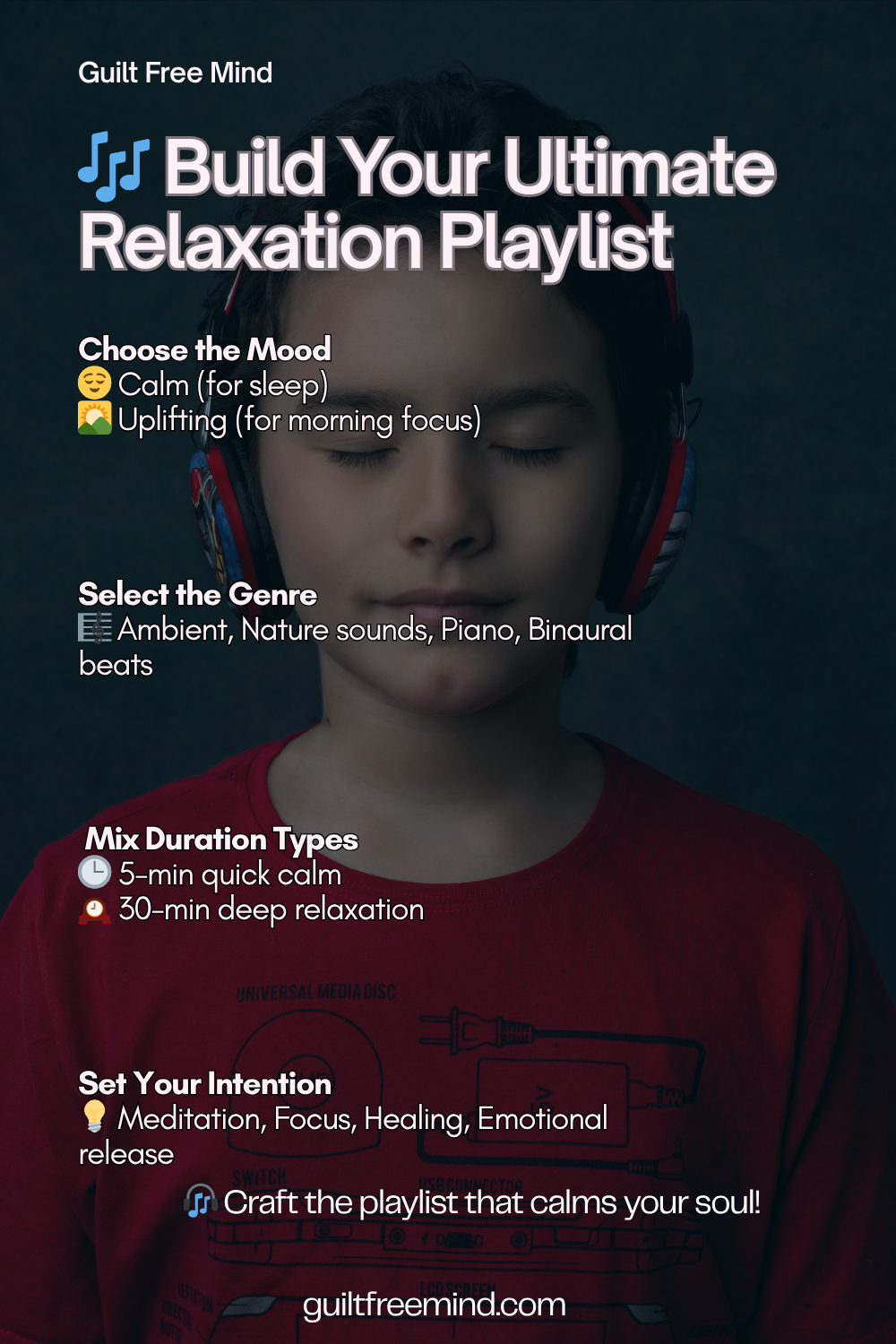
Building a relaxation music playlist is a fun, self-care project. Here’s how:
Choose Your Mood: Select music for anxiety, sleep, focus, or mood-lifting.
Pick Genres: Opt for instrumental relaxing music, nature sounds, or soft vocals [UNR Counseling].
Curate Tracks: Use platforms like Spotify or YouTube. Aim for 60–80 BPM tempos.
Test and Tweak: Listen for a week, adjusting tracks that feel less calming.
Organize: Create separate playlists for different needs (e.g., bedtime, focus).
Download this free printable to plan your perfect relaxation music playlist.
Illustrative example (a composite, not a real reader): Lila, a nurse, curated a relaxation music playlist for night shifts. She included piano and ocean tracks, listening during breaks. After two weeks, Lila felt less stressed, her calm demeanor boosting patient care. Relaxing lo-fi music was her self-care companion.
Curated Relaxation Music Playlist to Try Now
Ready to experience relaxation music firsthand? I’ve curated a special playlist featuring soothing tracks—perfect for anxiety relief, bedtime, or focus. Listen below and let the gentle melodies guide your self-care journey. Check out the “Peaceful Piano” playlist on Spotify, featuring gentle piano melodies designed to soothe anxiety, enhance focus, and prepare you for a restful sleep. This curated collection, with famous piano tracks and original compositions, offers a perfect backdrop for your self-care routine. What’s your favorite track? Share in the comments!
Relaxation Music vs. Other Techniques: Which Suits You?
Wondering how relaxation music stacks up against other methods for mental peace? This table compares relaxation music with mindfulness meditation, yoga, and aromatherapy, helping you choose the best fit for your self-care routine. Relaxation music stands out for its accessibility—anyone can listen anytime—while offering similar benefits like reduced anxiety and improved sleep.
Technique
Benefits
Accessibility
Best For
Relaxation Music
Reduces anxiety, aids sleep, boosts focus
High (anytime, anywhere)
Busy schedules, quick relief
Mindfulness Meditation
Enhances focus, reduces stress
Moderate (requires practice)
Deep introspection
Yoga
Improves flexibility, reduces tension
Moderate (needs space, time)
Physical and mental balance
Aromatherapy
Calms nerves, uplifts mood
Moderate (needs oils, diffuser)
Sensory relaxation
Each method has its charm, but relaxation music shines for its ease—perfect if you’re new to self-care or need instant calm. Try it with my curated playlist below and see what works for you!
Illustrative Scenarios: How People Use Relaxation Music
Here are five illustrative scenarios (composites, not real readers) showing how relaxation music can fit into daily life:
Anxiety: Paula’s Calm Paula, an accountant, used best relaxation music for anxiety during tax season. Her playlist of piano tracks eased her nerves, improving her focus and client interactions.
Bedtime: Sammy’s Sleep Sammy, a teacher, played relaxation music for bedtime with ocean sounds, falling asleep faster and waking refreshed, his teaching energy restored.
Focus: Raya’s Productivity Raya, a designer, used relaxing music playlist for focus to spark creativity, completing projects ahead of schedule and earning praise.
Depression: May’s Mood Lift May, a parent, listened to relaxation music to ease depression, finding joy in daily moments with her kids after weeks.
Anger: Nile’s Balance Nile, an IT consultant, used relaxing jazz music to calm anger, responding to work conflicts with poise, improving team harmony.
Explore More on Guilt Free Mind
At Guilt Free Mind, I’m committed to empowering my readers through six categories: Self-Care and Wellness, Understanding Personality Disorders, Creative Healing and Therapy, Mindful Productivity and Focus, Emotional Recovery and Resilience, and Stress, Anxiety, and Depression Toolkit. This article on relaxation music aligns with the Creative Healing and Therapy category, offering a soothing way to nurture mental peace through music. Within this category, explore the Art Therapy sub-hub for creative expression through painting and sculpting, or dive into the Journaling sub-hub for reflective healing with gratitude prompts. These practices complement the calming effects of relaxation music, enhancing your self-care journey. Check out these related articles to discover more creative tools for well-being and embrace a guilt-free mind.
Explore Related Sub-Hubs and Articles from Creative Healing and Therapy
These resources deepen your mental health journey, rooted in my blog’s mission.
Conclusion
Ready to make relaxation music your self-care superpower? 🌿 You deserve a guilt-free mind, and I’m here to help! Download my Free Relaxation Music Playlist Planner—packed with tips, track suggestions, and a printable guide. Subscribe to my blog for weekly mental health insights, and join my YouTube channel, Guilt Free Mind, for curated playlists and self-care videos. Start your calm journey today—your peace awaits! ✨
Frequently Asked Questions
What is the best music to calm anxiety?
Slow, instrumental relaxation music (60–80 BPM) with piano or nature sounds is most effective. Avoid lyrics to minimize distraction.
What type of music is good for anxiety?
Relaxing music with soft melodies, like classical or ambient tracks, reduces anxiety by calming the nervous system.
How does music reduce anxiety and depression?
Relaxation music lowers cortisol, boosts dopamine, and distracts from negative thoughts, easing anxiety and depression.
Does relaxing music help with meditation?
Yes, relaxing music enhances meditation and music practices by creating a calming backdrop, deepening focus.
What are the benefits of relaxation by music?
Benefits include reduced stress, improved sleep, enhanced focus, mood uplift, and anger regulation.
What is the most powerful relaxing music?
Instrumental relaxing music with nature sounds or slow classical pieces (e.g., Debussy) is often cited as most calming.
How does music relieve depression?
Relaxing music increases serotonin and dopamine, reducing depressive symptoms and fostering emotional balance.
How does stress relief music work?
Relaxation music slows heart rate, lowers cortisol, and activates relaxation responses, reducing stress.
Should you listen to angry music when angry?
Angry music can amplify emotions, so opt for relaxation music to calm anger instead.
How does music reduce anger?
Relaxation music calms the amygdala, reducing aggression and promoting emotional regulation.
What kind of music calms anger?
Slow, relaxation music like acoustic or ambient tracks soothes anger, avoiding high-tempo or aggressive genres.
About the Author
Hi, I’m Dr. Shruti Bhattacharya, a Ph.D. in Immunology, trauma survivor, and mental health advocate behind Guilt Free Mind. My mission is to empower you with science-backed, compassionate strategies to navigate life’s challenges and embrace a guilt-free mind. Through my blog, I share insights from my personal journey and expertise to help you build resilience, find calm, and thrive emotionally. Let’s embark on this path to wellness together!
Thoma, M. V., La Marca, R., Brönnimann, R., et al. (2013). The effect of music on the human stress response. PLoS ONE, 8(8), e70156. doi:10.1371/journal.pone.0070156
de Witte, M., Spruit, A., van Hooren, S., Moonen, X., & Stams, G.-J. (2022). Music therapy for stress reduction: a systematic review and meta-analysis. Health Psychology Review, 16(1), 134–159. doi:10.1080/17437199.2020.1846580
Jespersen, K. V., Pando-Naude, V., Koenig, J., et al. (2022). Listening to music for insomnia in adults. Cochrane Database of Systematic Reviews, CD010459. doi:10.1002/14651858.CD010459.pub3
Aalbers, S., Fusar-Poli, L., Freeman, R. E., et al. (2017). Music therapy for depression. Cochrane Database of Systematic Reviews, CD004517. doi:10.1002/14651858.CD004517.pub3
Linnemann, A., Ditzen, B., Strahler, J., Doerr, J. M., & Nater, U. M. (2015). Music listening as a means of stress reduction in daily life. Psychoneuroendocrinology, 60, 82–90. doi:10.1016/j.psyneuen.2015.06.008
I'm Dr. Shruti Bhattacharya, PhD (Immunology) — a researcher, mental health blogger, trauma survivor and art therapy advocate. After my own long road through trauma recovery, where painting became part of my healing, I started Guilt Free Mind to share compassionate, evidence-based guidance. Articles here are educational and not a substitute for professional care.