

Last Updated: May 31, 2026
If you’ve ever felt drained, dismissed, or like you’re walking on eggshells after spending time with your partner’s mother, you’re not alone. Many readers come to Guilt Free Mind searching for compassionate guidance on navigating a narcissistic mother-in-law who subtly undermines confidence and creates ongoing tension in the marriage (Verywell Mind).
Table of Contents
At a Glance: Dealing with a Narcissistic Mother-in-Law
- 8 Common Signs — From constant attention-seeking to subtle guilt-tripping and jealousy
- Covert vs Overt — Learn why covert narcissism is often more damaging and harder to spot
- Practical Boundary Scripts — Ready-to-use examples for parenting advice, guilt trips, triangulation, and more
- Impact on Marriage — Up to 72% higher divorce risk in high-conflict in-law situations (US data)
- Golden Child Dynamics — How to support your partner without creating more conflict
- When to Consider Low/No Contact — Clear signs and gentle guidance
- Healing Tools — Free art therapy printable + creative practices for emotional recovery
This guilt-free guide gives you validation, real stories, actionable steps, and compassionate tools to protect your peace and marriage — without shame or guilt.

This isn’t about being too sensitive or failing at “family harmony.” It’s about recognizing a painful but very real dynamic that affects countless marriages and mental health. You deserve to feel safe and respected in your own home and relationship.
As Dr. Shruti Bhattacharya (Ph.D. in Immunology, with additional psychology training and personal experience as a trauma survivor), I’ve supported thousands of readers through personality disorder insights, emotional recovery, and creative healing tools.
Signs of a Narcissistic Mother in Law
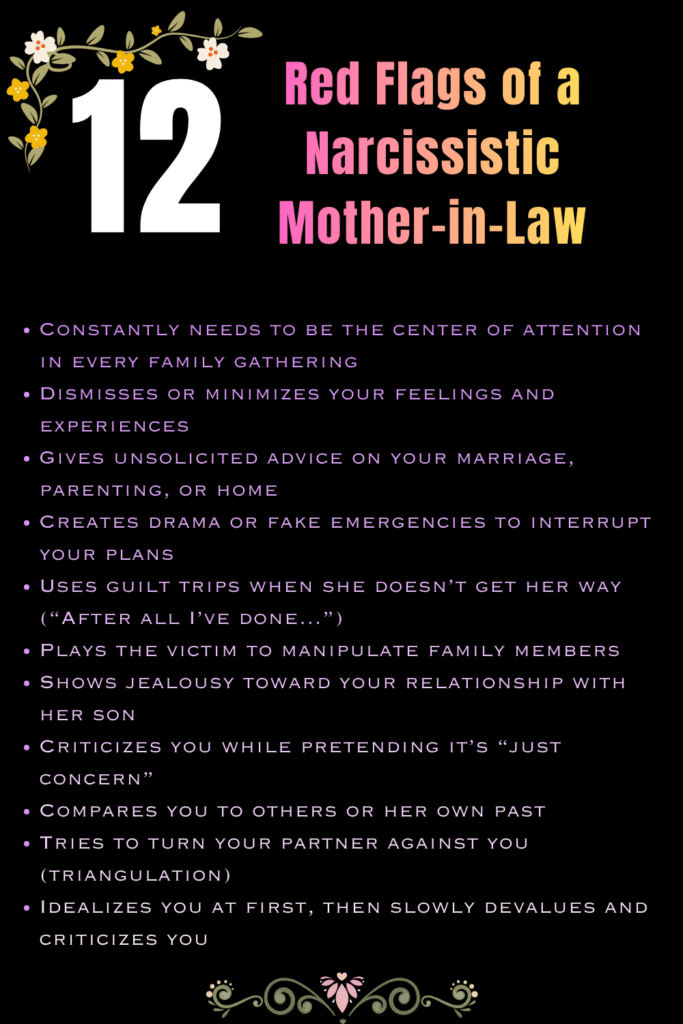
Recognizing the signs of a narcissistic mother in law is the first step toward reclaiming your peace. While only a qualified professional can diagnose narcissistic personality disorder, consistent patterns of behavior can help you understand what you’re experiencing. Here are 8 common signs of a narcissistic mother in law — explained with real-world context so you can relate:
Constant need for admiration and attention
She may dominate conversations, expect praise for everything she does, or become upset if the spotlight shifts away from her during family events. This leaves little room for others to share their achievements or feelings.
Lack of empathy for your feelings or experiences
Your emotions are often dismissed, minimized, or turned around to focus on how she feels. If you express hurt, she might respond with “You’re too sensitive” instead of offering understanding.
Frequent boundary violations with unsolicited advice
She inserts herself into your parenting style, career choices, household decisions, or even your marriage, acting as though her opinion is the final authority. These intrusions feel exhausting over time.
Triangulation by pitting family members against each other
She shares selective information with your partner or other relatives to create division, often positioning herself as the victim or the wise mediator. This tactic keeps her in control.
Guilt-tripping or playing the victim role
When things don’t go her way, she uses phrases like “After all I’ve done for you…” or becomes suddenly “ill” to shift focus and induce guilt. Many readers describe this as emotionally manipulative.
Jealousy toward your relationship with her son
She may view you as competition rather than family, making subtle (or not-so-subtle) comments that question your worth or loyalty. This jealousy often intensifies after milestones like engagement or having children.
Criticism disguised as “concern” or helpfulness
Comments like “I’m only saying this because I care” are followed by digs at your cooking, appearance, parenting, or home management. The disguise makes it harder to call out.
Idealizing you initially, then devaluing you over time
In the beginning, you might receive excessive compliments and gifts. Once you assert independence or set boundaries, the tone shifts to criticism, silent treatment, or passive-aggression.
Real-life scenario: Patricia shared how her mother-in-law would create last-minute “emergencies” right before couple plans, leaving her feeling guilty for wanting private time together (Choosing Therapy).
These signs of a narcissistic mother in law often build gradually, making them easy to rationalize at first. Trust your feelings — if interactions consistently leave you anxious, drained, or questioning your worth, the pattern deserves attention.
Take the Quiz: How Narcissistic Is Your Mother-in-Law Relationship?
Now that you’ve learned the common signs, you might be wondering how these patterns show up in your own situation.
Take this gentle, guilt-free self-assessment quiz to get clarity on the level of narcissistic traits in your relationship with your mother-in-law. It only takes a few minutes and can help you understand your experience better — without judgment or self-blame.
Quiz: How Narcissistic Is This Relationship? A Guilt-Free Self-Assessment

Remember: This quiz is for self-reflection only and is not a clinical diagnosis. Trust your feelings — your experience is valid.

What Does a Narcissistic Mother in Law Look Like? (Covert vs Overt)
Not all narcissistic mothers-in-law behave the same way. Some are loud and obvious, while others are quiet, subtle, and much harder to spot. Understanding the difference between overt and covert narcissism can help you make sense of your experiences and stop doubting yourself.
Overt narcissists are easier to identify because their behavior is bold and direct. Covert narcissists, on the other hand, operate more quietly — often hiding behind a mask of vulnerability or “caring,” which makes their manipulation confusing and deeply damaging.
Here’s a clear comparison to help you recognize the patterns:
| Aspect | Overt Narcissistic Mother-in-Law | Covert Narcissistic Mother-in-Law |
|---|---|---|
| Presentation | Loud, boastful, openly critical | Quiet, victim-playing, passive-aggressive |
| Control Tactics | Direct demands, public scenes | Guilt, silent treatment, “poor me” stories |
| Empathy | None, openly dismissive | Appears empathetic but weaponizes it |
| Impact on You | Obvious drama and arguments | Subtle erosion of self-worth and confusion |
| Hardest to Spot | Easier to identify | Much harder — often mistaken for “caring” |
Covert narcissism is especially damaging because it’s harder to name and address (Psych Central).
“Dealing with a narcissistic mother-in-law can cause immense stress and recurring arguments… They are often insecure and jealous.”
— Leanna Stockard, LMFT.
Narcissistic Mother in Law Boundaries Examples
Setting clear narcissistic mother in law boundaries is one of the most powerful and practical steps you can take to protect your peace, your marriage, and your mental health. Without boundaries, the emotional manipulation, guilt trips, and intrusions can continue indefinitely.
The good news is that you don’t need dramatic confrontations. Simple, consistent, and calm responses can make a big difference over time. Below are ready-to-use boundary scripts for the most common challenging situations. Here are practical, ready-to-use examples (Anne Wright):
| Situation | Example Script | Natural Consequence if Crossed |
|---|---|---|
| Unsolicited parenting advice | “We’ve decided on this approach. We’ll let you know if we need input.” | Shorten the visit or end the call politely |
| Last-minute plan changes | “We’ve already made plans as a couple. Let’s schedule another time.” | Stick to your original plans |
| Guilt-tripping | “I hear you’re upset. We need some space to discuss this calmly later.” | Reduce contact for a defined period |
| Triangulation with your partner | “We make decisions together as a team. Let’s talk when we’re all present.” | Limit one-on-one conversations |
| Criticism of your home/choices | “I’m not open to feedback on this right now. Let’s change the subject.” | Leave the gathering if it continues |
Practice these scripts with your partner first so you can present a united front. Remember, the goal isn’t to change your mother-in-law — it’s to protect your own well-being without guilt.
How Do Narcissists Treat Their In-Laws?
Narcissists often treat in-laws transactionally — viewing them as competition or extensions of their child rather than individuals with their own needs (Narcissistic Abuse Support). This means your value in their eyes depends on how useful you are to them or how well you serve their image and control needs. Common ways this plays out include:
Initial idealization followed by sudden devaluation
At first, you may be showered with compliments and gifts as the “perfect” daughter/son-in-law. Once you show independence or prioritize your own family unit, the praise stops and criticism or silent treatment begins. This sudden shift can leave you confused and constantly trying to regain their approval.
Treating you as an outsider or threat
Many narcissistic mothers-in-law see you as someone who “stole” their child. They may compete for your partner’s time, loyalty, and attention, often framing their interference as “family duty.” This competition can make you feel unwelcome in your own marriage and extended family.
Using your partner as a tool
They frequently manipulate their adult child (the “golden child”) to pressure you into compliance, creating painful loyalty conflicts in your marriage. This puts your partner in the middle, often forcing them to choose between you and their mother.
Emotional manipulation and control
This includes guilt trips, playing victim, spreading rumors within the family, or withholding affection/approval to keep everyone orbiting around their needs. These tactics are designed to make you feel responsible for their emotions while they avoid any accountability.
Lack of genuine respect for your role
Decisions about holidays, grandchildren, finances, or traditions are made without consulting you, reinforcing that your opinions don’t matter. This dismissal slowly chips away at your confidence and sense of belonging in the family.
These behaviors are not about you — they stem from the narcissist’s deep insecurity and need for control. Understanding this transactional dynamic helps you stop internalizing the rejection and focus on protecting your marriage and mental health.
The Impact on Your Marriage and Mental Health
Living with a narcissistic mother in law creates ripple effects that go far beyond occasional awkward family dinners. The constant tension, emotional manipulation, and loyalty conflicts can slowly erode the foundation of your marriage and your individual well-being.
US-centric stats: Research shows that discordance in perceptions about in-law relationships early in marriage significantly predicts higher divorce risk. In one study, couples with high discordance faced up to a 72% divorce rate over 16 years (NCBI).
In-law conflicts also contribute to increased anxiety, depression symptoms, and recurring marital arguments across many U.S. couples. The ongoing stress often leads to emotional exhaustion, reduced intimacy, and a sense of walking on eggshells even in your own home. Many readers describe feeling isolated, as if they’re fighting a battle no one else fully sees or understands.
Global/India context: In India and South Asian communities, 70% of South Asian women who reported emotional abuse in their marital homes identified their mother-in-law as the primary source (Behavioral Health News).

This cultural dynamic often amplifies the pressure in multigenerational households, where expectations of “family harmony” can silence daughters-in-law and delay healing.
The mental health toll is real: heightened stress, lowered self-esteem, chronic anxiety, and even symptoms of depression are common. Over time, this can lead to resentment toward your partner if the issue remains unaddressed, creating distance in the very relationship you’re trying to protect.
Real-life scenario (Holidays/Children): Meera dreaded family gatherings during festivals because her narcissistic mother-in-law would criticize her parenting publicly and monopolize time with the grandchildren. After setting time-limited visits and using pre-agreed signals with her husband, the holidays became far less stressful (Medium).
The good news? Recognizing the impact is the first step toward change. You don’t have to accept constant emotional drain as normal.
Supporting Your Partner (Golden Child Dynamics)
Partners raised by narcissistic mothers are often placed in the golden child role — expected to meet their mother’s emotional needs, provide validation, and remain loyal above all else. This creates deep loyalty conflicts when they marry. Your partner may minimize their mother’s behavior, feel intense guilt when setting boundaries, or automatically side with her to avoid conflict.
How to support your partner effectively:
- Use gentle “I” statements: “I feel overwhelmed when plans change last minute. I need us to decide together as a team.”
- Avoid attacking his mother. Focus on the impact on your marriage and your feelings.
- Validate his experience: “I know this is hard because she’s your mom. I’m not asking you to choose — I’m asking us to protect our own family unit.”
- Educate together: Read articles or watch videos on narcissistic family dynamics side by side.
- Seek couples therapy: A neutral professional can help your partner see the patterns without feeling attacked.
Remember — change takes time. Your partner may still be unlearning years of conditioning. Your role is to stand united while holding compassionate space for his healing (LinkedIn).
When to Consider Low or No Contact
Low or no contact is not a failure — it is an act of self-preservation when other strategies no longer work.
Clear signs it may be time:
- Boundaries are repeatedly ignored despite consistent enforcement
- Your mental health is deteriorating (constant anxiety, depression, or emotional exhaustion)
- Your marriage is suffering significantly from the ongoing conflict
- Children are being triangulated, criticized, or used as pawns
- Interactions leave you feeling unsafe or deeply traumatized
How to implement it thoughtfully:
- Start with structured low contact — shorter visits, no solo calls, limited holidays.
- Communicate the decision clearly with your partner first.
- Be consistent. Expect pushback, guilt trips, or flying monkeys (other family members pressuring you).
- Prepare emotionally — use journaling, art therapy, or support from Guilt Free Mind resources.
- Reassess regularly. Some people move to low contact successfully; others need full no contact for true peace.

You are allowed to choose your peace. Protecting your family does not make you a bad person (Daughters Rising).
“A boundary without a consequence is a suggestion.”
— Couples therapy specialists on narcissistic family dynamics
Creative Healing Tools for Recovery
Healing from the stress of a narcissistic mother in law isn’t just about setting boundaries — it’s also about gently rebuilding your inner peace and self-worth. At Guilt Free Mind, we believe creative and mindful practices can be powerful allies in emotional recovery.
Lean into Guilt Free Mind’s core categories for support:
Creative Healing and Therapy
Art therapy offers a safe, non-verbal way to process complex emotions like anger, grief, guilt, and confusion. Try expressive painting to release built-up tension or dream journaling to uncover subconscious patterns related to family dynamics. Explore Role of painting in art therapy, Significance of colors in Art Therapy, or mindfulness-based art therapy sessions. Many readers report feeling lighter after just 15–20 minutes of daily creative expression.
Emotional Recovery and Resilience
Build long-term strength through gentle self-reflection, positive self-talk practices, and trauma-informed tools designed to help you reclaim your narrative after emotional manipulation.
Stress, Anxiety, and Depression Toolkit
Access practical daily tools such as guided breathing exercises, grounding techniques, and CBT-inspired worksheets that help manage the anxiety spikes after difficult family interactions.
Printable Resource
One of the most effective ways to support your healing journey is through small, consistent creative practices. To help you get started right away, I’ve created a simple yet powerful tool specifically for readers navigating difficult family dynamics.
Download the free Beginner’s Painting Art Therapy Checklist & Starter Guide to begin your creative healing journey today.
This printable includes gentle prompts, color suggestions, and step-by-step guidance to help you release heavy emotions like guilt, anger, and resentment in a safe and nurturing way — no artistic skills required.
You can also use the Red Flags Checklist infographic above to track patterns without self-judgment.
These tools are designed to help you process emotions guilt-free, so you can show up more grounded and resilient in your marriage and daily life. Healing doesn’t happen overnight, but small, consistent creative practices create real transformation.
“The most dangerous threats to a marriage do not always come from inside the relationship.”
– Relationship experts on in-law interference (Emotional Affair Journey)
[Video Placeholder] Embed a short Guilt Free Mind YouTube video on boundary setting with family. https://www.youtube.com/c/GuiltFreeMind

How to Deal with a Narcissistic Mother in Law?
A step-by-step guilt-free guide to recognizing signs of a narcissistic mother in law, setting healthy boundaries, protecting your marriage, and healing using creative therapy tools.
- Recognize the Signs of a Narcissistic Mother in Law
Learn the 8 common signs including lack of empathy, boundary violations, guilt-tripping, triangulation, and jealousy. Trust your feelings when interactions consistently leave you drained or anxious.
- Understand the Impact on Your Marriage and Mental Health
Acknowledge how narcissistic behavior creates loyalty conflicts, anxiety, depression, and marital strain. Use the provided US and global statistics to validate your experience.
- Set Clear Narcissistic Mother in Law Boundaries
Use practical scripts for common situations like unsolicited advice, last-minute changes, and criticism. Always present a united front with your partner and follow through with natural consequences.
- Support Your Partner Through Golden Child Dynamics
Approach conversations with compassion using “I” statements. Validate your partner’s loyalty conflict and consider couples therapy to build a strong team.
- Decide When Low or No Contact is Necessary
Consider structured low contact or no contact if boundaries are repeatedly ignored, your mental health suffers, or your children are affected. Start small and reassess regularly.
- Use Creative Healing Tools for Recovery
Practice art therapy, painting, dream journaling, and resources from Guilt Free Mind’s Emotional Recovery and Stress, Anxiety & Depression Toolkit to process emotions and rebuild inner peace.
Explore The Other Categories on Guilt Free Mind
At Guilt Free Mind, we believe healing from difficult family dynamics like a narcissistic mother in law requires both practical strategies and gentle inner work. Here are our main categories with relevant resources to support your journey:
Understanding Personality Disorders
Deepen your knowledge of narcissistic traits and other personality patterns. Learn how to identify behaviors without self-blame and protect your emotional energy. These insights help you respond with clarity instead of confusion or self-doubt.
Self-Care and Wellness
Holistic approaches to nurture your mind and body while navigating challenging relationships. Prioritize your own well-being so you can show up stronger for yourself and your marriage.
Mindful Productivity and Focus
Learn how to protect your time and energy so you can focus on what truly matters — your peace and your own family. Reclaim your mental space and create healthy routines that support long-term emotional balance.
These resources are created with the same compassionate, guilt-free approach you’ll find throughout this article. Bookmark the ones that resonate most and return to them whenever you need s
Your Next Gentle Step
You deserve a peaceful home and a marriage where you feel safe, respected, and valued. Healing from a narcissistic mother-in-law is not only possible — it starts with one small, compassionate action today.
Here’s what you can do right now:
- Download the free Beginner’s Painting Art Therapy Checklist & Starter Guide to begin releasing heavy emotions through creative healing.
- Pick just one boundary script from this article and practice it with your partner.
- Watch this supportive video on my channel: How to Deal with a Narcissistic Mother-in-Law
You don’t have to do everything at once. Every small step you take is an act of self-respect and love for your future self.
You’ve already taken the first brave step by reading this far. I’m proud of you. Keep going — guilt-free.

FAQ Section
Consistent patterns of lack of empathy, boundary crossing, and attention-seeking that leave you feeling diminished are key indicators (WebMD).
Focus on clear boundaries, partner alignment, self-care, and creative healing practices (Focus on The Family).
She may appear charming publicly but controlling or dismissive privately.
Often transactionally, with initial idealization followed by devaluation.
Only when repeated boundary violations cause significant harm — always prioritize your safety and peace (The Hart Centre).
About the Author
Dr. Shruti Bhattacharya is the founder and heart of Guilt Free Mind. With a Master’s in Counselling Psychology and Ph.D. in Immunology, she combines scientific understanding of the body’s stress and inflammatory responses with compassionate mental health tools. Her mission is to help readers build emotional freedom without guilt or shame.
Dr. Bhattacharya’s unique blend of expertise and empathy shapes every piece of content:
- Academic & Scientific Rigor — Holding a Ph.D. in Immunology and a Bachelor’s degree in Microbiology, she brings deep insight into how chronic shame and body-related stress trigger low-grade inflammation and disrupt the gut-brain axis. This biological understanding informs her strong advocacy for body neutrality — recognizing that reducing the mental fight with your body can lower unnecessary stress responses and support both mental and physical well-being.
- Dedicated Mental Health Advocacy — With over 15 years of experience supporting hundreds of individuals through online platforms and personal guidance, Dr. Bhattacharya helps readers navigate body image struggles, anxiety, and emotional challenges with practical, evidence-based strategies.
- Empathetic Connection to Readers — Known for her warm and relatable voice, she turns complex research into accessible advice. Her personal journey as a trauma survivor fuels her commitment to creating safe spaces where readers can drop the pressure to love or hate their bodies and simply exist with more peace.
- Lifelong Commitment to Wellness — Dr. Bhattacharya lives the principles she shares, integrating science-based habits like mindfulness, balanced nutrition, and body-neutral self-care into her daily life. Her work on Guilt Free Mind continues to inspire readers to find calm and confidence through gentle, guilt-free approaches.
🏆 Guilt Free Mind was named one of the Top 100 Mental Health Blogs on Feedspot in 2025.

Follow me on:
Disclaimer:
This article is for informational and educational purposes only. It is not a substitute for professional mental health advice, diagnosis, or treatment. Please consult a qualified mental health professional for personalized support.
References
- Annie Wright, L. (n.d.). The narcissistic mother-in-law: How to protect your marriage and your sanity. Annie Wright Psychotherapy. https://anniewright.com/the-narcissistic-mother-in-law-how-to-protect-your-marriage-and-your-sanity/
- Behavioral Health News. (n.d.). The son belongs to his mother: South Asian daughters-in-law and the mental health toll of family hierarchy. https://behavioralhealthnews.org/the-son-belongs-to-his-mother-south-asian-daughters-in-law-and-the-mental-health-toll-of-family-hierarchy/
- Choosing Therapy. (n.d.). Narcissistic mother-in-law: 8 signs & how to cope. https://www.choosingtherapy.com/narcissistic-mother-in-law/
- Daughters Rising. (2021, July 16). How to deal with an elderly narcissistic mother: 12 tips to save your sanity. https://daughtersrising.info/2021/07/16/how-to-deal-with-an-elderly-narcissistic-mother-12-tips-to-save-your-sanity/
- Emotional Affair. (n.d.). Driven apart: Narcissistic mother-in-law. https://www.emotionalaffair.org/driven-apart-narcissistic-mother-in-law/
- Focus on the Family. (n.d.). Confronting a disrespectful and controlling mother-in-law. https://www.focusonthefamily.com/family-qa/confronting-a-disrespectful-and-controlling-mother-in-law/
- Narcissistic Abuse Support. (n.d.). What to do if you have a narcissistic in-law. https://narcissistabusesupport.com/what-to-do-if-you-have-a-narcissistic-in-law/
- Psych Central. (n.d.). How to survive a narcissistic mother-in-law. https://psychcentral.com/disorders/how-to-survive-a-narcissistic-mother-in-law
- Stockard, L. (2023, March 15). How to deal with a narcissistic mother-in-law. Verywell Mind. https://www.verywellmind.com/how-to-deal-with-a-narcissistic-mother-in-law-8364613
- WebMD. (n.d.). Narcissistic mother. https://www.webmd.com/mental-health/features/narcissistic-mother
