


Quick answer: The most effective response to gaslighting is not to win the argument. Stay calm, say what you remember in one short sentence, refuse to debate your own reality, and leave the conversation if it starts going in circles. Over time, protect yourself by writing things down, checking your perceptions with people you trust, setting firm boundaries and getting support. If gaslighting comes with control, threats or fear, treat it as abuse and plan for your safety.
You walk away from a conversation feeling confused. You were sure about what happened, but now you are not. You find yourself apologising for things you did not do, double-checking your memory, and wondering whether you really are “too sensitive”. If that feels familiar, you may be dealing with gaslighting.
This guide brings together everything you need in one place: how to tell gaslighting apart from an honest disagreement, exactly what you can say in the moment, ten ways to deal with it over time, and how to rebuild trust in your own mind afterwards.
Table of Contents
At a Glance: Responding to Gaslighting
| Question | Short answer |
|---|---|
| What is gaslighting? | A pattern of manipulation that makes you doubt your memory, perception or sanity, so the other person gains control. |
| How does it feel? | Confused, anxious, “on edge”, constantly apologising, unable to trust your own judgement. |
| Best first response | One calm sentence: “I remember it differently, and I’m going to trust my memory.” Then stop debating. |
| What usually backfires | Long explanations, collecting “proof” to make them admit it, arguing about tiny details. |
| Longer-term steps | Write things down, reality-check with trusted people, set boundaries, reduce contact, get support. |
| When it is abuse | When it is part of a pattern of control, threats, isolation or fear. Make a safety plan and contact a helpline. |
What Is Gaslighting?
Gaslighting is a form of psychological manipulation in which one person repeatedly denies, twists or rewrites your experience until you start to doubt your own memory, perception or judgement. The goal, conscious or not, is control: if you no longer trust your own mind, you are more likely to rely on theirs.
The term comes from Patrick Hamilton’s 1938 play Gas Light and the 1944 film Gaslight, in which a husband secretly dims the gas lamps at home and then insists to his wife that the light has not changed, slowly convincing her she is losing her mind. Psychoanalysts began using “gaslighting” as a clinical term in the early 1980s (Calef & Weinshel, 1981), and psychotherapist Robin Stern brought it to a wide audience with her book The Gaslight Effect (2007). By 2022, the word had become so common that Merriam-Webster chose it as its Word of the Year, after searches for it rose by 1,740%.
Sociologist Paige Sweet (2019) adds an important point: gaslighting is not only about one manipulative person. It works best where there is already an imbalance of power, for example between partners with unequal money or status, between parents and children, or between a manager and an employee. That is one reason it is so common in abusive relationships.

Is It Gaslighting or an Honest Disagreement?
Everyone remembers things differently sometimes. Two people can sincerely disagree about what was said at dinner last week. That is not gaslighting. The difference lies in the pattern, the purpose and the effect on you.
| Honest disagreement | Gaslighting |
|---|---|
| Happens occasionally, about details | Happens repeatedly, about important things |
| Both people stay curious: “Maybe I’m wrong” | One person is always right and you are always “confused” |
| Your feelings are taken seriously even if memories differ | Your feelings are dismissed: “You’re overreacting”, “You’re too sensitive” |
| You leave the conversation feeling heard | You leave feeling confused, guilty or “crazy” |
| No one gains control from it | The other person ends up making more of the decisions |
| Evidence can settle it | Evidence is ignored, denied or turned against you |
If you are unsure, notice how you feel after the conversation and over the weeks that follow. People who are being gaslit tend to become less confident, more anxious and more isolated over time.

Common Gaslighting Tactics (and What They Sound Like)
Gaslighting rarely looks dramatic. It is usually a series of small, everyday moves. Here are the most common ones, with examples of how they can sound.
| Tactic | What it sounds like |
|---|---|
| Denying things that happened | “I never said that.” “That didn’t happen.” |
| Countering your memory | “You always get things mixed up.” “Your memory is terrible.” |
| Trivialising your feelings | “You’re making a big deal out of nothing.” “Can’t you take a joke?” |
| Withholding or refusing to engage | “I’m not discussing this again.” “I don’t know what you’re talking about.” |
| Diverting the topic | “Is that something your friend put in your head?” |
| Rewriting history | Retelling past events so that you are always the one at fault. |
| Recruiting others | “Everyone thinks you’re overreacting.” “Even your mother agrees with me.” |
| Questioning your sanity | “You need help.” “You’re being paranoid again.” |
| Mixing cruelty with kindness | Warmth, gifts or affection right after hurtful behaviour, so you doubt that it was really that bad. |
That last tactic matters. In a study of 65 people who had been gaslit by a romantic partner, researchers found the gaslighting usually happened within relationships that swung between affection and abuse (Klein et al., 2023). The good moments made the bad ones harder to name.
The Three Stages of Gaslighting
Robin Stern describes gaslighting as something that tends to deepen in three stages:
- Disbelief: something feels off, but you brush it aside as a one-off.
- Defence: you argue back, gather evidence and go over the same conversations again and again, trying to prove your point.
- Depression: you feel flat and joyless, and you start to accept their version of you.
Most people look for help during the second stage, when the arguing is exhausting. The good news is that you can step out of the cycle at any stage.
Why Gaslighting Works (and Why It Is Not Your Fault)
People who are gaslit are often described as gullible. The research says otherwise. Gaslighting works because it targets things that are normally healthy:
- Trust. In a close relationship, you assume the other person is being honest with you.
- Love and loyalty. The affectionate moments make you want to believe the best of them.
- Openness to feedback. Thoughtful people are willing to consider that they might be wrong.
- Power differences. When someone controls money, housing, your job or your family’s approval, disagreeing feels risky (Sweet, 2019).
- Isolation. The fewer people you talk to, the harder it is to check what is real.
Being gaslit says more about the other person’s behaviour than about your intelligence or strength.

How to Respond to Gaslighting in the Moment
When someone is gaslighting you, the natural reaction is to explain, justify and prove. Unfortunately, that usually keeps you stuck in their version of events. These steps work better.
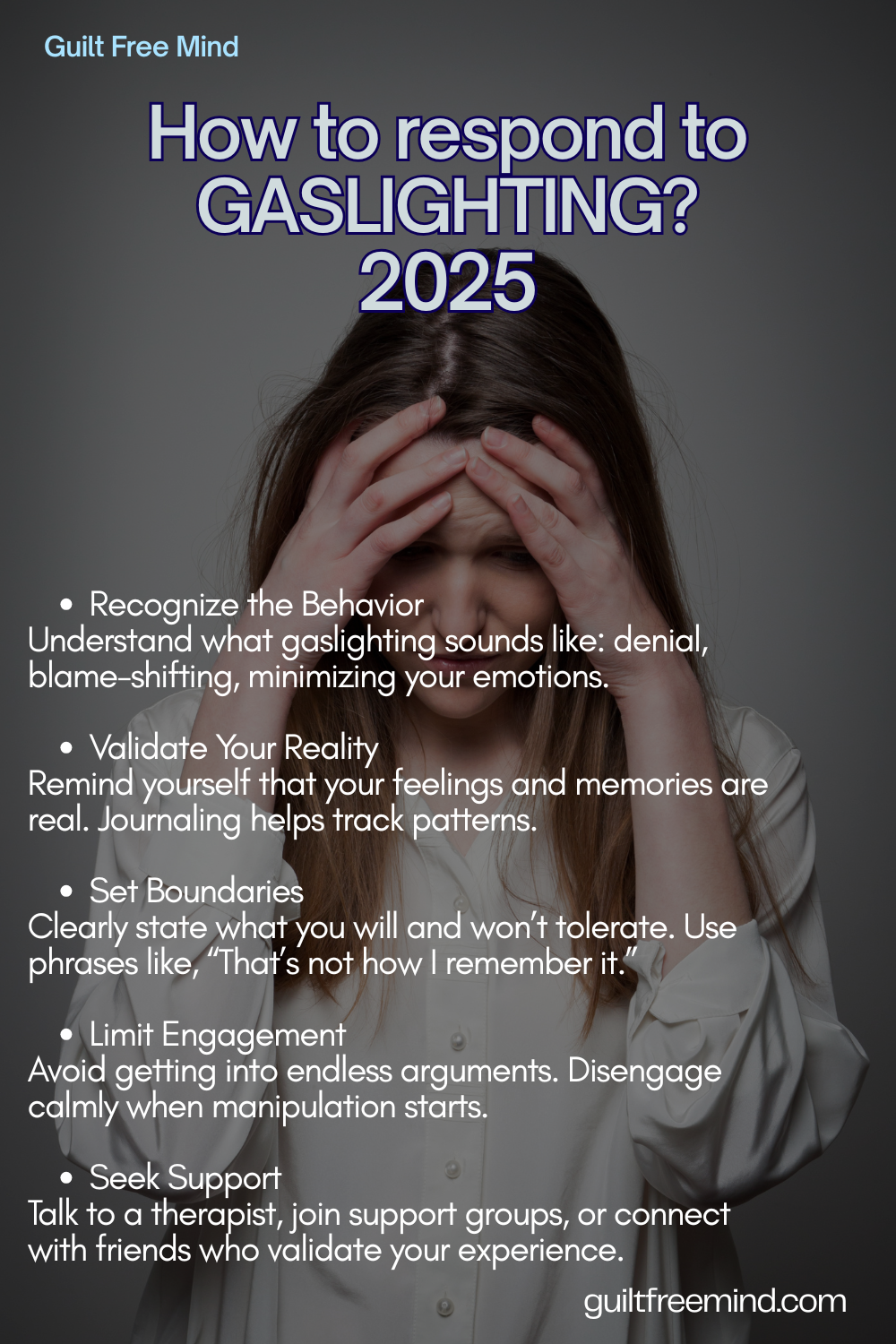
1. Pause before you answer
Take a slow breath. Notice what you are feeling in your body: a tight chest, a hot face, a sinking stomach. Those signals are information. You do not have to respond straight away.
2. State your reality once, calmly
Say what you remember in one short sentence, without asking for agreement. For example: “I remember it differently, and I’m going to trust my memory.”
3. Do not debate the details
A gaslighter can argue about tiny details forever. You do not need them to agree with you for your experience to be real.
4. Name the pattern, not the person
“I notice that when I bring up how I feel, the conversation turns to what’s wrong with me.” This is calmer and safer than “You’re gaslighting me”, which often triggers more denial.
5. Leave circular conversations
If the conversation keeps looping, end it: “I’m going to stop here. We can talk later when we’re both calm.” Then actually step away.
What to Say When Someone Is Gaslighting You
| If they say… | You can say… |
|---|---|
| “That never happened.” | “We remember it differently. I know what I experienced.” |
| “You’re too sensitive.” | “My feelings are valid, even if you don’t share them.” |
| “You’re imagining things.” | “I’m not going to argue about my own memory.” |
| “Everyone agrees with me.” | “I’m happy to talk about this between the two of us.” |
| “You need help.” | “If you’re worried about me, let’s talk about that calmly another time. Right now I’m ending this conversation.” |
| “I was only joking.” | “It didn’t feel like a joke to me, and I’d like you to stop.” |
| “Why do you always start fights?” | “I raised a concern. I’d like it to be heard, not turned around.” |
You do not have to use these word for word. The point is to keep it short, calm and about your own experience, without asking for permission to feel what you feel.
If it happens over text or WhatsApp, the same rules apply, only shorter. Reply once (“I remember it differently”), do not get pulled into a long back-and-forth, and take screenshots for your own records. You can also simply wait until you feel calm before replying, or not reply at all.
How to Deal with Gaslighting: 10 Ways to Protect Yourself Over Time
Responding well in the moment helps, but gaslighting is a pattern, so it needs a longer-term plan. These steps protect your sense of reality week after week.

- Trust your first reaction. Your gut sense that “something is off” is often right. Notice it before it gets talked away.
- Write it down. Keep brief, dated notes of what was said and done, plus screenshots of messages. Store them somewhere private and secure, such as an email account only you can open. You are not building a case to make them confess; you are creating an anchor for your own memory.
- Stop trying to make them admit it. A person who gaslights is rarely persuaded by evidence. Let go of the goal of getting them to agree.
- Reality-check with someone you trust. Tell a friend, sibling or counsellor what happened, as it happened. Gaslighting thrives in isolation.
- Set one clear boundary at a time. For example: “If you call me crazy, I will leave the room.” Then follow through every time.
- Walk away from circular arguments. You do not owe anyone an endless debate about your own memory.
- Share less with them. If they use what you tell them against you, keep conversations brief and factual. Some people call this the “grey rock” approach.
- Protect your independence. Keep your own phone, bank account, friendships and support network wherever you safely can.
- Get professional support. A counsellor or psychologist can help you sort out what is real, untangle self-blame and decide what you want to do.
- Plan for your safety. If there is control, threats, monitoring, financial abuse or any violence, contact a domestic abuse helpline and make a safety plan before you confront anyone or try to leave.
What Not to Do
| Tempting, but… | Why it backfires | Try instead |
|---|---|---|
| Over-explaining and justifying | It invites more arguing and keeps you on the defensive. | One calm sentence, then stop. |
| Collecting proof to make them confess | Evidence is usually denied or turned against you. | Keep notes for yourself, not for them. |
| Calling them a narcissist or a gaslighter mid-argument | Labels tend to escalate things and lead to more denial. | Name the behaviour: “When you say I imagined it…” |
| Secretly recording conversations | Laws on recording differ by country and situation, and it can be unsafe if discovered. | Write notes; get legal advice before recording. |
| Confronting them when you feel unsafe | Confrontation can increase risk in controlling relationships. | Talk to a helpline and plan first. |
| Keeping it to yourself | Isolation makes it easier to doubt your memory. | Tell at least one trusted person. |

Gaslighting in Different Relationships
With a partner
Partner gaslighting often starts small and grows. It is frequently part of a wider pattern called coercive control, in which one partner gradually takes over the other’s choices, money, friendships and sense of self (Stark, 2007). If your partner also monitors your phone, controls the money, cuts you off from friends or frightens you, please read our guide to healing from emotional abuse and consider contacting a helpline. Our article on the signs of gaslighting in relationships may also help you put a name to what is happening.
With a parent or family member
Family gaslighting can sound like “That never happened, you had a lovely childhood” or “You’re remembering it wrong.” In many families, including many Indian families, there is strong pressure to “adjust” and keep the peace, which can make it even harder to trust your own memories. Our guides to narcissistic parents and psychopathic mothers go deeper into these patterns.
At work
Gaslighting also happens in the workplace. Researchers in India developed and tested a 12-item scale for it and found two main parts: having your concerns trivialised, and being made to feel afflicted, doubting your competence and sanity. Higher scores went along with lower job satisfaction and more role conflict (Kukreja & Pandey, 2023). At work, keep written records, confirm important conversations by email (“Just to confirm what we agreed today…”) and speak to HR or a trusted senior colleague.
In healthcare
Some people describe “medical gaslighting”, when real symptoms are repeatedly dismissed as stress or “all in your head”. It helps to write down your symptoms and how long you have had them, bring someone with you to appointments, and ask for a second opinion when you feel unheard.
What Gaslighting Does to You
Gaslighting is not “just words”. Research is starting to measure its effects:
- In two studies of adults in Israel and the United States, people who reported more gaslighting from a partner also reported more depression and poorer relationship quality, even after other forms of partner abuse were taken into account (Tager-Shafrir et al., 2024).
- People who had been gaslit by a partner described a shrinking sense of self and difficulty trusting other people (Klein et al., 2023).
- Many people describe anxiety, constant second-guessing, difficulty making decisions, shame, and a feeling of “walking on eggshells”.
The same study by Klein and colleagues also offers hope: people who recovered described distancing themselves from the person, investing in healthier relationships, and doing meaningful activities that helped them feel at home in their own bodies again. Some even described growing through the experience.
How to Recover from Gaslighting and Trust Yourself Again
Even after the gaslighting stops, the self-doubt can linger. Rebuilding self-trust is like rebuilding a muscle: small, regular repetitions work best.
- Make small decisions on your own. What to eat, what to wear, which route to take. Notice that your choices are fine.
- Keep a short daily journal. Write down what happened and how you felt. Reading it back shows you that your memory is reliable.
- Spend time with people who take you seriously. Healthy relationships quietly correct the message that you are “too much”.
- Notice the inner critic. When you hear “you’re overreacting” in your own head, ask whose voice that really is.
- Consider therapy. A trauma-informed therapist can help with anxiety, self-blame and the urge to keep replaying old arguments. Our article on overthinking may also help.

Downloadable Resource: Get our free Gaslighting Recovery Checklist to track your gaslighting healing steps, with prompts for journaling and boundary-setting.
When Gaslighting Is Abuse: Your Options and Where to Get Help
When gaslighting is part of a pattern of control, it is a form of emotional abuse, and in some places it can be part of a crime. In India, the Protection of Women from Domestic Violence Act, 2005 recognises verbal and emotional abuse as domestic violence. In England and Wales, “controlling or coercive behaviour” in an intimate or family relationship has been a criminal offence since 2015 (Serious Crime Act 2015, section 76). Laws differ, so a local legal adviser or helpline can tell you what applies to you.

If you feel unsafe or need to talk to someone:
- India: Emergency 112 · Women Helpline 181 · Tele-MANAS (free mental health support, 24/7) 14416 or 1-800-891-4416
- United States: National Domestic Violence Hotline 1-800-799-7233 (or text START to 88788) · 988 Suicide & Crisis Lifeline (call or text 988)
- United Kingdom: National Domestic Abuse Helpline 0808 2000 247 (24 hours) · Samaritans 116 123
- Anywhere: If you are in immediate danger, contact your local emergency number.
If someone else might check your phone or browser, consider using a private window or a trusted friend’s device to look for help.
Conclusion
You cannot always stop someone from gaslighting you, but you can stop letting their version of events replace your own. Keep your responses short and calm, step out of circular arguments, write things down, stay connected to people who see you clearly, and get support. Your memory, your feelings and your perception matter. You are not “too sensitive” for noticing that something is wrong. If you have been pushed until you snap and then blamed for it, our guide to reactive abuse may also help.
If this article helped, you might like our gentle weekly newsletter on healing and emotional wellbeing: join the Guilt Free Mind community.
See you in my next blog post,
Dr. Shruti
Check out the other hubs of Guilt Free Mind
At Guilt Free Mind, my content is organized into six categories to support your mental health journey:
- Self-Care and Wellness: Learn practices to nurture your mind and body.
- Understanding Personality Disorders: Gain insights into complex mental health conditions.
- Creative Healing and Therapy: Explore art, music, and writing for emotional growth.
- Mindful Productivity and Focus: Boost efficiency while staying grounded.
- Emotional Recovery and Resilience: Build strength to overcome challenges.
- Stress, Anxiety, and Depression Toolkit: Find strategies to manage tough emotions.
Frequently Asked Questions
Keep it short and calm. State what you remember in one sentence, for example “I remember it differently, and I trust my memory”, and then stop debating. If the conversation goes in circles, leave it. Over time, write things down, check your perceptions with someone you trust and set clear boundaries.
Use calm, brief statements about your own experience rather than arguments about the facts: “We remember it differently.” “My feelings are valid.” “I’m not going to argue about my own memory.” “I’m ending this conversation now.”
Only if it feels safe. A calm, private conversation about a specific behaviour can help in some relationships. But if the person is controlling, threatening or has been violent, talk to a domestic abuse helpline and make a safety plan first.
Sometimes people deny things because they are defensive, embarrassed or genuinely remember events differently. A one-off denial is not gaslighting. What matters is the repeated pattern and its effect on you: if you regularly end up doubting your own mind, the impact is real whatever their intention.
Some people can change if they recognise the pattern, take responsibility and get help. Change shows up as consistent behaviour over time, not promises. Your safety and wellbeing come first, and you do not have to wait for someone else to change before protecting yourself.
Yes. When it is repeated and used to control or undermine someone, gaslighting is a form of emotional or psychological abuse, and it is often part of coercive control.
About the Author
Dr. Shruti Bhattacharya is the founder and heart of Guilt Free Mind, where she combines a Ph.D. in Immunology with advanced psychology training to deliver science-backed mental health strategies. Her mission is to empower readers to overcome stress, anxiety, and emotional challenges with practical, evidence-based tools. Dr. Bhattacharya’s unique blend of expertise and empathy shapes her approach to wellness:
- Academic & Scientific Rigor – Holding a Ph.D. in Immunology and a Bachelor’s degree in Microbiology, Dr. Bhattacharya brings a deep understanding of the biological foundations of mental health, including the gut-brain connection. Her completion of psychology courses, such as The Psychology of Emotions: An Introduction to Embodied Cognition, from University of Cambridge enhances her ability to bridge science and emotional well-being.
- Dedicated Mental Health Advocacy – With over 15 years of experience, Dr. Bhattacharya has supported hundreds of individuals through online platforms and personal guidance, helping them navigate mental health challenges with actionable strategies. Her work has empowered readers to adopt holistic practices, from mindfulness to nutrition, for lasting resilience.
- Empathetic Connection to Readers – Known for her compassionate and relatable voice, Dr. Bhattacharya is a trusted guide in mental health, turning complex research into accessible advice. Her personal journey as a trauma survivor fuels her commitment to helping others find calm and confidence.
- Lifelong Commitment to Wellness – Dr. Bhattacharya lives the principles she shares, integrating science-based habits like balanced nutrition and stress management into her daily life. Her personal exploration of mental health strategies inspires Guilt Free Mind’s practical, reader-focused content.
🏆 Guilt Free Mind was named one of the Top 100 Mental Health Blogs on Feedspot in 2025.

Follow me on:
Disclaimer: This content is for informational purposes only and is not a substitute for professional medical advice.
References
- Calef, V., & Weinshel, E. M. (1981). Some clinical consequences of introjection: Gaslighting. Psychoanalytic Quarterly, 50(1), 44–66.
- Klein, W., Li, S., & Wood, S. (2023). A qualitative analysis of gaslighting in romantic relationships. Personal Relationships, 30(4), 1316–1340. https://doi.org/10.1111/pere.12510
- Kukreja, P., & Pandey, J. (2023). Workplace gaslighting: Conceptualization, development, and validation of a scale. Frontiers in Psychology, 14, 1099485. https://doi.org/10.3389/fpsyg.2023.1099485
- Merriam-Webster. (2022). Word of the Year 2022: Gaslighting. Reported by NBC News, 28 November 2022. nbcnews.com
- Stark, E. (2007). Coercive Control: How Men Entrap Women in Personal Life. Oxford University Press.
- Stern, R. (2007). The Gaslight Effect: How to Spot and Survive the Hidden Manipulation Others Use to Control Your Life. Morgan Road Books. See also: Are you being gaslighted? What are the stages?
- Sweet, P. L. (2019). The sociology of gaslighting. American Sociological Review, 84(5), 851–875. https://doi.org/10.1177/0003122419874843
- Tager-Shafrir, T., Szepsenwol, O., Dvir, M., & Zamir, O. (2024). The gaslighting relationship exposure inventory: Reliability and validity in two cultures. Journal of Social and Personal Relationships, 41(10), 3123–3146. https://doi.org/10.1177/02654075241266942
- Government of India. (2005). The Protection of Women from Domestic Violence Act, 2005.
- UK Government. (2015). Serious Crime Act 2015, section 76: Controlling or coercive behaviour in an intimate or family relationship. legislation.gov.uk
- National Domestic Abuse Helpline (UK), run by Refuge: nationaldahelpline.org.uk
- National Domestic Violence Hotline (US): thehotline.org

4 Comments
Hi there, I wish for to subscribe for this webpage to get most recent updates, therefore where can i do it please help
out.
Hi. Thank you for your interest. The subscribe button is in the sidebars.
For hottest information you have to go to see world wide web and on web I found this web page as a finest site
for most recent updates.
I have to thank you for the efforts youve put in penning this site. Im hoping to view the same high-grade blog posts by you later on as well. In fact, your creative writing abilities has encouraged me to get my very own website now 😉